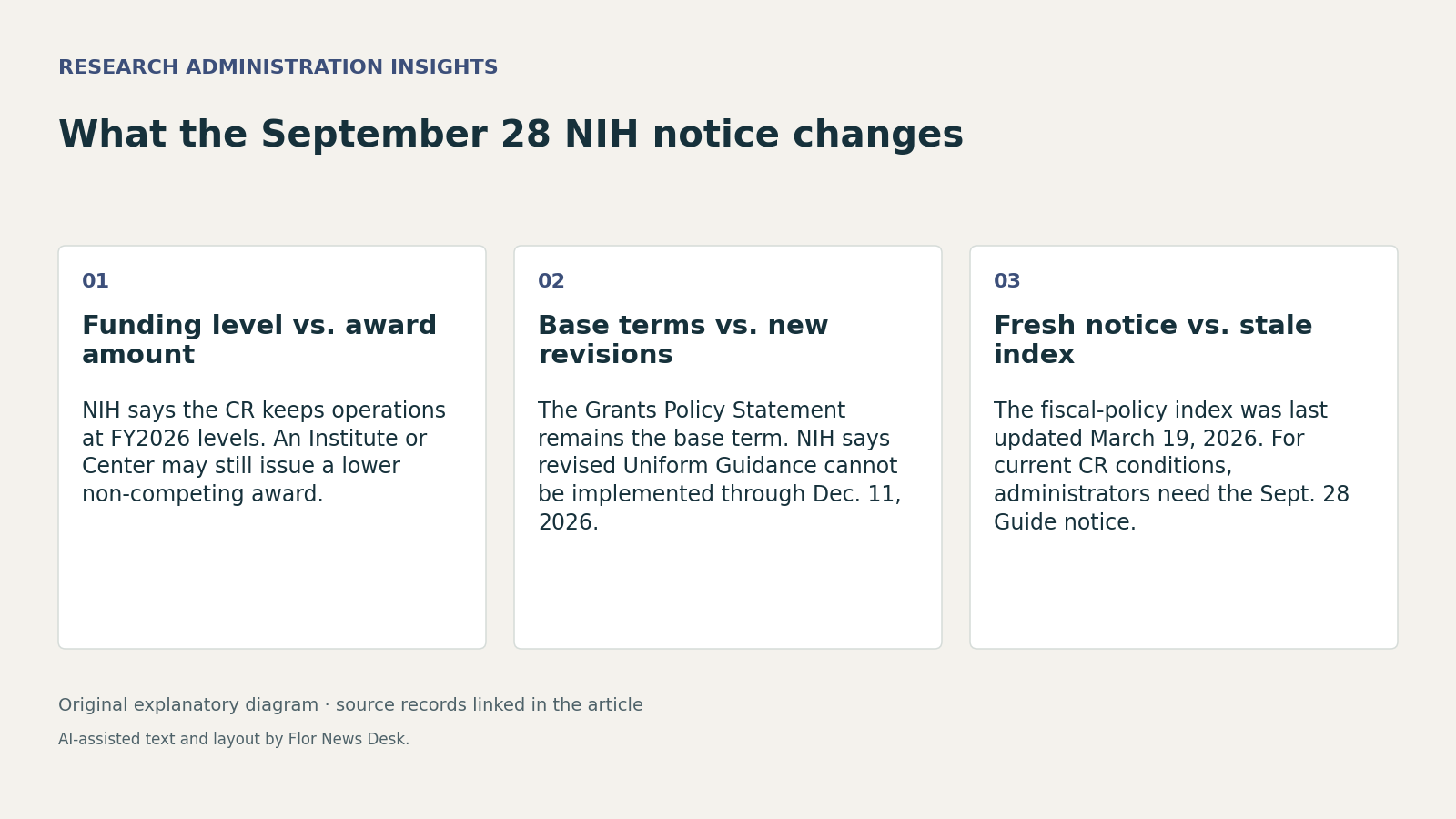
On September 28, 2026, NIH told recipients it was operating under the Continuing Appropriations and Extensions Act, 2027, signed on September 2, and that the continuing resolution runs through December 11, 2026 at Fiscal Year 2026 enacted levels. In the same notice, NIH said the continuing resolution bars the agency from implementing revisions to the Uniform Administrative Requirements for Federal Awards, including 2 CFR Part 200, through that date. For research administrators, that creates two separate near-term questions: how much money may be available in a non-competing award, and whether any planned local rollout assumed NIH had already moved to revised federal grant rules. NOT-OD-26-131
The budget point is narrower than an across-the-board cut. NIH said its Institutes and Centers may, at their discretion, issue non-competing research grant awards below the amount shown on the most recent Notice of Award, and that upward adjustments will be considered after Fiscal Year 2027 appropriations are enacted. That wording authorizes case-by-case lower award levels, but it does not show that every non-competing award will be reduced, or by how much. A prudent institutional response is therefore to recast short-term cash planning around existing award documents and conservative burn-rate assumptions, rather than telling investigators that extra funds are either certain or foreclosed. NOT-OD-26-131
The compliance point is different. NIH’s Grants Policy Statement page says the March 2026 edition is a standard term and condition of award, except where a Notice of Award states otherwise, and that policy changes published in the NIH Guide can supersede the policy statement and become award terms. That makes the September 28 Guide notice operationally important even though the briefed record does not show it amending any individual award by itself. Research offices should therefore review any NIH-specific procurement, subaward, or internal checklist changes that were timed to expected Uniform Guidance revisions and pause the parts that depend on NIH implementation, not merely on an institution’s own internal preferences. NIH Grants Policy Statement NOT-OD-26-131
The notice also exposes a common monitoring problem. NIH’s fiscal policy notices page describes itself as a source for annual budget guidance, funding levels, and policy updates affecting grants, but the page was last updated on March 19, 2026. The briefed record says it does not include the September 28 notice and still lists an earlier FY2026 continuing-resolution item. That means a familiar index can be useful background yet still be stale for active continuing-resolution management. Administrators should treat dated index pages as reference material, then look to current NIH Guide notices and award documents for live constraints. NIH fiscal policy notices NOT-OD-26-131
A September 24 NIH recipient reminder on advocacy and lobbying, although about a different topic, repeated two points that matter here: the Grants Policy Statement is a term and condition of award, and recipients should contact their grants management specialist early when restrictions affect project operations. Read alongside the September 28 continuing-resolution notice, that supports a practical campus message. If a department wants to assume a higher non-competing award or proceed as though revised Uniform Guidance rules already govern NIH awards, the safer path is to check the Notice of Award and route award-specific questions through the named grants management specialist. Advocacy and lobbying reminder NOT-OD-26-131
What the current record cannot establish is which Uniform Guidance revisions NIH would have implemented absent the continuing resolution, which Institutes or Centers will actually issue reduced awards, or what policy will apply after December 11, 2026. Until NIH publishes follow-up guidance, the defensible administrative posture is limited and temporary: budget to current documents, avoid assuming new federal administrative rules are already in force for NIH awards, and document any local pause as a response to the September 28 notice rather than as a permanent policy change. NOT-OD-26-131