NSF’s Fiscal Year 2027 Graduate Research Fellowship Program competition has already passed its October 2026 application deadlines, but the immediate administrative question for universities is no longer applicant traffic. It is whether the institution is ready for an award structure that NSF places with the enrolled institution of higher education, using a Research.gov-only application path and separate reference-letter routing. The FY2027 solicitation says applications had to be submitted through Research.gov/GRFP, with major-field deadlines from October 19 through October 23, 2026, and reference letters due by 8:00 p.m. Eastern on October 16, 2026 (FY2027 solicitation).
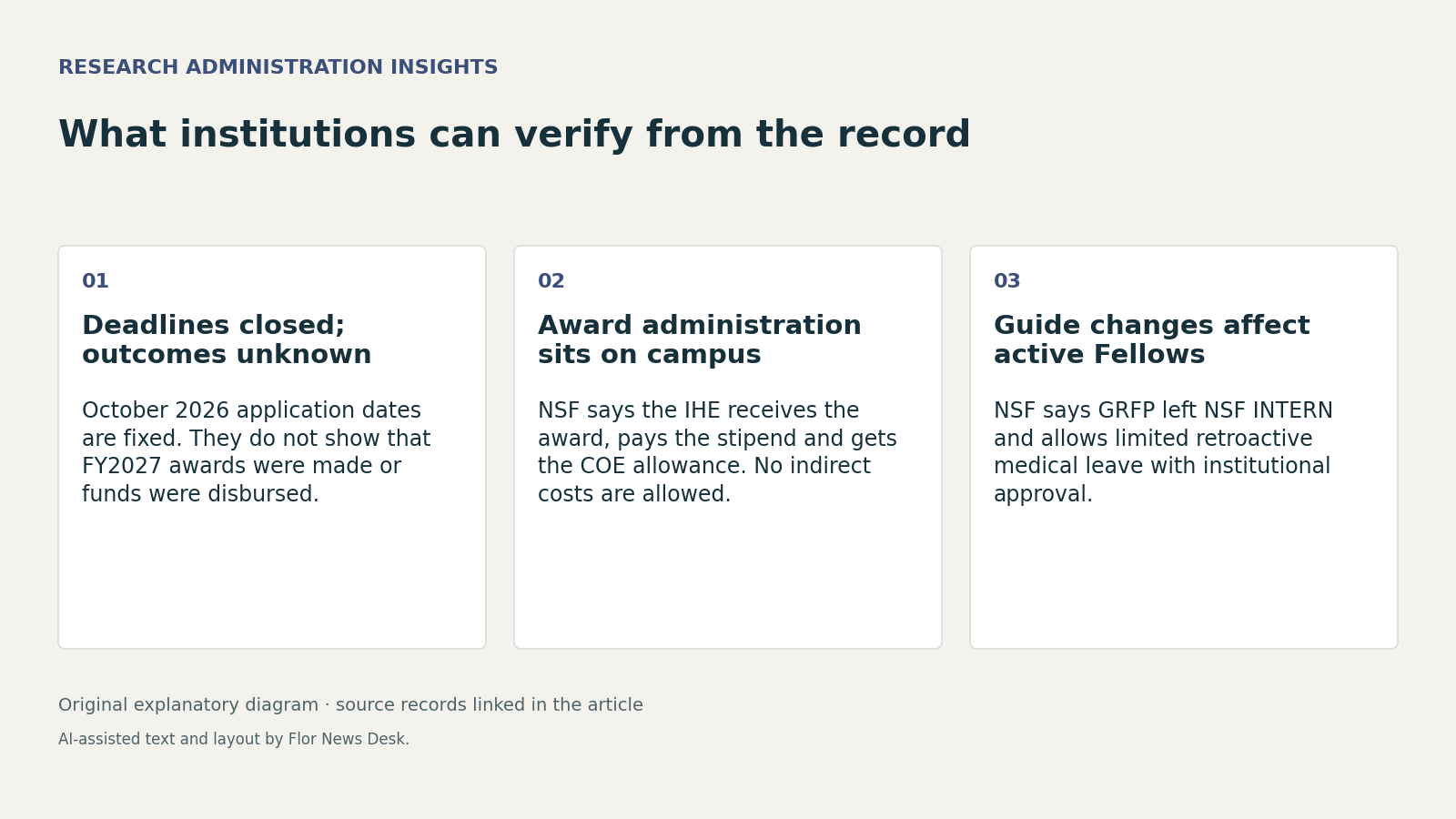
As of October 27, 2026, those dates matter mostly as fixed rules for the closed competition, not as evidence of any award outcome. The solicitation is explicit that it governs the FY2027 competition and replaces an earlier solicitation, but the source record does not show that awards have been issued or that any institution has received money. The brief also notes that the solicitation’s mention of anticipated award announcements in early April is only an expectation in that document, not proof of the final FY2027 schedule or result (FY2027 solicitation). For research offices, that means separating deadline compliance from award-readiness.
The most concrete award-readiness issue is money handling. NSF says each Fellowship provides three years of support over a five-year Fellowship period, with a $37,000 stipend and a $16,000 Cost of Education allowance for each supported year. NSF also says the award goes to the Fellow’s enrolled institution of higher education, which manages the award and disburses the stipend; no indirect costs are allowed, and the Fellowship can be transferred after the first Fellowship year (FY2027 solicitation). The practical inference is narrow but important: bursar, payroll and graduate-school teams should verify payee setup, stipend disbursement logic and transfer handling before notices arrive, while recognizing that the source record does not establish NSF’s actual payment timing.
A second check is policy guidance for active Fellows. NSF’s July 6, 2026 Administrative Guide update says GRFP no longer participates in NSF INTERN, although Fellows may still participate in INTERN through another active NSF award available to them. The same notice adds a limited route for retroactive medical leave, with institutional approval as one stated condition, and says the leave can cover the current or immediately preceding Fellowship year; NSF says those guide updates apply to all active Fellows and all awardee institutions (Administrative Guide update notice). That is enough to require local guidance changes, but not enough to infer a standard documentation workflow, because the notice is only a summary.
The remaining near-term task is cleaning up applicant-facing instructions for the next cycle. NSF’s application guidance page says GRFP applications are prepared in the GRFP Application Module on Research.gov; applicants must upload transcripts showing their most recent academic status; the selected major field determines both the deadline and the review group; and at least two reference letters must be received, even though applicants may request up to five and rank them (How to Apply). That page has no publication date in the retrieved record and is general guidance rather than a competition-specific rule set, so institutions should use it to align advising materials, then check future solicitations for binding dates and any changed requirements.
Taken together, the October-closed solicitation and the July guide update support a specific administrative conclusion. On the current record, institutions should treat GRFP as a Research.gov-based application program whose funds and several policy decisions run through the institution, not directly as a self-administered student award (FY2027 solicitation; Administrative Guide update notice; How to Apply). They should not treat these documents as evidence that FY2027 awards, payments or campus implementation have already occurred.