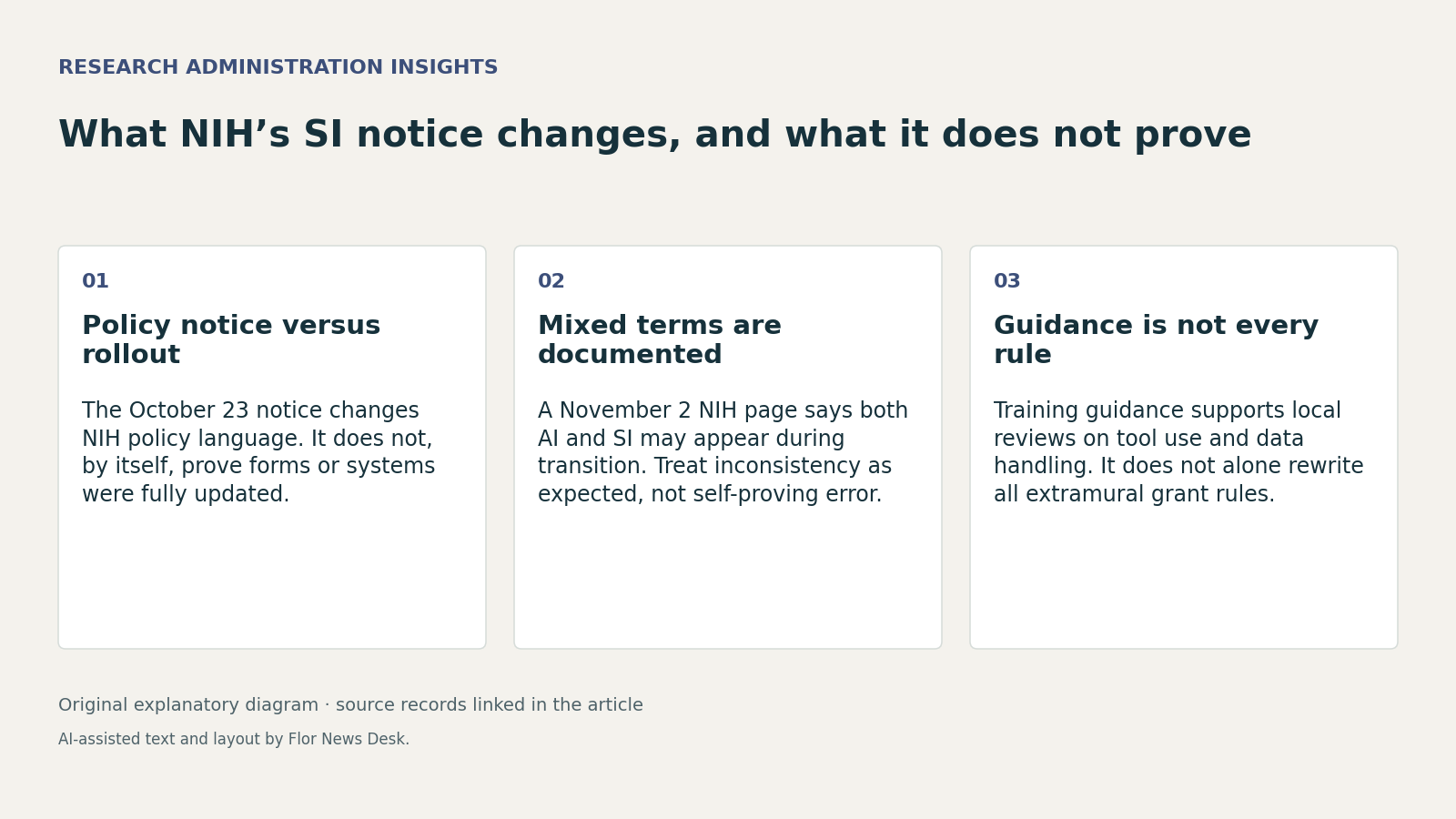
NIH’s October 23, 2026 notice on “Super Intelligence” creates an immediate research-administration task: treat the terminology change as live NIH policy language, but do not mistake that for evidence that every grant form, website, or submission rule has already been rebuilt. In NOT-OD-27-011, NIH says the federal government is transitioning from “Artificial Intelligence” and “AI” to “Super Intelligence” and “SI” under Executive Order 14434, gives NIH’s working definition of SI, and names the NIH Office of the Chief Super Intelligence Officer as the contact point for inquiries.
That matters because NIH’s own policy-change index says notices published in the NIH Guide supersede conflicting information in the NIH Grants Policy Statement, and that compliance with those policy updates becomes a term and condition of award. The same index lists NOT-OD-27-011 as a 2026 policy notice, not a funding opportunity announcement (NIH policy changes index). For campus offices, the safest immediate reading is narrow but real: NIH-facing administrative materials that explain agency policy, submission expectations, or award conditions should be checked for terminology that now conflicts with the notice.
The available record does not support a broader claim that NIH has already finished implementation. A November 2, 2026 Fogarty International Center funding-news page carries a transition banner saying NIH websites are changing, that federal agencies are now using “Super Intelligence” in place of “Artificial Intelligence,” and that readers may see both terms during the transition (Fogarty funding news, November 2, 2026). Administratively, that means mixed language across institute pages is currently documented. Research offices therefore have reason to warn investigators about inconsistent wording, but not to assume that older labels on NIH pages, forms, or portals have already been retired or made noncompliant.
A second practical implication is governance around drafting tools and sensitive data. An NIH training page framed as guidance on AI/SI use says natural-language programs such as ChatGPT and Bard do not meet NIH authorship criteria, that use of such tools in manuscript work should be disclosed and described, and that external or public generative SI tools may be used only for public data, not personally identifiable information or consented clinical research data (NIH training guidance). That page does not state that it amends extramural application rules. Still, it is enough evidence for research offices to review local training, IRB support materials, and proposal-development guidance where staff discuss tool use, manuscript support, or handling of sensitive data in NIH-funded work.
The new office contact in the notice is also operationally important. Even without proof of full system rollout, naming the NIH Office of the Chief Super Intelligence Officer gives campuses a defined place to route unresolved terminology questions and to separate those from internal drafting or compliance questions (NOT-OD-27-011). What the sources do not establish is equally important: there is no verified evidence here of revised application packages, changed peer-review criteria, new submission validators, or a completed agency-wide web update.
So the immediate administrative sequence is a controlled one. First, inventory NIH-facing guidance, templates, and training pages for references to AI that describe NIH policy rather than scientific content. Second, flag mixed AI/SI wording in active materials instead of silently normalizing it, because NIH itself has documented a transition period (Fogarty funding news, November 2, 2026). Third, record the legal and policy basis for any local edits in the October 23 notice and the NIH policy-notice index, while noting that the present source record does not prove final implementation in forms or systems (NOT-OD-27-011; NIH policy changes index).