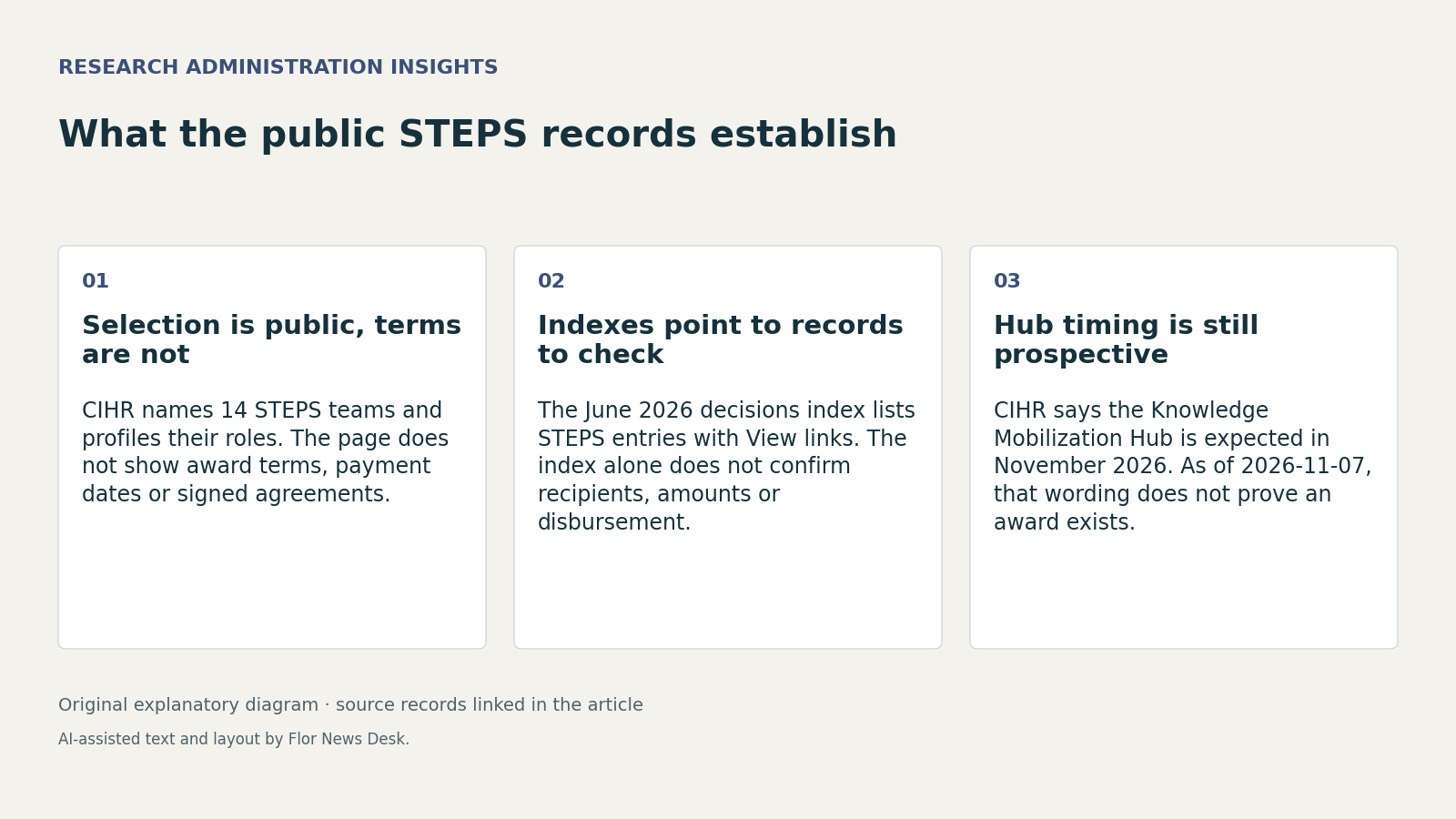
CIHR has made the Team Grant: Strengthening Resilient and Equitable Public Health Systems (STEPS) more visible publicly, but not yet fully auditable from public records alone. A CIHR page modified on 2026-11-03 names 14 STEPS team profiles and says the initiative includes a STEPS Knowledge Mobilization Hub expected in November 2026. For research offices, that is enough to treat team selection as publicly signalled by CIHR, but not enough to assume every internal step of award activation is complete, because the same page does not show decision IDs, Notice of Award terms, contribution agreements, payment dates or proof that funds reached institutional accounts (CIHR STEPS page).
The next useful record is CIHR’s Funding Decisions Notifications index. Under June 2026, the index lists the STEPS umbrella competition code 202601EPH and seven STEPS subcompetition entries: 202601HE0, 202601HE4, 202601HE5, 202601HE6, 202601HE7, 202601HE8 and 202601HE9. Each entry has a View link, which indicates there are follow-up records administrators should trace. But the index page itself does not name recipients, amounts, terms or payment status, so it cannot by itself settle whether a posted team profile has been translated into an institutionally actionable award record (Funding Decisions Notifications).
The peer review page helps with process, not award execution. It shows two 2026 STEPS peer review committees under 202601EPH and identifies Louise Potvin and Shilpa Dogra as chairs, alongside scientific officers and members, on a page modified 2026-08-13. What it does not show is equally important: no meeting dates, applicant assignments, recusal information, scores, rankings, recommendations or funded-team list. Administrators therefore should not read the committee roster as evidence of which application was assessed by which panel or why a team was funded (STEPS peer review committees).
A separate funding clue comes from the Centre for Research on Pandemic Preparedness and Health Emergencies. Its investments table marks STEPS as results, gives a registration deadline of 2025-09-17 and an application deadline of 2026-01-14, and lists $2,248,967 in the column for funds provided by CRPPHE. That is useful partner-funding context, but the table does not show the full STEPS funding envelope across all partners, named recipients, award instruments, disbursement dates or whether any specific institution has been paid. The same page also says CRPPHE investments are currently guided by an Interim Investment Plan 2023–2025, a past-labelled period that the page does not update, which is a reminder not to treat surrounding prose as current status unless the record dates it directly (CRPPHE investments).
The administrative question, then, is not whether CIHR has said something publicly; it has. The question is which document an institution will rely on for spending, hiring, subawards or reporting. On the evidence available here, a cautious verification sequence is to match any posted team to the relevant CIHR decision entry on the June 2026 index; confirm internally whether a Notice of Award or other signed instrument exists; check the eligible start date and payment schedule in the institution’s grants or finance system; and ask whether any knowledge-mobilization or subrecipient obligations appear in award paperwork rather than only on the public profile pages (Funding Decisions Notifications, CIHR STEPS page).
The hub deserves separate handling. CIHR’s STEPS page says the Knowledge Mobilization Hub is expected in November 2026, and as of 2026-11-07 that remains a forward-looking statement, not evidence that a hub award or contract has already been issued (CIHR STEPS page). For research administrators, the practical implication is to prepare for a possible second layer of contracting or reporting coordination without assuming its structure, host institution or authority over the 14 teams until CIHR publishes a direct award record or announcement.