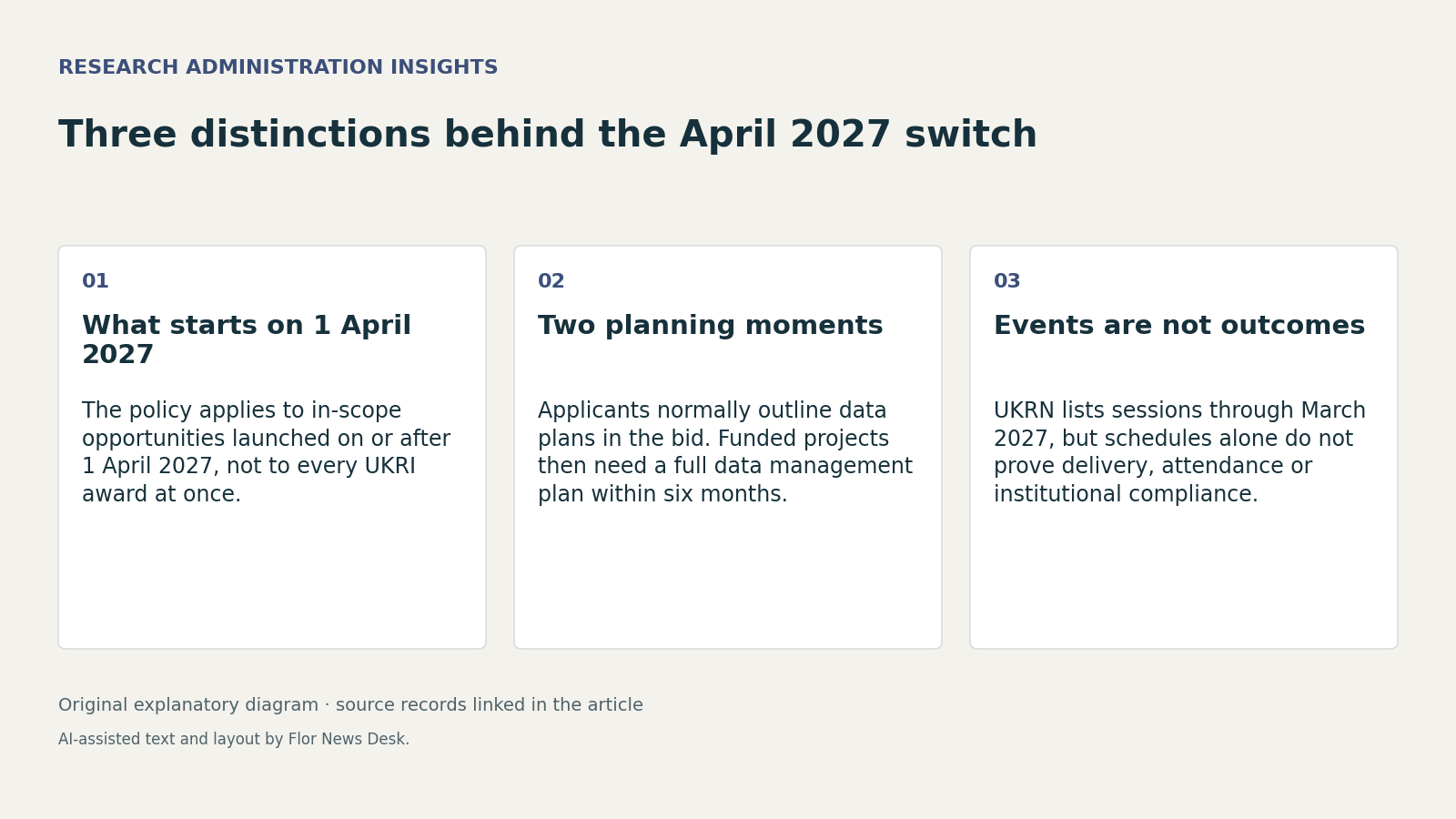
UK Research and Innovation’s new research data policy is no longer a consultation issue. UKRI published the policy on 14 October 2026, and it applies to in-scope funding opportunities launched on or after 1 April 2027 across the research councils, UKRI-wide schemes, and specified Innovate UK and Research England funding (policy; news release). For research offices, that date matters because the policy changes both proposal-stage and post-award expectations: applicants will normally outline data-management and data-sharing plans in the application, and funded projects must have a full project data management plan within six months of the award start, or within six months of an individual studentship project starting under a training grant (policy).
The operational implication is broader than a template update. The policy ties sharing deadlines to different points in the research lifecycle: data needed to understand and validate published findings should be shared by the time of publication, while unpublished data with potential long-term reuse value should be shared no later than two years after UKRI funding ends. UKRI also says it will monitor implementation and may respond proportionately to repeated or extensive non-compliance (policy). Analysis: those features turn the policy into a coordination problem across pre-award review, award setup, publication support and project closeout, not just a repository question.
What is less settled, as of 1 November 2026, is the support package around the rule. UKRI’s implementation update says feedback on the draft policy informed changes on clarity, scope, data management plans and research-relevant digital objects, and it says UKRI plans updated application and peer-review guidance, costing guidance, a monitoring and evaluation framework, guidance on intellectual property alongside open-research expectations, community resources, and a webinar on 25 November 2026 (implementation update). Those are useful signals, but they remain plans in that record. They do not yet establish that every form, costing route or monitoring process needed for April 2027 is already in place.
A separate source of practical momentum is a UK Reproducibility Network programme page dated 22 October 2026. It lists a free six-part online series running from October 2026 to March 2027, with sessions on research data planning and review, data deposit and FAIR data, monitoring and indicators, surveys, skills, and incentives (UKRN programme). The 22 October 2026 session is already past by the current date, but that page does not establish whether it occurred or what was delivered. What it does provide is a schedule of topics that closely matches the administrative handoffs institutions will need to sort before 1 April 2027.
That transition point is easy to miss if institutions treat the policy as a general statement rather than a scope rule. UKRI’s open-research hub says the new policy applies to new UKRI funding opportunities launched on or after 1 April 2027, while earlier guidance still applies before that date (open research hub). The same hub also links to guidance on sharing data about people and to tools and services such as DMPonline and the Digital Curation Centre (open research hub). Analysis: during the crossover period, research offices may need a call-by-call scope check rather than a single campus-wide switch. A hypothetical example is two otherwise similar applications submitted under opportunities launched on opposite sides of 1 April 2027; the office may need different internal checklists.
The practical message is narrower than “attend webinars.” UKRI says the policy replaces multiple earlier policies and principles with one framework intended to support FAIR research data, but the source record does not yet prove completed UKRI-wide implementation materials or institutional readiness (news release). With less than six months between publication and the effective date for in-scope opportunities, the immediate task for research administrators is to map which upcoming calls will fall into scope, identify where application-stage questions and post-award handoffs will change, and use the scheduled sector events as evidence-gathering opportunities rather than as proof that compliance systems are already settled.