NSF’s October 27, 2026 Dear Colleague Letter created a short-lived funding path, not a broad new competition. The agency invited supplemental funding requests tied to the 2027 Presidential SI Challenge and set a November 10, 2026 submission deadline, with the Dear Colleague Letter and NSF’s Funding at NSF listing both dating the opportunity to October 27. As of November 2, 2026, that leaves institutions a narrow period to decide whether any currently funded project can support a compliant supplement request.
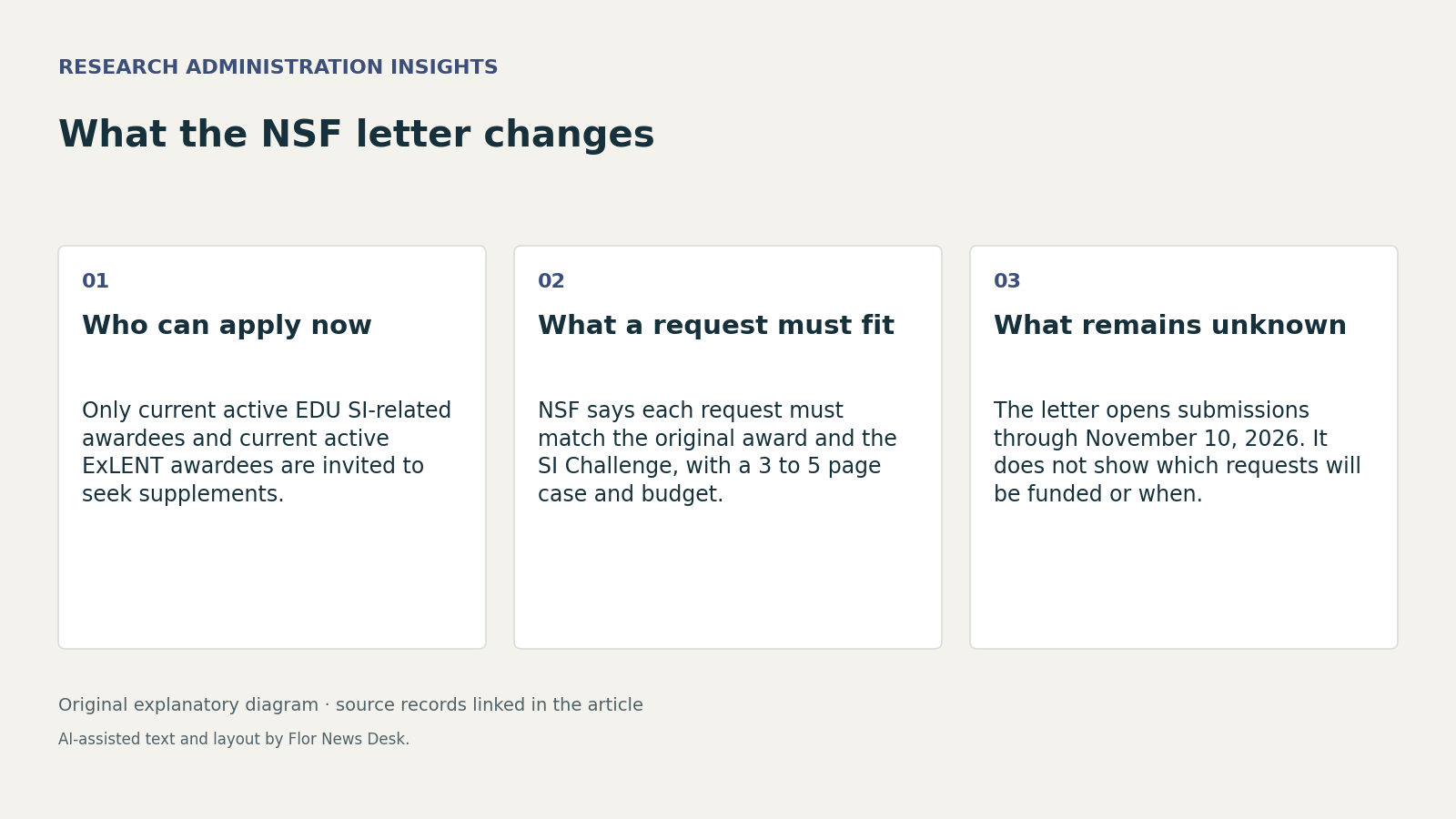
The first practical filter is eligibility. NSF limited the invitation to principal investigators with current active NSF Super Intelligence-related awards from the Directorate for STEM Education and to current active awards from the Experiential Learning for Emerging and Novel Technologies program led by the Directorate for Technology, Innovation and Partnerships in collaboration with EDU (Dear Colleague Letter). That matters administratively because the core question is not whether a campus has general SI expertise. It is whether it can identify an active award in one of the named pools, confirm that the principal investigator is still eligible to request a supplement, and route the request through existing award management channels.
The second filter is financial and procedural. NSF says each supplement request may be no more than 20% of the original award, no more than $100,000 per principal investigator, and may support up to 12 months, with requests governed by the Supplemental Support rules in Proposal & Award Policies & Procedures Guide Chapter VI.E.5 (Dear Colleague Letter). The same letter says NSF suggests a 3 to 5 page request covering activities, alignment, expected outputs, anticipated teams and school submissions, partner roles, and a justified budget. In practice, that means sponsored research staff cannot treat this as a short narrative add-on. They need a scope statement and budget that fit both NSF supplement policy and the original award structure.
The programmatic aim is also narrower than a generic SI outreach idea. NSF describes the effort as support for middle- and high-school students, educators and schools, with principal investigators acting as mentors or catalysts for teams and schools entering the Presidential SI Challenge (Dear Colleague Letter). NSF also says funded supplements would come with access to NSF-led NAIRR resources, while the agency’s Super Intelligence focus-area page places those resources in the broader National Artificial Intelligence Research Resource Pilot context. The analytical point is simple: a proposed supplement has to connect an existing award to that specific K-12 challenge function, not just to SI work in the abstract.
That distinction matters because NSF’s SI portfolio is much broader than this notice. The Super Intelligence focus-area page says NSF invests more than $700 million each year in SI-related work and highlights multiple funding pathways, including other Dear Colleague Letters aimed at different educational and workforce objectives. That broader portfolio context is useful, but it does not expand this invitation. Research offices should resist reading the SI landing page as evidence that all NSF SI awardees, or all AI-related educational projects, can use this supplement route.
The source record also sets clear limits. The Funding at NSF listing classifies this item as a Dear Colleague Letter and sends readers back to the letter for deadline details, reinforcing that the listing is an index rather than the operative rulebook. The Dear Colleague Letter says requests will be reviewed under NSF’s merit review process, but it does not show how many supplements NSF expects to fund, how many active awards qualify, or what outcomes will follow after November 10, 2026. So the immediate administrative takeaway is cautious and concrete: screen active awards, test scope and budget fit, and do not mistake an invitation to apply for an approved award or a confirmed implementation result.