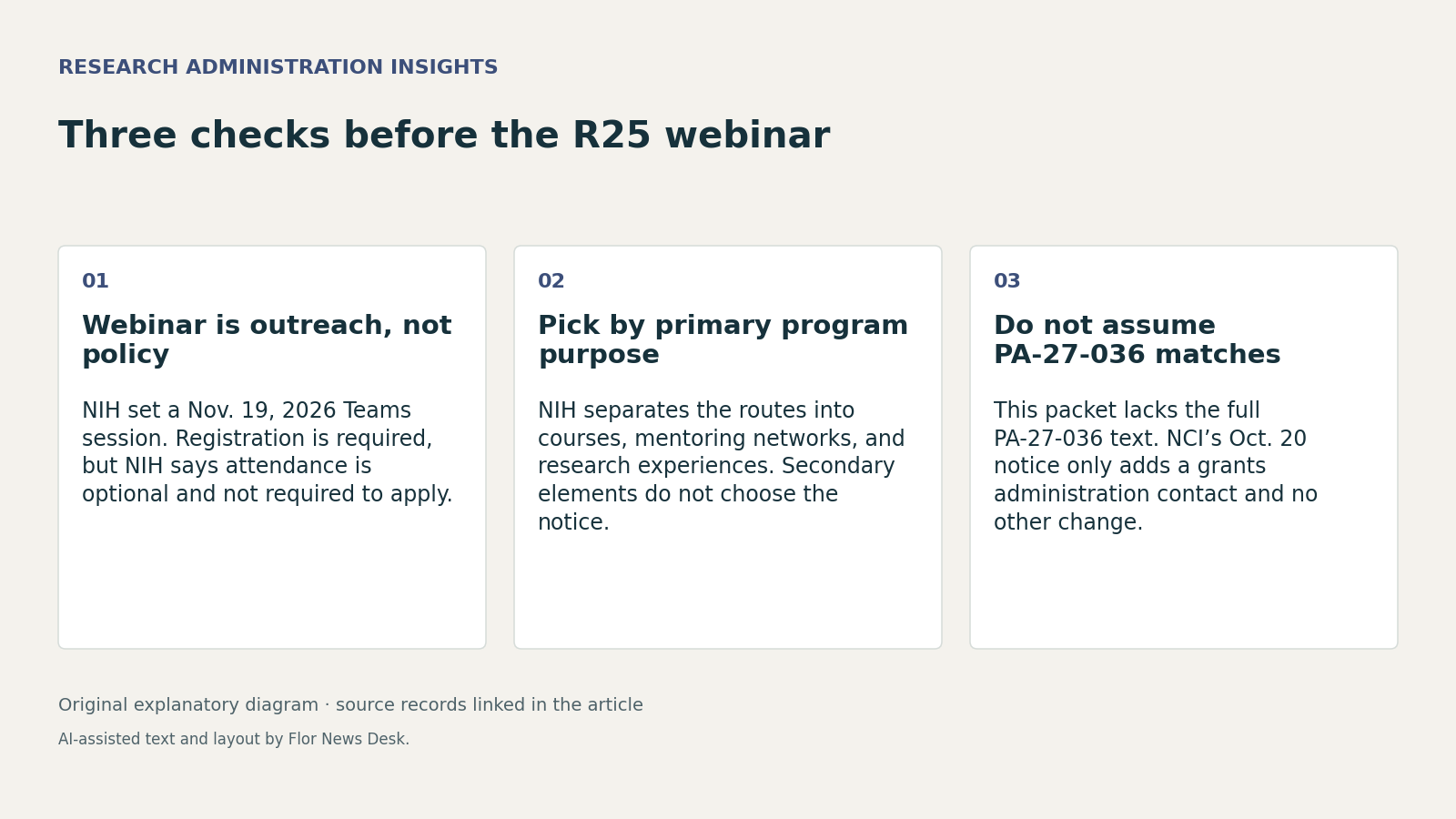
NIH’s November 19, 2026 webinar on the new Parent R25 research education opportunities matters less as an announcement than as an internal deadline for sorting proposals correctly. The Office of the Director scheduled the Microsoft Teams session for 2:00 to 3:30 p.m. ET, with registration required, advance questions due by November 17, and a recording promised; NIH also says attendance is optional and not required to submit an application. That makes the event outreach and technical assistance, not a new funding rule, award decision, or automatic revision to any notice. Webinar notice
What institutions can already do is map each idea to the right parent notice. NIH’s September 21 funding blog says the three new opportunities are PA-27-034 for Courses, Curriculum & Methods, PA-27-035 for Mentoring Activities & Networks, and PA-27-036 for Research Experiences. The same post says applicants should choose the notice that matches a proposal’s primary purpose, even if the project also includes mentoring or research experiences, and it warns that participating Institutes, Centers, and Offices can differ by notice. It also says these education activities must remain distinct from federally supported training programs such as NRSA T32 awards. NIH Funding Blog
That primary-purpose test has immediate routing consequences because the parent notices do not line up perfectly on administration. PA-27-035 can use either the R25 grant mechanism or the UE5 cooperative agreement mechanism, and the notice says applicants should consult the intended NIH Institute or Center about which route applies. The same notice frames mentoring as sustained activity, expecting at least a year of regular contact and tracking later research-related outcomes. As analysis, that means a campus intake process that treats every R25 concept as interchangeable risks missing mechanism questions before budgeting and approvals begin. PA-27-035
For PA-27-034 and PA-27-035, several deadline and compliance points are already fixed in the record. Both are marked Clinical Trial Not Allowed, while still permitting appointed participants to gain research experience in a clinical trial led by a mentor or co-mentor. Both list recurring due dates of September 25, January 25, and May 25; for the first three cycles shown, NIH lists earliest start dates of July 2027, December 2027, and April 2028. Both describe project periods of up to five years, typically expected direct costs of no more than $500,000, and indirect cost reimbursement at 8 percent of modified total direct costs. PA-27-034 separately says non-domestic entities, non-domestic components of U.S. organizations, and foreign components are not allowed. PA-27-034 PA-27-035
The record is thinner for PA-27-036 than for the other two. This source packet does not include the full PA-27-036 announcement, so it cannot establish that notice’s full budget, due-date, or eligibility terms. What is documented is narrower: NIH’s blog identifies PA-27-036 as the Research Experiences parent notice, and the National Cancer Institute’s October 20, 2026 notice says it added grants administration information in Section VII for NCI’s participation and made no other changes. That is useful for question-routing, but it is not evidence that other terms changed. NIH Funding Blog NCI notice
Research offices therefore have a practical reason to use the November 19 session without treating it as a gatekeeper. NIH says staff from the Division of Biomedical Research Workforce and NIH Institutes and Centers will cover overview, application guidance, programmatic considerations, and grant-writing strategies. By November 17, campuses can queue questions on Institute participation, PA-27-035 mechanism choice, and whether the full PA-27-036 text supports any assumptions drawn from PA-27-034 and PA-27-035. Because NIH says the webinar will be recorded and participation is optional, the best use is to document clarifications for future intake and submission workflows, not to wait for a policy change the notice does not promise. Webinar notice