Crossref’s 2026-09-15 rollout of automatic funder-name matching to ROR IDs matters less to research offices than one narrower question: did those new identifiers actually reach the feed your campus uses? Crossref’s own records now show that the answer was not consistently yes for at least part of the first five weeks after launch. In its 2026-09-15 announcement, Crossref said new or updated records with funding information but no funder identifier would be matched to ROR IDs and added to enriched metadata available through its REST API, while existing records would remain unchanged unless updated (Crossref blog, 2026-09-15).
The operational caveat arrived later. Crossref’s status page says in an incident update timestamped 2026-10-21 12:01 UTC that the new matches introduced on 2026-09-15 were not added to the Metadata Plus REST API pool, that Crossref did not notice until 2026-10-21, and that the same omission affected the most recent JSON snapshot (Crossref status). Crossref also said the missing data would be back-filled into the REST API and included in the next issued snapshot (Crossref status).
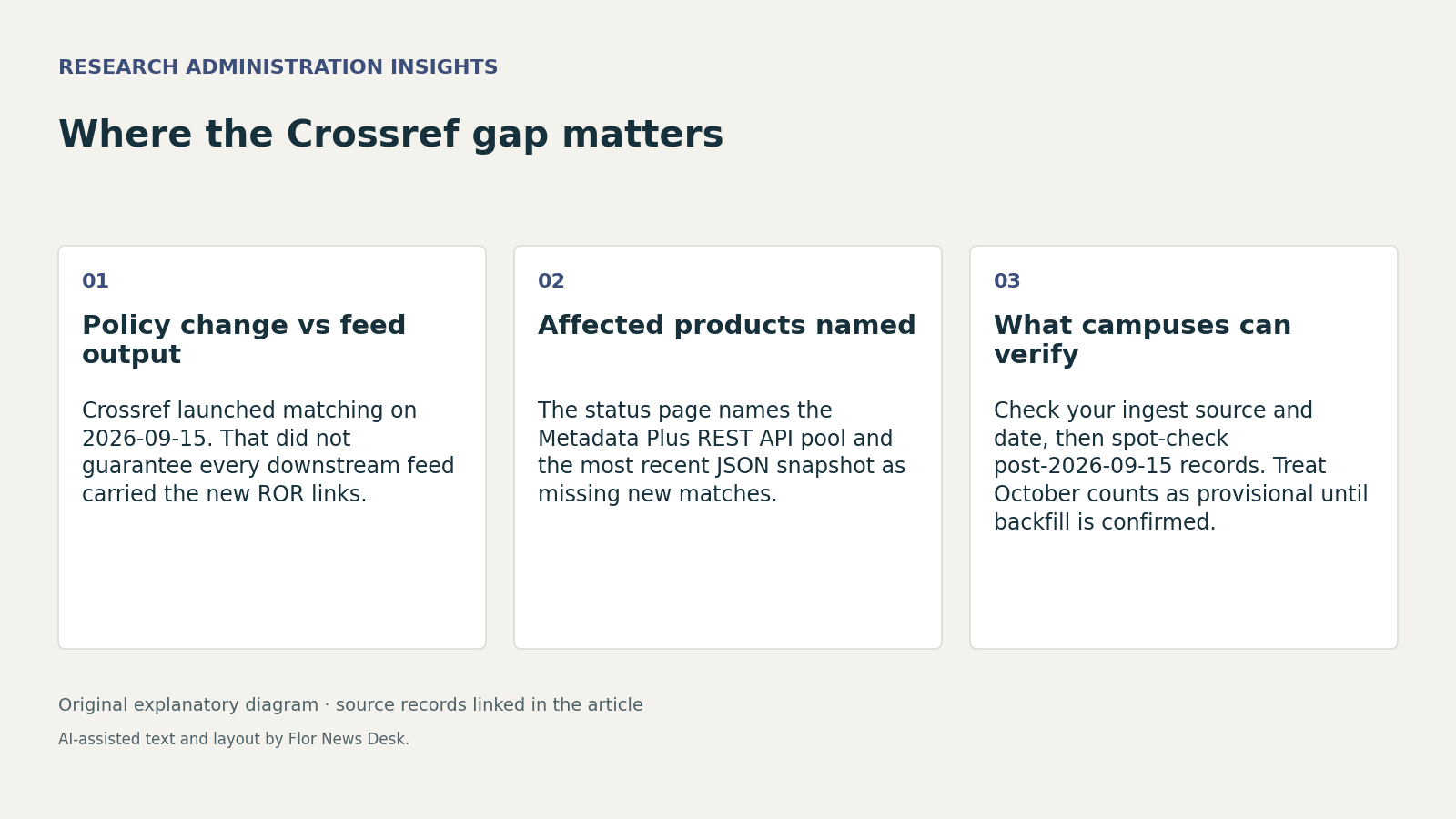
For research administrators, the practical distinction is between a metadata-enrichment policy and the specific delivery channels that downstream systems actually ingest. Crossref’s blog establishes the policy change: matching begins for new or updated deposits from 2026-09-15, and Open Funder Registry identifiers remain in place rather than being replaced (Crossref blog, 2026-09-15). The status page establishes that, despite that rollout, at least one important delivery path, the Metadata Plus REST API pool, and one export product, the latest JSON snapshot, missed those new matches until Crossref started remediation (Crossref status).
That means institutions should not treat “live since 2026-09-15” as proof that their own reporting inputs carried the new ROR links throughout the period from 2026-09-15 to 2026-10-21. That is analysis, not a new sourced fact: if a campus counted funder-linked outputs from a feed that Crossref later said lacked the new matches, then counts or reconciliations built from that ingest may need to be rerun after backfill. The source record does not show how many records were affected, whether other Crossref access routes behaved differently, or whether any particular institution’s reports were wrong.
A sensible immediate check is administrative rather than theoretical. Confirm whether your local pipeline depends on the Metadata Plus REST API pool, the JSON snapshot, or another source; record the last ingest date; then spot-check a small set of works deposited or updated after 2026-09-15 to see whether expected funder-name-to-ROR-ID links appear in your stored records. If they do not, that absence is consistent with the incident Crossref described, though the sources here cannot establish record-by-record causation.
The latest status note also stops short of a clean completion marker. Crossref said on 2026-10-23 18:55 UTC that newly updated works include funder-name-to-ROR-ID matches in the Metadata Plus pool and that backlog reindexing was expected to take up to 24 hours (Crossref status). As of the 2026-10-23 retrieval reflected in the brief, that is still an expectation, not evidence that every missing match had already propagated or that the next snapshot had been issued. For any October reporting cycle, the prudent posture is provisional: preserve audit dates, note the source feed used, and be ready to rerun funder-linking once Crossref confirms the backfill outcome in a current record.