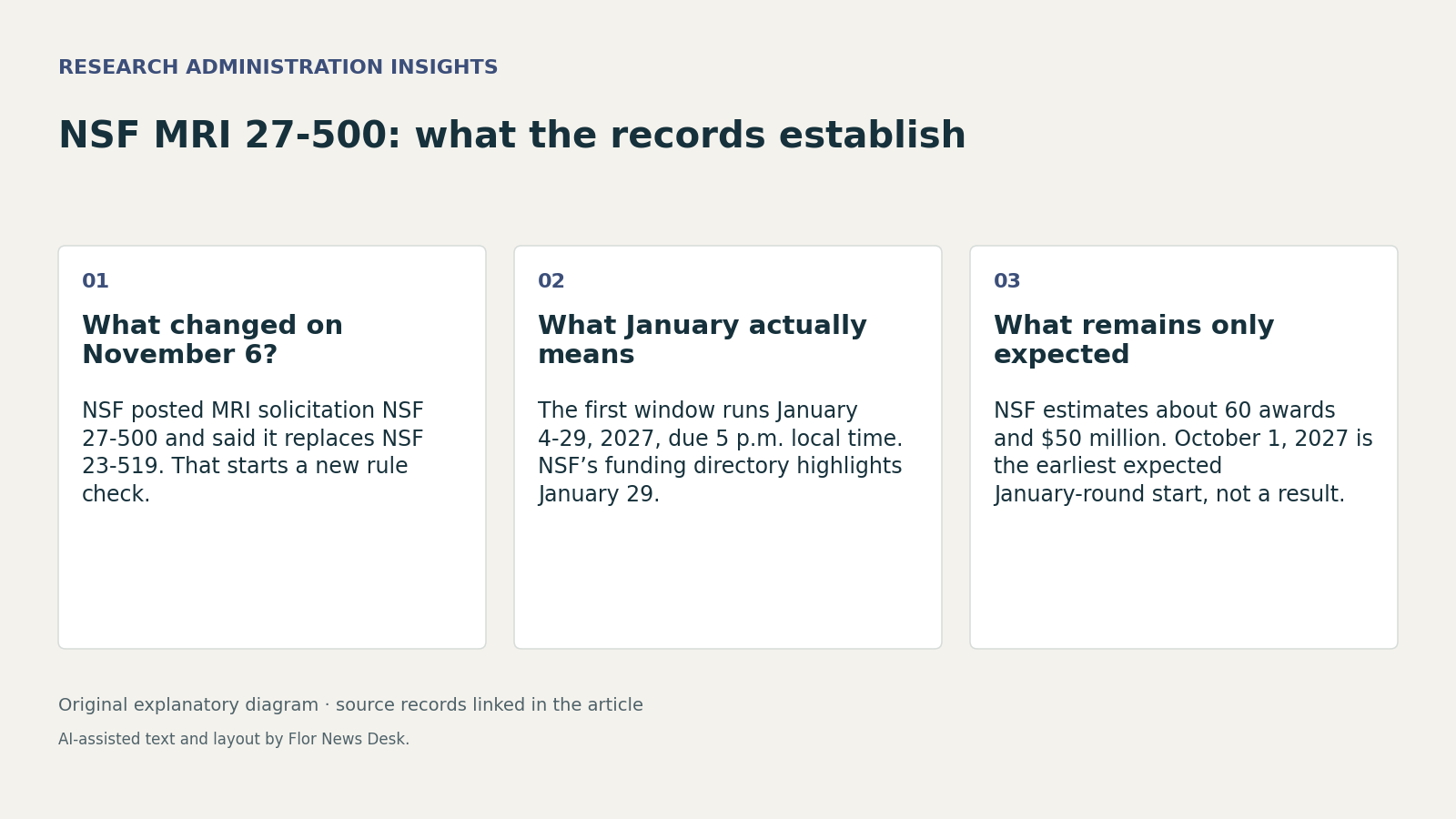
NSF posted solicitation NSF 27-500 for the Major Research Instrumentation Program on November 6, 2026, replacing NSF 23-519 and opening a full-proposal window from January 4 through January 29, 2027, due by 5 p.m. the submitting organization’s local time MRI solicitation. NSF’s central funding directory now lists MRI under newest funding opportunities with a posted date of November 6, 2026 and a next required due date of January 29, 2027 NSF funding page. For research offices, that combination makes MRI an immediate calendar and rule-checking issue, not just a program to watch.
The first sorting question is substantive, not clerical. NSF says MRI supports either acquisition of a multi-user research instrument or development of an instrument with new capabilities MRI program page. The solicitation ties those categories to different expected award durations: acquisition projects may be funded for up to three years, while development projects may be funded for up to five years MRI solicitation. As analysis, that means institutions cannot treat every MRI concept as the same kind of proposal simply because it shares a deadline; the project type affects how an office should test timeline assumptions against the solicitation.
The clearest documented policy shifts from the prior cycle are limited but significant. NSF says NSF 27-500 replaces NSF 23-519, and the revision notes say organizational submission limits and tracks have been eliminated, while helium recovery equipment proposals will still be considered separately from research-instrument proposals MRI solicitation. The program summary page now says there are no restrictions or limits on the number of proposals per organization, but it also directs readers to the solicitation for additional eligibility details MRI program page. The practical implication is narrow but important: a summary-page signal about volume does not replace a solicitation-level compliance review.
Timing is the other immediate distinction. NSF says the solicitation sets three submission windows, and the program page also lists a later 2027 window running from October 18 through November 19, 2027 MRI solicitation MRI program page. But only proposals submitted in the January 2027 window are linked in these records to an earliest expected start date of October 1, 2027 MRI solicitation. That matters for internal scheduling. It supports planning around a possible October start for January submissions, but it does not establish that awards will be made then.
Funding figures require the same caution. The solicitation says anticipated awards are Standard Grants, with an estimated 60 awards and an anticipated funding amount of $50,000,000, both subject to available funds MRI solicitation. The program page separately says the roughly 60-award figure depends on available funds and on the number and quality of submissions MRI program page. Those are planning signals, not outcomes. Nothing in these records shows money already received by institutions or confirms how many awards NSF will actually make.
The strongest reason to act now is therefore procedural, not predictive. NSF’s funding directory confirms the near-term external due date NSF funding page, while the program page and solicitation together show that the January round, later 2027 opportunity, project-type definitions and revised submission-limit language are spread across different records MRI program page MRI solicitation. The source record used here does not establish every substantive change from NSF 23-519 or every detailed requirement in NSF 27-500. It does establish one workable conclusion: institutions considering MRI for early 2027 should review the new solicitation directly rather than rolling forward assumptions from the prior cycle.