Grants.gov records retrieved on 2026-10-18 give research offices a source-backed starting point for REST API testing: the documentation says the `search2` and `fetchOpportunity` endpoints do not require authentication, lists separate production and staging base URLs, and sets out a formal versioning policy across the API portfolio (API Resources, API Guide, API Versioning). That is enough to begin technical validation. It is not enough to show when the REST route first appeared or whether it should replace any existing campus process.
That distinction matters because the retrieved source text is undated. The records available for review on 2026-10-18 do not include a publication date or last-updated date in the extracted text, so they support availability on the retrieval date, not a launch date. The API Resources page says “RESTful APIs for use by Applicant and Agency S2S web developers to integrate with Grants.gov are available here” and groups the catalog into Applicant API and Grantor API areas. But those pages, as retrieved, do not establish that a migration from another Grants.gov access method is complete.
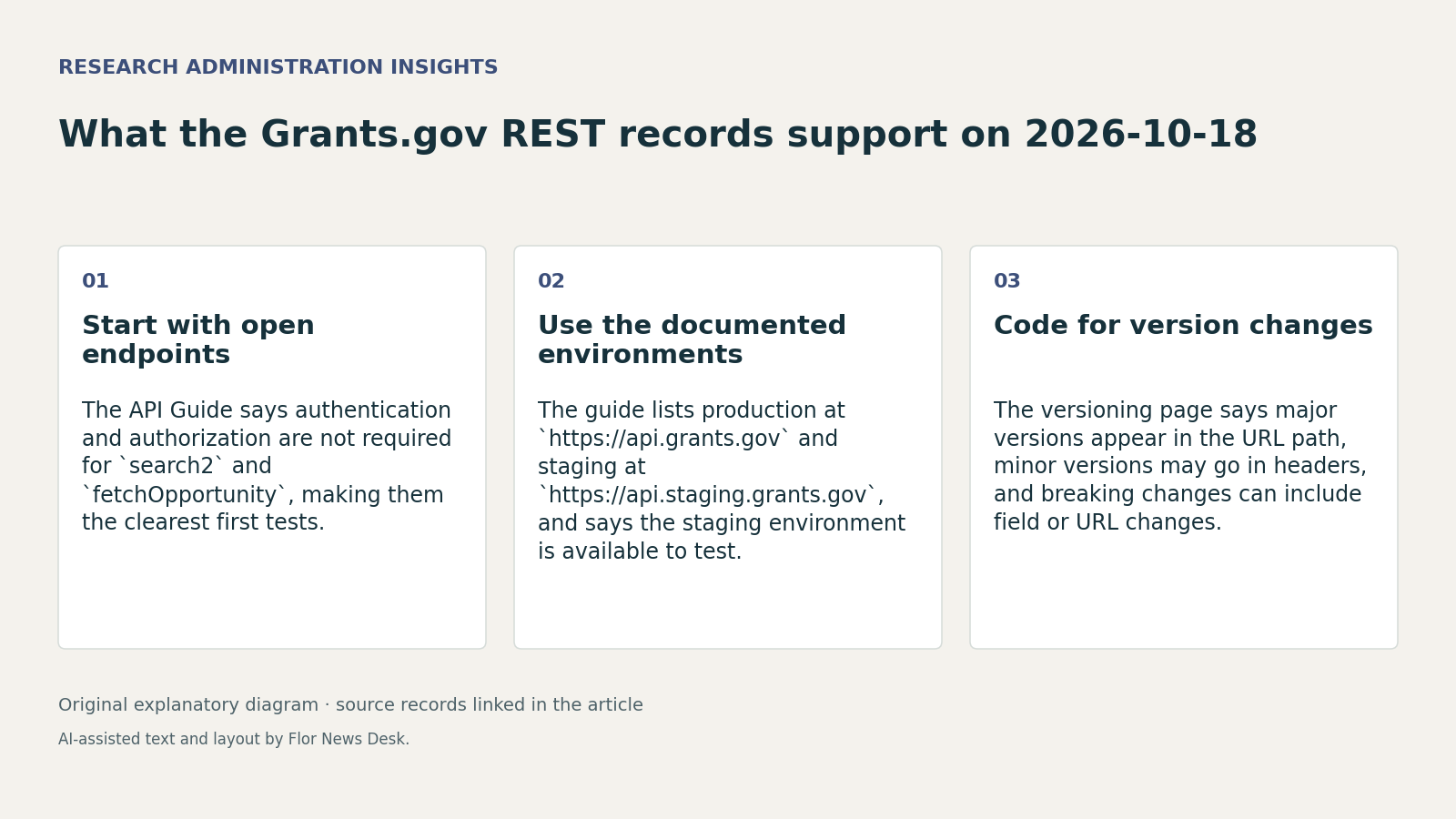
The immediate operational value is in the API Guide. Grants.gov says “Authentication and authorization are not required” for `search2` and `fetchOpportunity`, and it provides a sample `POST` request to `https://api.grants.gov/v1/api/search2` with a JSON body containing a keyword. For a research office, that makes those two endpoints the lowest-friction first tests. A team can check how keyword searches behave, what response structures look like, and whether the returned records contain the fields local workflows actually use before waiting on credentials for other calls.
The same guide says some API interactions do require an API key and instructs users to obtain one by opening a Grants.gov Help Desk ticket. It also lists two environments: production at `https://api.grants.gov` and staging at `https://api.staging.grants.gov` (API Guide). In practical terms, that supports a two-track approach. Start limited testing with the open endpoints, and in parallel request any needed key for endpoints that are not open. Institutions that split opportunity discovery, compliance review and system integration across different teams also have a useful cataloging clue from the resources page, which separates Applicant and Grantor APIs rather than presenting a single undifferentiated menu.
The API Versioning page adds the rule that should shape implementation planning. Grants.gov says major versions appear in the URL path, such as `/v1/`, while optional minor versions should be sent in HTTP headers. It defines breaking changes broadly, including removing an HTTP method, renaming or removing fields, changing query parameters, or modifying URL structure. The page also says Grants.gov will support at least one previous major version and will communicate deprecation timelines. For research offices, that means endpoint testing is only the start. Import routines should log version context and be designed for future parser changes.
What the record does not establish is just as important. These three pages do not, on their own, provide rate limits, uptime commitments, a dated change log, or proof that REST outputs match every field an institution may already rely on elsewhere (API Guide, API Resources, API Versioning). The cautious operational threshold is therefore validation, not replacement. Test `search2` and `fetchOpportunity`, inspect returned fields against campus requirements, request an API key where needed, and keep any current fallback path until local side-by-side checks show the documented REST route can support the work it is meant to carry.