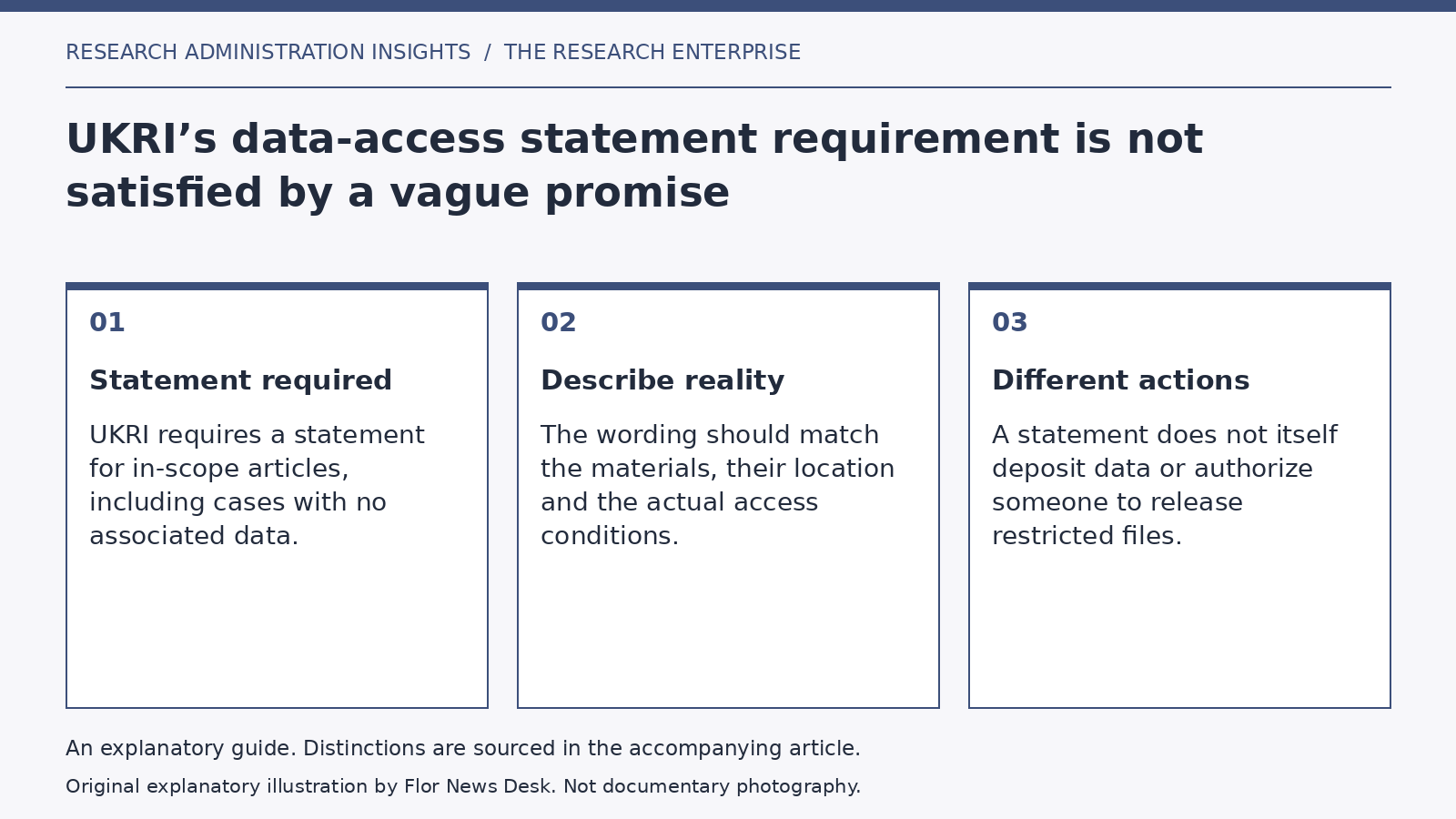
UKRI requires a data-access statement in research articles within the scope of its open-access policy, including where no data are associated with the article or the data are inaccessible. The policy text describes a statement that helps readers understand where underlying research materials are available and how they may be accessed. It does not make every research material unrestricted merely by requiring the statement.
UKRI’s frequently asked questions says it does not prescribe a particular content or format for these statements and points authors toward further guidance. That flexibility leaves an important editorial task: a sentence can be present while still failing to explain the actual situation. Institutions should distinguish the existence of the field from the usefulness and accuracy of what it says.
Start with the material, not the stock sentence
For a hypothetical paper based on a shared dataset, a useful drafting conversation would begin with the identity of the data, the version used and the route a reader could follow. For a paper without associated data, copying a promise to supply data on request would create a different problem: it would imply the existence of something the authors have not identified. These examples illustrate reasoning, not a finding about a specific publication.
Where access is restricted, the statement should not imply that the author can personally grant permission that belongs to another institution or process. Nor should it disclose sensitive details merely to appear complete. The relevant team needs to reconcile the explanation with the actual access arrangement and applicable protections.
Check the reader’s next step
An institutional check can ask what a reader could reasonably do after reading the statement. Is there an identifiable record, an appropriate access process or a clear explanation of why access is limited? A generic sentence that leads nowhere may require clarification, even when it occupies the correct place in the manuscript.
The statement is therefore a small but substantive part of the research record. It should describe availability rather than perform it, and explain limitations rather than erase them. A repository deposit, permission decision and access statement remain different actions. Keeping them aligned gives readers a more reliable account without promising data or rights that the author cannot actually provide.