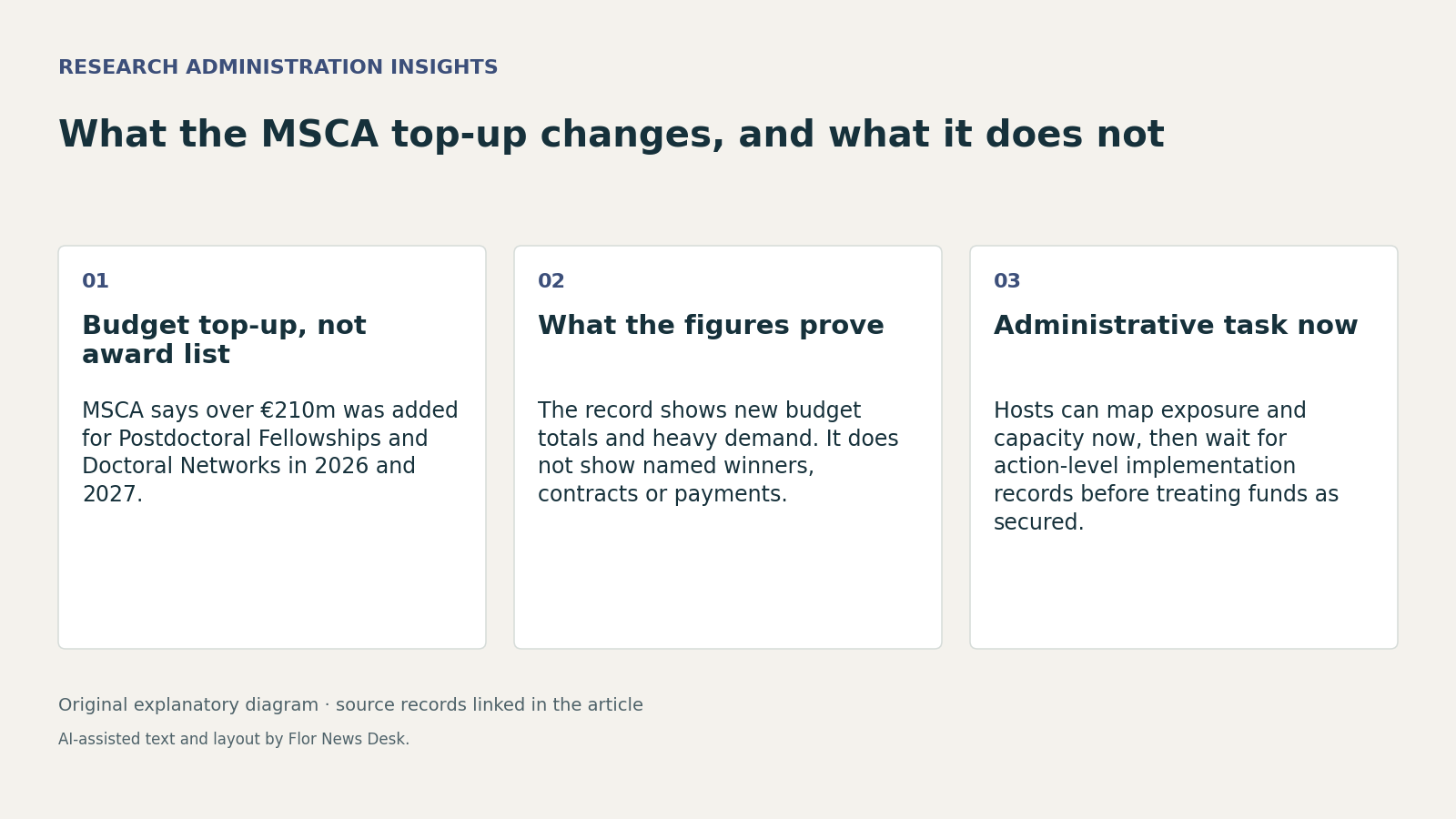
On 1 October 2026, the European Commission, via the Marie Skłodowska-Curie Actions, announced more than €210 million in additional funding under the Choose Europe initiative for MSCA Postdoctoral Fellowships and MSCA Doctoral Networks in 2026 and 2027, with a stated aim of enabling more than 700 additional researchers to build careers in Europe MSCA announcement. For research offices, the most useful reading is narrow: this is evidence of a budget top-up and a programme target, not evidence that any institution has already gained extra awards, signed grant agreements or received money.
The published figures are still important. According to the MSCA page, 2026 budgets will reach €434 million for MSCA Postdoctoral Fellowships and €628 million for MSCA Doctoral Networks; 2027 budgets are stated as €459 million and €645 million respectively, with more than €1.3 billion foreseen for MSCA overall in 2027 MSCA announcement. Those totals can support internal planning because they signal a larger funding envelope in named actions. They do not, on the public record, show how the extra money is divided between the two schemes beyond those end totals, or whether specific unfunded proposals will now convert into awards.
The same notice gives the clearest reason the Commission may have chosen this route. MSCA says the 2026 Postdoctoral Fellowships call received 21,627 applications, which it describes as both a programme record and the highest proposal count for any EU research and innovation funding action in more than 40 years MSCA announcement. That is useful evidence of application pressure. It is not evidence of success rates, reserve-list mechanics or institutional conversion. A university that hosted many applicants can infer demand for MSCA placements, but not that it is now due a larger award share.
A second public notice matters because it widens the policy frame without settling the administrative detail. On 9 October 2026, the European Research Executive Agency said the Commission had allocated an additional €500 million to Horizon Europe on 29 September 2026 for use through the end of 2027, with REA managing around half through new Nature and Bridging actions; the page also says some research-infrastructure-related Bridging topics support the Choose Europe initiative REA notice. That broader amendment shows Choose Europe is not confined to MSCA. But the REA record does not establish whether the MSCA top-up is the same money, a subset of it or a parallel budget decision, so institutions should not double-count the two announcements in forecasts.
The practical question now is not how much an institution will receive, but which existing proposals and host commitments could be affected if selections expand. Research offices can already map exposure in the two named MSCA actions, test whether supervisors, desk space, payroll arrangements and researcher-support processes could absorb additional fellows, and prepare to revise internal budgets if award-level records later appear. Because the MSCA notice does not identify beneficiaries, signed grant agreements, payment dates or disbursements, finance teams cannot treat the announcement as booked income MSCA announcement.
As of 27 October 2026, the public record supports four concrete points: the announcement date, the named MSCA actions, the higher published budget totals and the scale of reported demand MSCA announcement. It does not yet establish implementation outcomes such as funded proposal lists, legal commitments or cash flow. For research administration, that distinction is the story: readiness is warranted, but certainty still requires documents that have not yet been shown in the cited record.