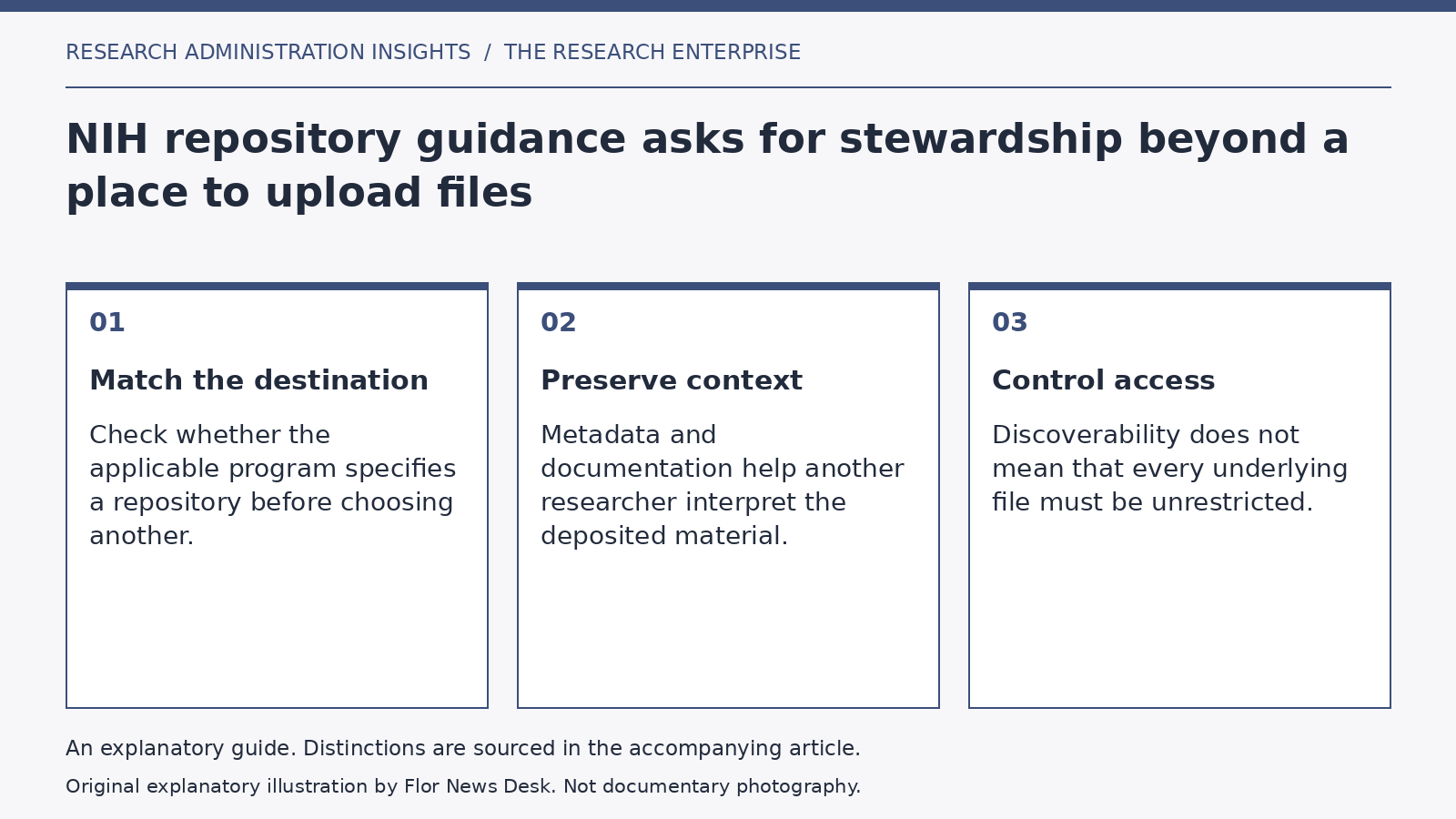
NIH’s repository guidance distinguishes an appropriate research-data service from generic storage. It encourages established repositories and identifies circumstances in which a program or funding opportunity specifies the destination. Its selection guidance also describes desirable characteristics such as persistent identifiers, sustainability, metadata, provenance and appropriate controls for human-participant data. A working upload button addresses only a small part of that task.
The companion data-management guidance emphasizes documentation that explains collection methods, labels and variables. That makes the distinction concrete: preserving a file is not the same as preserving enough context for another researcher to understand it. The relevant documentation depends on the study and data type, rather than on a universal folder structure.
Test the handoff from another person’s position
A useful hypothetical exercise is to give a colleague the material intended for deposit without relying on explanations available only in the original team’s conversation. Can the colleague identify the version, interpret the variables and find the conditions governing access? An unexplained column or ambiguous file name would reveal a documentation question before deposit, not necessarily a defect in the chosen repository.
The exercise should not involve sending restricted data to an unauthorized person. A permitted example or a metadata-only check can test parts of the workflow without broadening access. Institutional specialists are better placed to resolve project-specific access and consent questions than a general checklist that assumes every dataset should be publicly downloadable.
Separate discovery from permission
A persistent identifier can help someone locate a record without granting unrestricted access to every underlying file. That separation is useful rather than contradictory. A repository may need to make the existence and description of data discoverable while enforcing an appropriate access process.
For administrators comparing options, the decision record could therefore explain the required destination, the descriptive material to accompany the files and who will handle later questions. It should also identify any unresolved condition before representing the deposit as complete. No single feature proves that a repository is suitable for every project. The stronger test is whether its actual service and the research team’s documentation together support the intended sharing arrangement.