NIH gave research offices a narrow implementation job on October 19, 2026: correct local guidance for PA-27-037, the Predoctoral to Postdoctoral Transition Award (Parent F99/K00 - Clinical Trial Not Allowed), before the revised language starts applying to receipt dates beginning December 8, 2026. The timing matters because NIH had already framed the parent F99/K00 as a single application structure used across participating Institutes, Centers, and Offices, so stale campus templates could misstate a live parent requirement rather than a niche institute exception. NIH correction notice NIH Extramural Nexus post
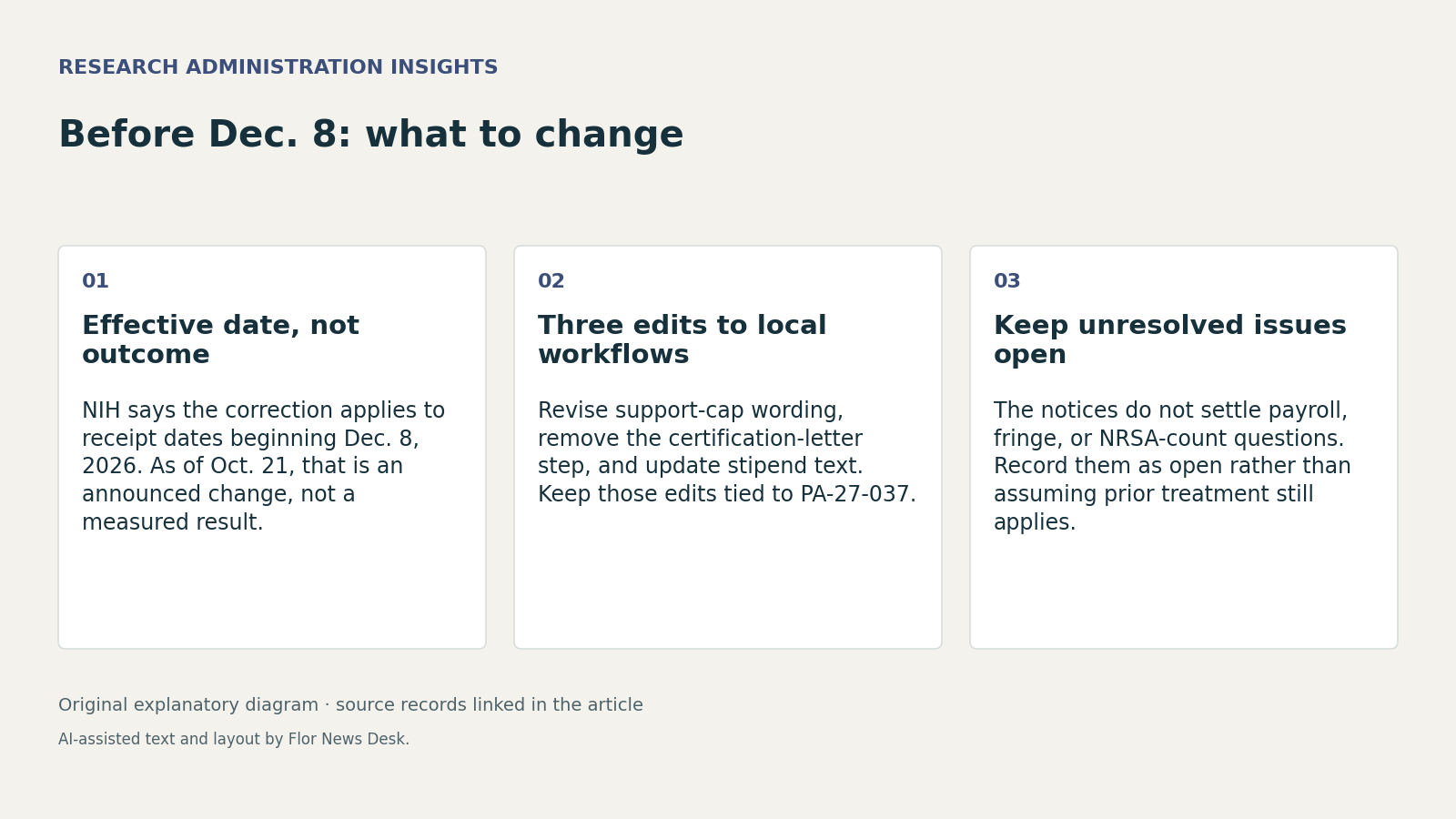
The first operational change is the support clock. NIH’s correction says the award project period is up to five years of aggregate support across both phases, with up to two years in the F99 predoctoral phase and up to three years in the K00 postdoctoral phase. NIH correction notice For administrators, the safest reading is narrow: update forms and advising text to reflect one aggregate ceiling, but do not infer answers the notice does not supply about leave, interruptions, or any interaction with other training support. Those outcome questions are not resolved in the record here.
The stipend edit is smaller in wording but potentially larger in local interpretation. The correction removes Kirschstein-NRSA from the opening stipend sentence and leaves the passage describing a stipend as a subsistence allowance during the training experience. NIH correction notice That supports an immediate text fix in budget instructions and training-office FAQs. It does not, on this record alone, establish a payroll treatment, fringe-cost rule, or campus method for counting NRSA time. If a local guide still labels this parent F99/K00 stipend NRSA after December 8, it will be carrying forward an assumption NIH has at least stopped expressing in this NOFO.
The cleanest workflow change is documentary: Section IV no longer requires a Certification Letter under SF424 (R&R) Other Project Information. NIH also says all other aspects of PA-27-037 stay the same. NIH correction notice That combination argues for targeted cleanup, not a general rebuild. Internal portals, pre-submission checklists, and departmental instructions should remove any mandatory certification-letter upload for this opportunity, while leaving unrelated attachment controls alone unless another NIH record changes them.
A second October 19 notice makes the parent announcement newly relevant to one more institute. The National Institute of Biomedical Imaging and Bioengineering says it is participating in PA-27-037 for receipt dates on or after December 8, 2026, and updates the participating-organization list, Assistance Listing numbers, and agency contacts. NIBIB participation notice What that does not show is equally important: the notice does not add new eligibility, review criteria, funding amounts, or evidence of future award volume. Research-development teams can add NIBIB to mission-fit screening, but should not market it as extra capacity absent a direct funding record.
The July 8 NIH Extramural Nexus post is useful mainly as context, not authority. It presented the parent F99/K00 as a common framework across participating NIH components and emphasized mission alignment, but it predates the October correction and is not the binding requirements text. NIH Extramural Nexus post Its scheduling language is also partly historical by October 21, 2026, because it describes August 8, 2026 as the first standard receipt date and due dates continuing through April 2029 without establishing what happened after August 8. Training slides built from that post now need a policy-layer update from the October notices.
A practical response before December 8 is therefore a short, role-based audit rather than a speculative policy rewrite. Sponsored-programs staff can change intake questions and attachment rules to match the corrected Section IV. Graduate or training offices can replace support-cap and stipend wording in applicant guides. Payroll, effort, and compliance teams should log unresolved questions about stipend classification, fringe treatment, and any NRSA-count practice as open issues, because the correction notice does not settle them. That is the central lesson of these records: NIH has clarified three text points and one participating institute, but the notices do not justify broader claims about implementation outcomes. NIH correction notice NIBIB participation notice