The 8 October 2026 metascience statement from the U.S. National Science Foundation and UK Research and Innovation matters for research offices as an operating signal, not as a new funding call. The two agencies say their collaboration will run through the NSF Office of Metascience and the UK Metascience Unit, and that they intend in the coming months to formalise the partnership and identify initial joint opportunities for work NSF statement; UKRI position statement. As of 20 October 2026, the retrieved records do not confirm whether that later formalisation has happened.
That distinction matters. The UKRI page labels the document a position statement and attributes it to ESRC, UKRI, NSF and the Department for Business, Innovation, Science and Trade UKRI position statement. The NSF-hosted version says the work will cover four areas: measuring research productivity and impact, improving review and funding processes, studying uptake of methods and tools, and responsibly analysing metascience-relevant data NSF statement. Neither record gives funding amounts, pilot designs, participation criteria, data-sharing terms or measured outcomes.
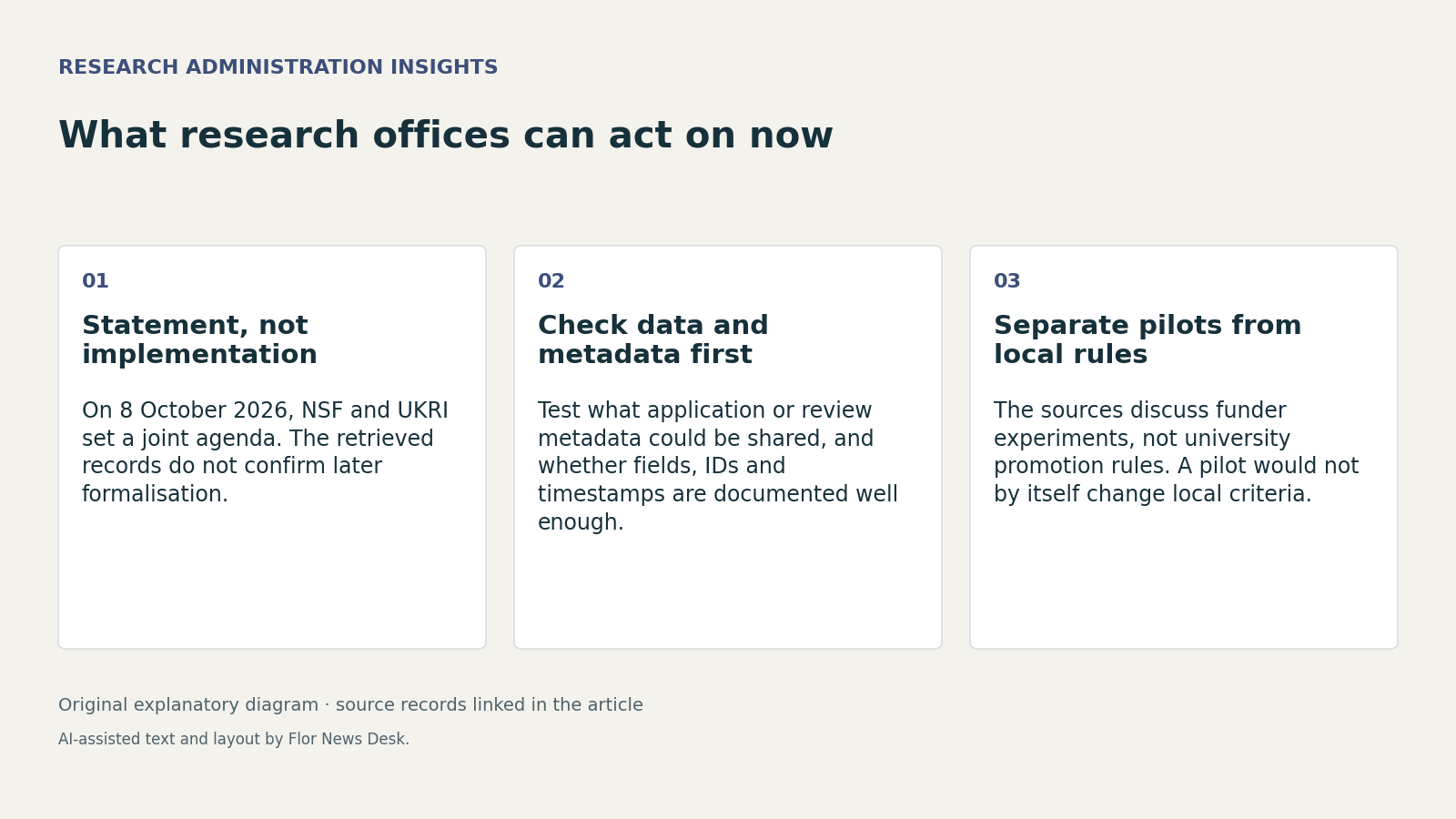
For administrators, the first sensible test is data scope. If a future joint project asked an institution to contribute application, award or review metadata, could the institution identify which fields were reusable for analytical study and which were constrained by confidentiality or prior notices? That is analysis, not a claim that such a request exists. It follows from the statement’s combination of review-process experimentation and responsible data analysis. A hypothetical example: a pilot that compares review-process variants could need timestamps, panel composition data or application characteristics without needing proposal text.
The second check is metadata and provenance. The agencies’ interest in measurement means local systems will be more useful only if records can be interpreted reliably across time. Research offices should know which persistent identifiers and timestamps their grant systems can export, what each field means, and whether a later analyst could tell when a record was created, changed or linked to another record. Without that provenance, an institution could share data that are technically extractable but analytically weak or easy to misread.
The third check is governance boundaries between funder experiments and local evaluation rules. The statement discusses funding, conduct and evaluation as processes that can be studied and improved UKRI position statement. It does not announce changes to university promotion, hiring or internal assessment criteria. Research offices therefore have a communications task as well as a compliance task: if a pilot invitation appears later, participation in a funder experiment should be explained as separate from any automatic change in local reward structures.
The most important limit on this story is the source record itself. The two pages are essentially the same joint statement mirrored on two sites, not independent evidence of implementation. The NSF page also frames the partnership as part of building an international network of metascience units among like-minded countries NSF statement. But until a later document sets terms, money or procedures, the practical takeaway is narrower: this is an early notice that funders want to study their own systems more deliberately, and research offices should make sure their data governance, metadata documentation and evaluation boundaries are ready before any specific pilot arrives.