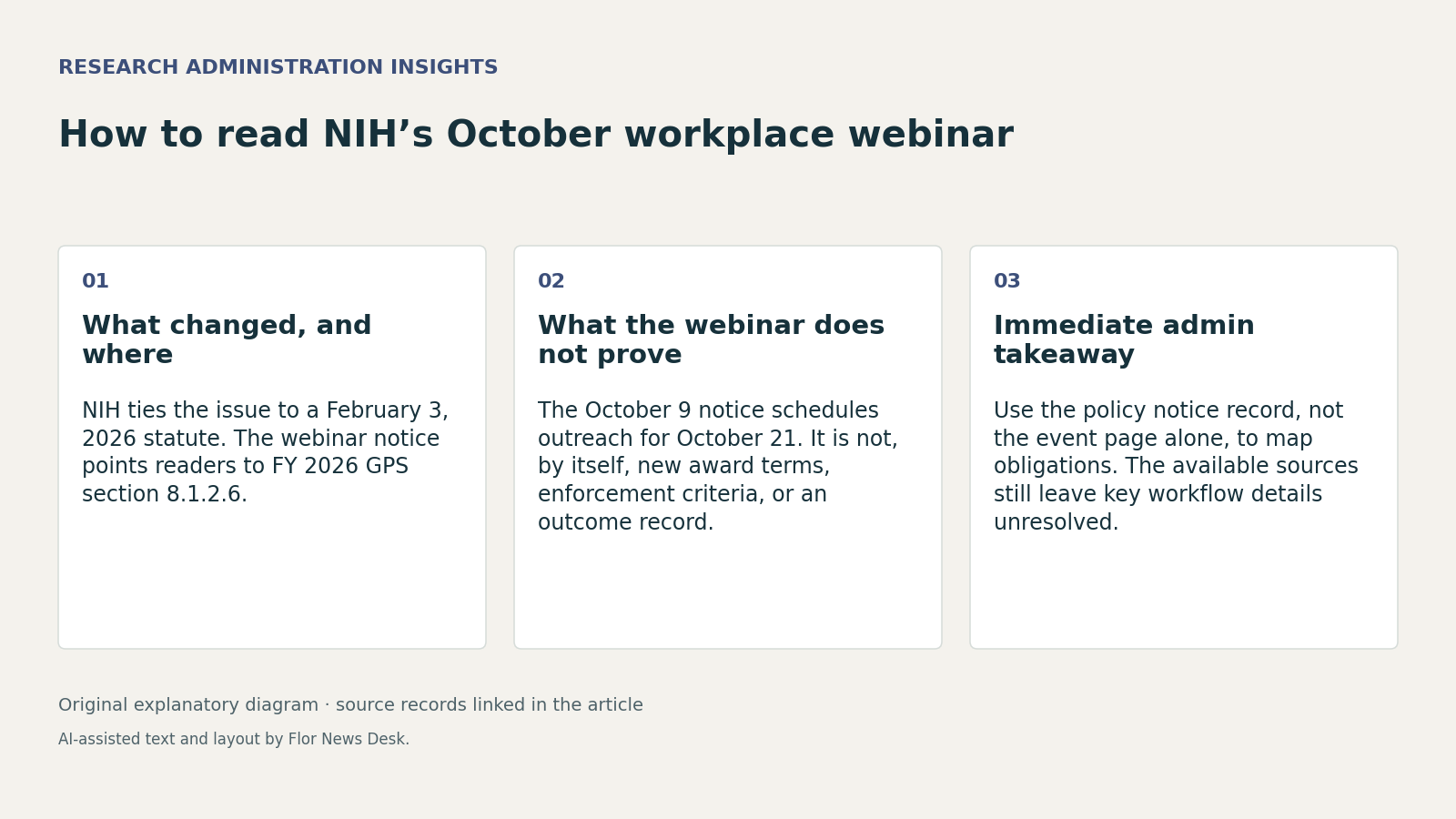
NIH’s October 21, 2026 webinar on harassment, bullying, retaliation and hostile-workplace investigations is best read as an implementation signal, not as a fresh policy issuance. In its October 9 notice, NIH said the session would cover “recent updates” on supporting a safe and respectful workplace at institutions that receive NIH funding, and tied those updates to the Consolidated Appropriations Act, 2026, signed on February 3, 2026, plus the FY 2026 NIH Grants Policy Statement, section 8.1.2.6 NIH webinar notice.
That distinction matters for research offices. The October 9 document is an event announcement, not a standalone set of new award terms. The briefed record says NIH used it to point readers back to the statute, to the FY 2026 Grants Policy Statement section where the requirements were incorporated, and to an earlier NIH communication. As of the supplied current date, 2026-10-21, the webinar was scheduled for 10 a.m. EDT later the same day, so the same notice cannot yet establish that the event occurred, what NIH actually said on the call, or whether the promised recording was posted NIH webinar notice.
The more important authority question is where NIH says binding updates sit. NIH’s policy-change index says policy notices published in the NIH Guide supersede information in the NIH Grants Policy Statement, and that compliance with those updates becomes a term and condition of award. That page also lists an August 12, 2026 notice, NOT-OD-26-097, under the title “Recent Updates: Supporting a Safe and Respectful Workplace at Institutions that Receive NIH Funding” NIH policy changes index. For administrators, the immediate implication is procedural: do not treat the webinar page alone as the operative source. The institution needs the underlying notice text and the cited Grants Policy Statement section in the same compliance file before deciding what internal instructions are actually anchored in NIH policy.
What the available records do establish is narrower. NIH says the February 2026 law updated how institutions handle investigations arising from harassment, bullying, retaliation or hostile working conditions involving senior/key personnel on NIH awards NIH webinar notice. What the records here do not establish are detailed enforcement criteria, a measured implementation result, or a new deadline imposed on October 9. They also do not supply the full text of NOT-OD-26-097. That leaves a practical gap: an institution can know NIH is emphasizing this area without yet being able, from these three records alone, to settle every downstream workflow question.
A second October notice adds context. On October 8, 2026, NIH opened a request for information on reducing administrative burden in extramural research and specifically said it wanted input on burdens that can fall disproportionately on smaller or less-resourced research administration operations. But NIH also said that RFI was for planning only, not a solicitation or a commitment to change policy, and responses are not due until December 8, 2026 NIH administrative-burden RFI. The juxtaposition does not prove NIH will revise workplace requirements. It does suggest, as analysis, that institutions should separate two tasks: near-term compliance mapping under existing authority, and longer-term comments about operational burden if NIH seeks changes later.
For now, the most defensible administrative move is disciplined source control. Research offices can document that NIH has elevated the issue through an October 21 outreach event, identify the August 12 policy notice NIH flags as relevant, and verify the cited FY 2026 Grants Policy Statement section before translating the issue into local procedures NIH webinar notice NIH policy changes index. The records in hand support that review step. They do not yet support stronger claims about new October enforcement, completed implementation, or the exact institutional workflow NIH will accept.