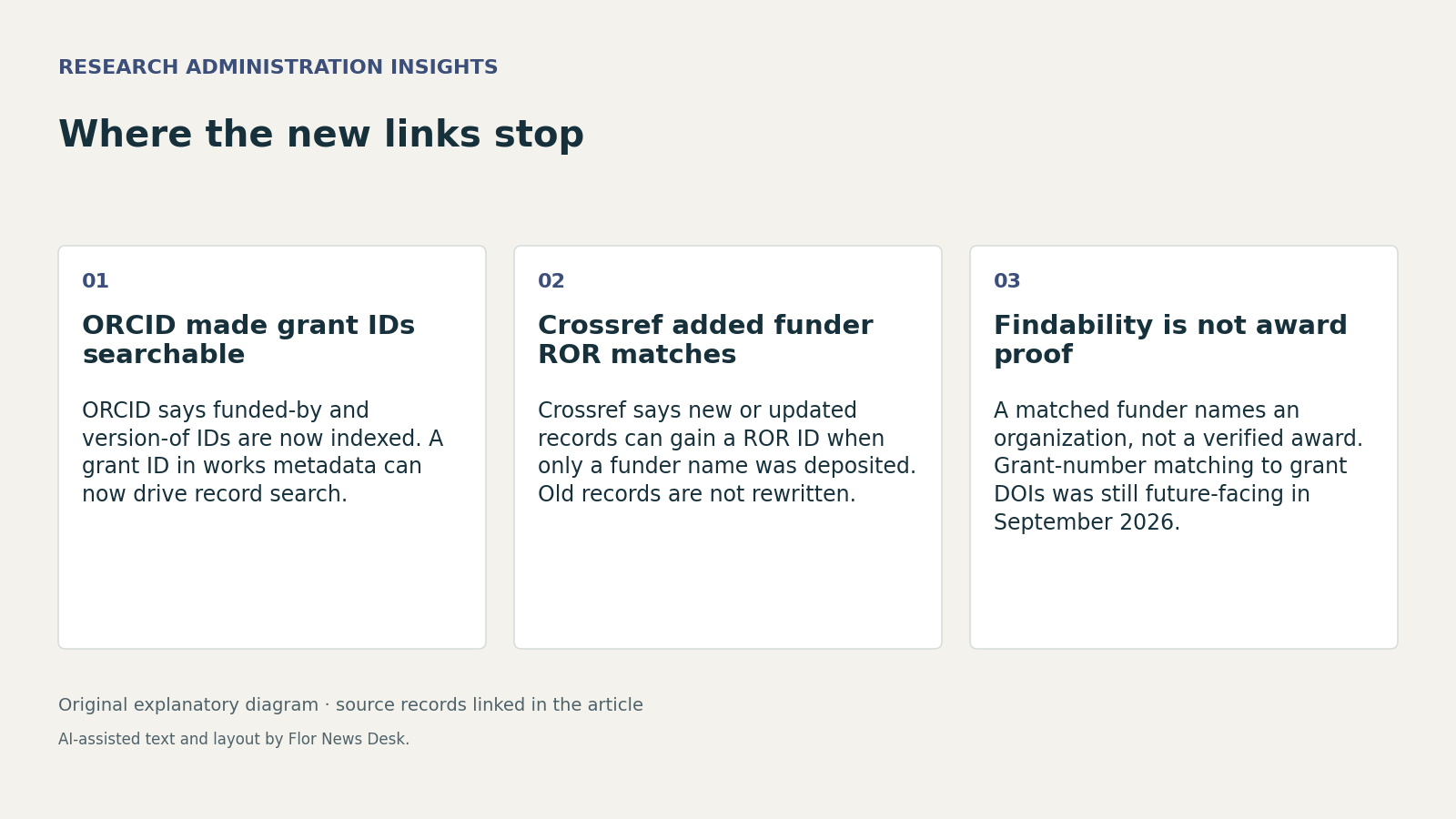
On 13 October 2026, ORCID said its API began indexing funded-by and version-of identifiers for search, including the ability to find ORCID records carrying a specific grant identifier in publications (ORCID release notes). Read with Crossref’s 15 September 2026 move to match deposited funder names to ROR IDs when no identifier is supplied (Crossref, 15 September 2026), that is a concrete metadata change for research offices: public infrastructure for discovering links among outputs, funders and organizations has improved. The record does not show that institutions, publishers or vendors have already turned those links into complete reporting.
The ORCID change matters because it shifts a grant identifier from passive metadata to searchable metadata. ORCID says the funded-by relationship on works metadata can describe a grant or other funding awarded for a work, and the same 13 October release added Research Resource IDs, or RRIDs, as supported external identifiers in that relationship (ORCID release notes). For administrators, that widens opportunity and ambiguity at the same time. A search hit can now show that an identifier is present, but the record can also represent research resources such as software pipelines, core facilities, reagents or instruments rather than a conventional award.
Crossref’s September change addresses a different failure point: missing organizational identifiers in deposited funding metadata. Crossref says that, from 15 September 2026, new or updated records with funding information but no funder identifier are automatically matched to ROR IDs, while existing metadata is not rewritten and Open Funder Registry identifiers remain in place (Crossref, 15 September 2026). Because the matched ROR IDs flow into Crossref-enriched metadata through the REST API, institutions now have a direct way to inspect whether newly deposited outputs expose a machine-readable funder organization link.
What this does not establish is award-level certainty. Crossref’s own April 2026 methods post reported 99% precision and 81% recall on a manually labeled set of 3,505 funder names under its relaxed weighted evaluation, and it said the current strategy returns zero or one ROR ID per input even though some funder strings can correspond to more than one organization (Crossref, 27 April 2026). That is useful evidence that matching can work well, but it is still Crossref’s evaluation, not an external audit, and it describes organization matching rather than proof that a specific grant number has been linked to a specific grant record.
That distinction matters because Crossref’s 15 September post said its next step would be to connect grant numbers and funder identifiers to grant DOIs registered with Crossref (Crossref, 15 September 2026). As of that post, this was still a plan, and the April methods post also framed grant matching as future work (Crossref, 27 April 2026). So the practical question for research offices is not whether grant-output linkage has been solved. It is whether their own metadata is now complete enough to be found when the public services can search or enrich it.
A sensible short test follows from the sources. First, pick a known grant identifier that already appears in publications and check whether your ORCID-connected systems can retrieve records through the newly indexed search route (ORCID release notes). Second, inspect a small sample of new or recently updated Crossref records from your institution to see whether funding metadata now includes enriched ROR IDs alongside any existing funder identifiers (Crossref, 15 September 2026). Third, flag older outputs separately: Crossref says legacy records are not changed automatically, so missing links there may reflect deposit age rather than matching quality (Crossref, 15 September 2026). The public record supports this as a testing window, not as evidence of completed ecosystem uptake.