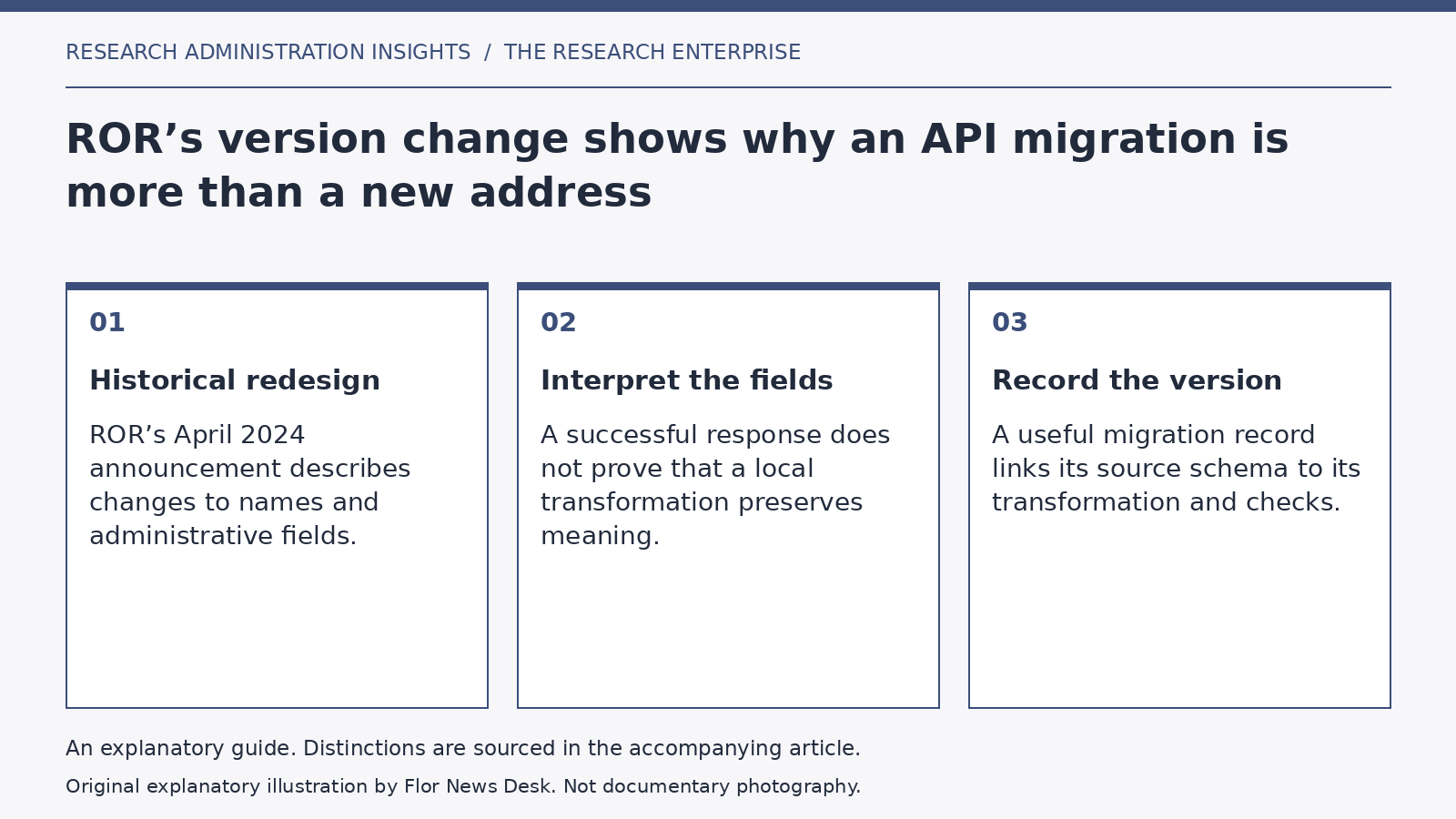
ROR’s introduction of its second major schema in April 2024 changed more than the address used to request organizational records. Its launch explanation describes redesigned multilingual names, administrative creation and modification dates, and reorganized location and website information. For research administrators, the enduring lesson is that an identifier can remain familiar while the surrounding record requires a different interpretation.
The registry’s June 2025 retirement timetable subsequently set out changes to unversioned requests and the planned withdrawal of the first version. These are dated announcements about a migration, not a live test of an institutional connection today. They nevertheless provide a concrete example of why changing a request path without reviewing the returned fields is an incomplete migration strategy.
A successful response can conceal a changed meaning
Consider a hypothetical reporting system that expects one institution name in a single field. If a newer schema represents several names with language and type information, selecting the first available value is not necessarily the same operation as choosing a display name under an explicit rule. The system may still run and produce a plausible label while losing a distinction that matters to users.
A more informative acceptance test would compare a small set of records with different naming and organizational characteristics. It would ask which name is displayed, which aliases remain searchable and what happens when a field is absent. This proposed test concerns a local application’s behavior; it is not evidence of errors in ROR’s records or of a failure by any named institution.
Keep the source version with the result
Administrative dates also need labels that explain what they date. A registry-record modification should not be silently presented as the date an institution was founded, renamed or reorganized. That would replace the meaning of the source field with an unsupported historical claim.
A migration record can preserve the requested schema version, the transformation rule and the sample checks performed. The aim is not a larger collection of technical logs for its own sake. It is a traceable explanation of how an institutional identity reached a report, so that later changes can be distinguished from both software defects and genuine changes in the underlying organization.