Canada’s Tri-agency grants management solution has moved far enough into public implementation planning that research offices should stop treating it as a distant modernization project. But the practical implication is not a campus-wide cutover date. The current agency record points instead to a period of coexistence, in which some opportunities will move first while others remain in legacy systems TGMS overview Implementation page.
The three agencies say TGMS is being developed as a single platform for finding opportunities, applying, tracking status, receiving decisions and terms, submitting reports or amendment requests, and receiving payment TGMS overview. The same page says the discovery phase included engagement with the research community and industry, confirmation of a procurement approach, and receipt of authorities to proceed with implementation, while the implementation phase covers building the solution with users and the solution provider and onboarding funding opportunities TGMS overview. That matters because it marks an implementation posture, but it does not establish that every listed function is already live.
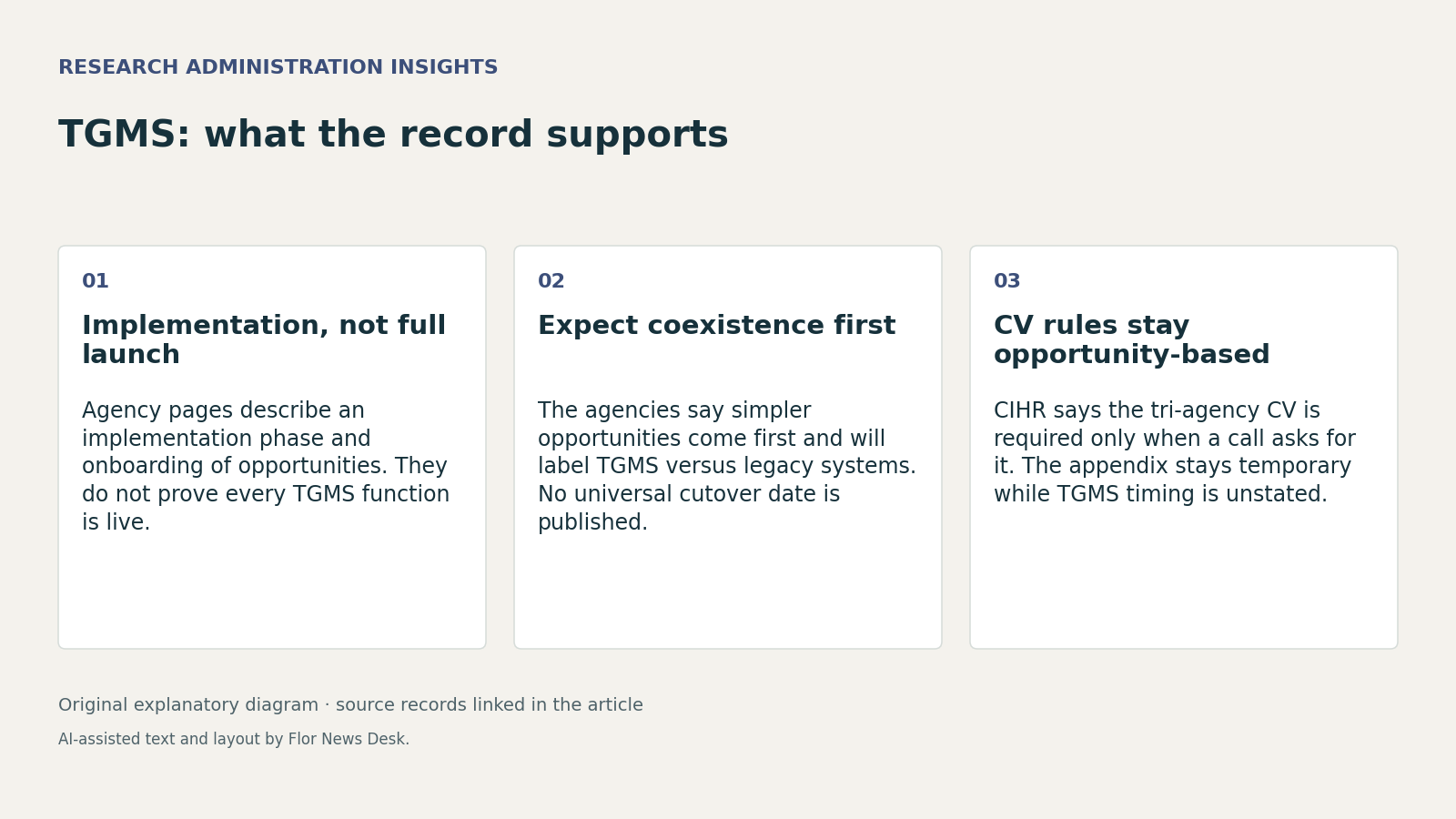
The strongest operational signal is on the implementation page: the agencies say TGMS will replace existing grants-management systems, including the Canadian Common CV, and that rollout will begin with a small subset of simpler funding opportunities before expanding to more complex ones over time Implementation page. They also say they will indicate whether a funding opportunity is hosted in TGMS or in a legacy system during the transition Implementation page. For institutions, that means the first useful task is not migration itself but inventory: identify every local instruction, checklist and support page that assumes CCV or any single agency workflow, because opportunity-level divergence is now part of the announced plan.
The CV record reinforces that point. CIHR’s tri-agency CV FAQ describes a narrative-style CV with three sections and a five-page English or six-page French limit, but it also says applicants must use it only when the funding opportunity requires it and follow the relevant formatting instructions Tri-agency CV FAQ. CIHR further says the tri-agency CV was developed alongside TGMS, piloted in select opportunities, and is intended to become the CV component of TGMS, while the appendix remains a temporary addition pending TGMS launch Tri-agency CV FAQ. The administrative lesson is narrow but important: do not replace all local CV guidance with one TGMS-era template yet. Institutions need opportunity-specific guidance until the agencies publish broader migration evidence.
The procurement record is also useful mostly for what it does not prove. The industry-engagement page says an Industry Day was held on 2019-08-23, that Microsoft Power Platform was chosen in spring 2022 through a competitive procurement process led by Shared Services Canada, and that an RFP was launched on 2022-10-25 to select a vendor to help configure the solution Industry engagement. But that page does not identify a selected configuration vendor, and its 2022 future-tense wording about what the RFP would lead to is only a historical expectation as of 2026-10-29, not proof of a completed procurement outcome Industry engagement.
So the short institutional checklist is modest. Assign one team or lead to monitor each opportunity notice, clean up local material that treats CCV rules as universal, and prepare applicant communications around a mixed environment. Reserve staff time for training once dates appear, because the agencies say support is expected to include technical help, videos, demonstrations and live instructor-led sessions, but the current public pages do not provide rollout dates or an institution-by-institution schedule Implementation page. The next milestones worth watching are concrete ones: named opportunities entering TGMS, dated training notices, and published evidence that a legacy function has actually been replaced rather than only announced.