UK Research and Innovation’s new research data policy creates a date-driven administrative problem, not just a policy one. UKRI published the policy on 14 October 2026 and says it applies to in-scope funding opportunities from 1 April 2027, although the announcement describes opportunities “published” from that date while the policy page uses “launched” announcement policy. For research offices, that means proposal triage needs a date test and a scope test before investigators ever see a revised template.
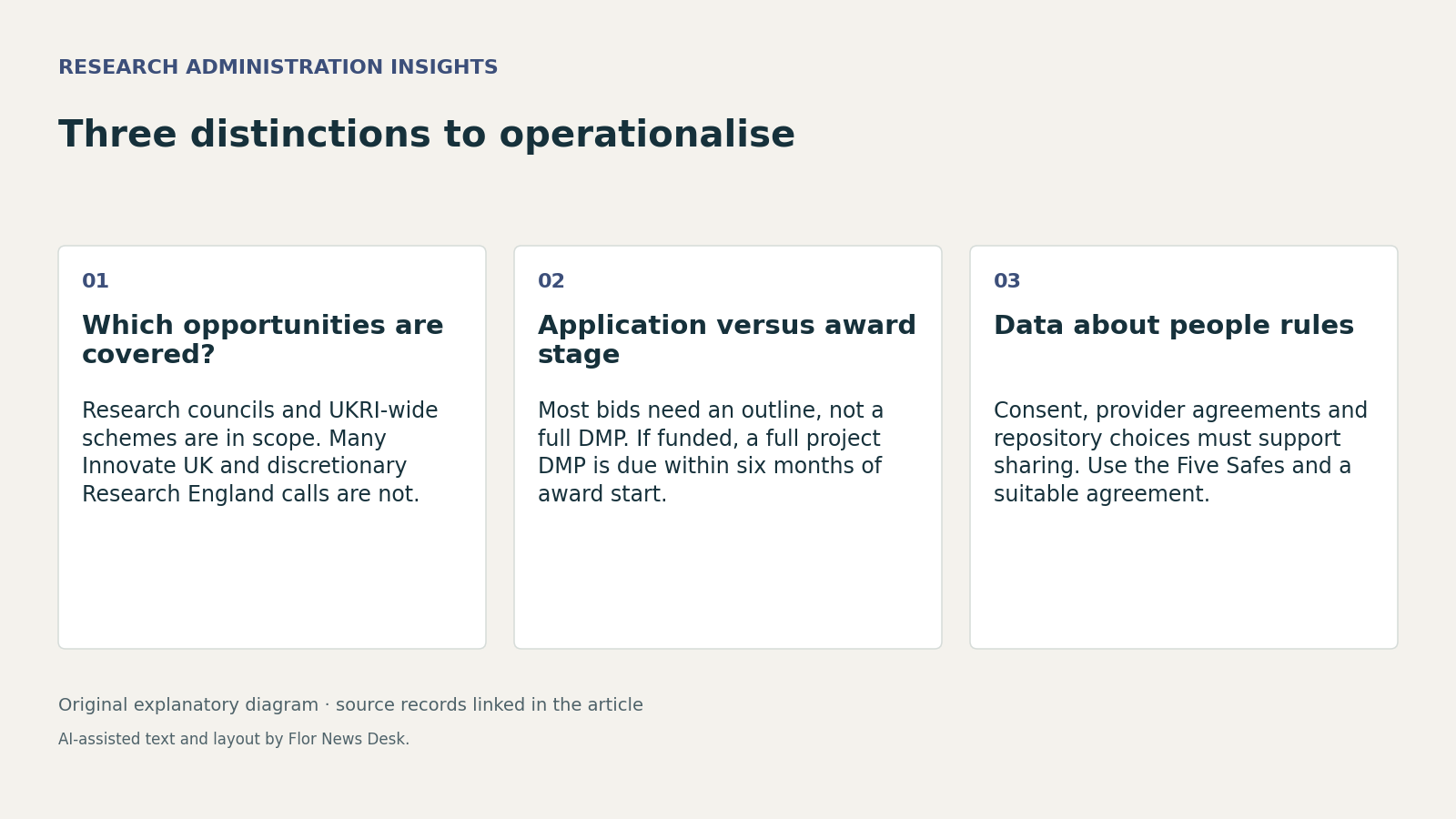
The scope test is the first place institutions could overgeneralise. UKRI says the policy covers research funded by the research councils and UKRI-wide schemes, plus some activities funded by Innovate UK and Research England announcement policy. But Annex 1, as summarised in the policy record, says most Innovate UK funding is out of scope unless opportunity guidance says otherwise, and most discretionary Research England funding is out of scope unless scheme terms and conditions say so policy. The practical implication is simple: a university cannot label all UKRI-branded opportunities one way. Internal guidance needs a call-level check, and the available records do not establish a single live list of every in-scope scheme.
The second change is workflow design around data management plans. The policy says applicants will normally provide an outline of how they will manage and share research data, while some data-intensive opportunities may require a full data management plan for assessment. If an award is made, a full project data management plan must be in place within six months of the award start, or within six months of the start of individual studentship projects under training grants policy. That is not just a wording update. It suggests pre-award teams should separate three things that are often bundled together: the application-stage prompt, any scheme-specific full-plan requirement, and the post-award trigger for the completed plan.
The policy also sets two sharing deadlines that matter for closeout and publication workflows. Data needed to understand and validate published findings must be shared no later than publication. Data with potential long-term reuse value must be shared no later than two years after UKRI funding ends if they remain unpublished policy. Institutions do not need to prove new infrastructure from these records, but they do need to check whether repository, publications and award-end processes can identify those two different clocks.
The most immediate policy-adjacent work may sit with ethics, contracts and information governance teams. UKRI’s companion guidance on sharing data about people applies with the policy to the same in-scope opportunities from 1 April 2027 guidance. It says protocols, participant information and consent arrangements should allow for sharing where researchers collect data directly from people. For indirectly collected data, it says sharing as a research output should be agreed in principle with the provider during the data application process, and if sharing cannot happen, code, scripts, documentation and access information should still be made available guidance. The same guidance says sharing must follow the Five Safes framework and use an appropriate repository with a suitable data sharing agreement guidance. That does not answer every legal or ethical question, but it does tell institutions where their standard consent and data-provider language may now be misaligned.
UKRI’s consultation history helps explain why implementation support is still a live issue. The engagement page says UKRI consulted in 2025, received 105 written responses, heard requests for clearer scope and practical support, and in October 2026 published the policy and the people-data guidance engagement page. The same page says UKRI is preparing updated application sections, reviewer guidance, data management plan resources, costing guidance and a monitoring framework, and lists a webinar for 25 November 2026 engagement page. As of 15 October 2026, those are still planned support materials in the record, not completed implementation. That is why the immediate task for research offices is not waiting for the perfect toolkit. It is identifying which calls will flip on 1 April 2027, then updating templates, routing rules and training around the distinctions UKRI has already fixed in the policy text.