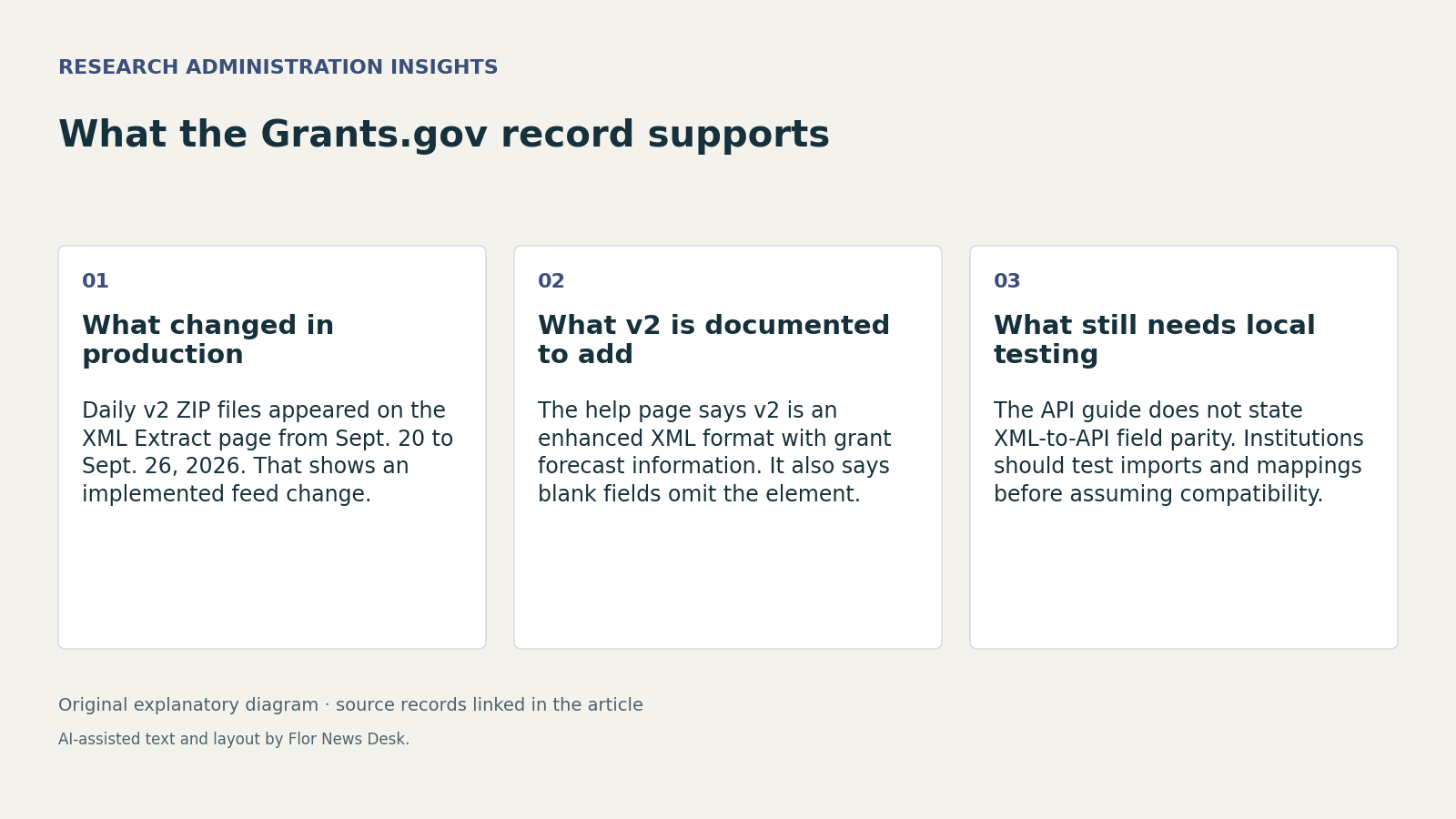
Grants.gov’s daily XML extract appears to have changed in production on September 20, 2026, when its download page began listing files named `GrantsDBExtract20260920v2.zip` and then additional daily v2 ZIPs through at least September 26, 2026. Grants.gov describes the extract as a once-daily export of its grants database for download and database import, aimed primarily at power users and database owners (XML Extract). For research offices that ingest opportunity data automatically, that is an operations issue first, not a funding-policy story.
The clearest documented change is on Grants.gov’s help page for opportunity data downloads. It says filenames ending in v2 use an enhanced XML format that includes grant forecast information, and that the XML schema is packaged inside the ZIP file (Download Opportunity Data). The same page says an element is omitted when its field is blank, and it marks several fields as forecast-only, including Close Date, Estimated Synopsis Post Date, Fiscal Year, Estimated Synopsis Close Date, Estimated Award Date, Estimated Project Start Date, Grantor Contact Name, and Grantor Contact Phone Number (Download Opportunity Data). It also describes a Version field formatted as either Forecast X or Synopsis X (Download Opportunity Data).
That combination matters because it changes the administrative question from “Did Grants.gov announce a policy?” to “What does the local parser expect?” If an institutional import assumes a fixed set of synopsis-style elements, or treats missing nodes and blank values as the same thing, v2 may need mapping or validation work. That is analysis, not a documented failure: the source record does not state that existing imports will break, but it also does not offer a backward-compatibility assurance (XML Extract; Download Opportunity Data).
Teams that rely on both XML downloads and API-based lookups should also avoid assuming the two channels changed together. Grants.gov’s API materials confirm production and staging REST endpoints, say some APIs require an API key, and note that authentication and authorization are not required for the `search2` and `fetchOpportunity` endpoints. The guide gives an example path of `/v1/api/search2` and points developers to the SOAP system-to-system portfolio (API Resources; API Guide). But the guide does not mention the new v2 extract files or say whether API responses expose the same forecast-related fields as the download feed (API Guide). For administrators, that gap argues for a parity test rather than an assumption.
The system-to-system schema pages are useful, but only up to a point. One Applicant System-to-System page describes `GrantsCommonTypes-V1.0.xsd` as a common schema, lists web service version(s) as V2.0, and provides training and production URLs (Grants Common Types). What the page does not establish is equally important: it does not say this is the exact schema inside the new daily extract ZIPs, and it does not tie the v2 extract filenames to a dated migration event (Grants Common Types).
A practical response, based on the record, is narrow and test-driven. Download a current v2 ZIP from the extract page and run it through the same validation path used in production imports (XML Extract). Check how local code handles omitted elements, and decide whether forecast-only fields belong in internal opportunity dashboards or should be filtered until staff define a use case (Download Opportunity Data). If the office also uses Grants.gov APIs, repeat the check against staging and production endpoints before treating API and XML results as interchangeable (API Guide).
The main limit in the source record is dating and scope. None of the cited pages in this brief shows a dated change notice explaining why v2 appeared, whether non-v2 files continue elsewhere, whether vendors have already adapted, or whether every downstream service sees the same forecast data. Until a more explicit Grants.gov migration record appears, research offices have enough evidence to test now, but not enough to assume complete platform-wide equivalence or disruption.