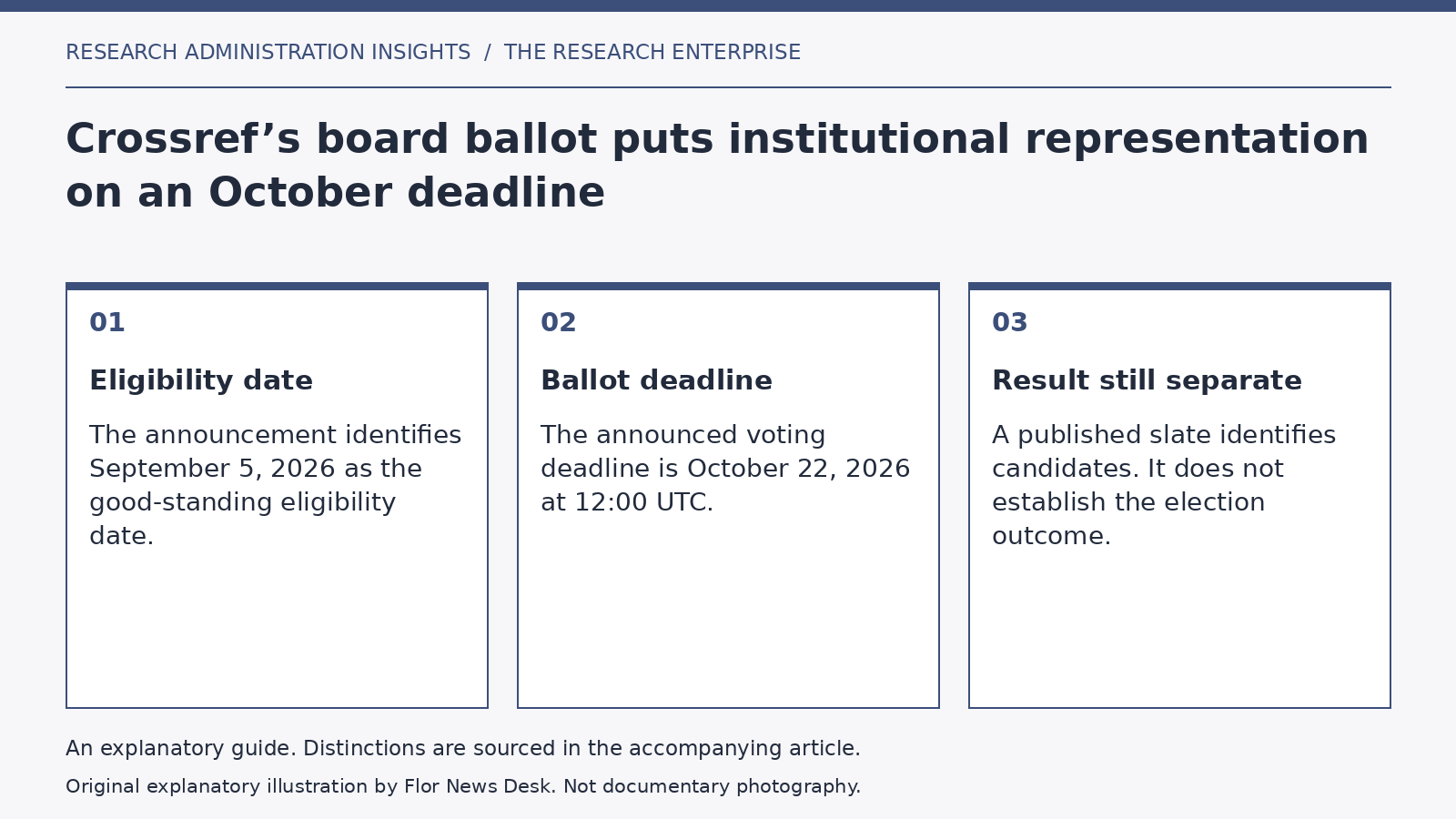
Crossref’s 2026 board election is an institutional decision with a defined deadline. The September 21 slate announcement says members in good standing on September 5 are eligible to vote, with ballots closing at 12:00 UTC on October 22. Those dates identify an active election process. They do not establish who will win or how an incoming board will vote on future questions. The election announcement is the relevant record for the timetable.
For a university or small publisher, the practical issue is not whether an individual researcher uses Crossref metadata. It is whether the member organization has an eligible ballot and a person responsible for handling it. Crossref’s governance page describes the board’s role in strategic direction and the membership’s role in choosing directors. That is different from an open survey of all people who depend on scholarly identifiers.
Locate the decision inside the institution
A sensible internal process would identify the designated voting contact, circulate the published candidate information to relevant colleagues and record how the organizational preference was settled. This is a proposed administrative approach, not a statement that any member has followed it. It avoids two opposite errors: treating the ballot as one employee’s private preference, or circulating it so broadly that nobody remains accountable for submission.
The election can also be separated from consultation on particular technical policies. A member might support a candidate’s experience without endorsing every future implementation choice. Conversely, dissatisfaction with a service does not establish that a candidate can personally change a fee, schema or product. Those are distinct decisions with their own records.
A slate is only one stage
An election tracker should distinguish eligibility, ballot availability, submission and published results. Moving an item straight from candidate announcement to confirmed representation would turn an anticipated outcome into a fact. Institutions can instead preserve the dated announcement alongside their own submission confirmation and wait for the official result before updating governance records. That modest separation gives staff a usable audit trail without predicting the election or inventing a mandate for directors who have not yet been elected.