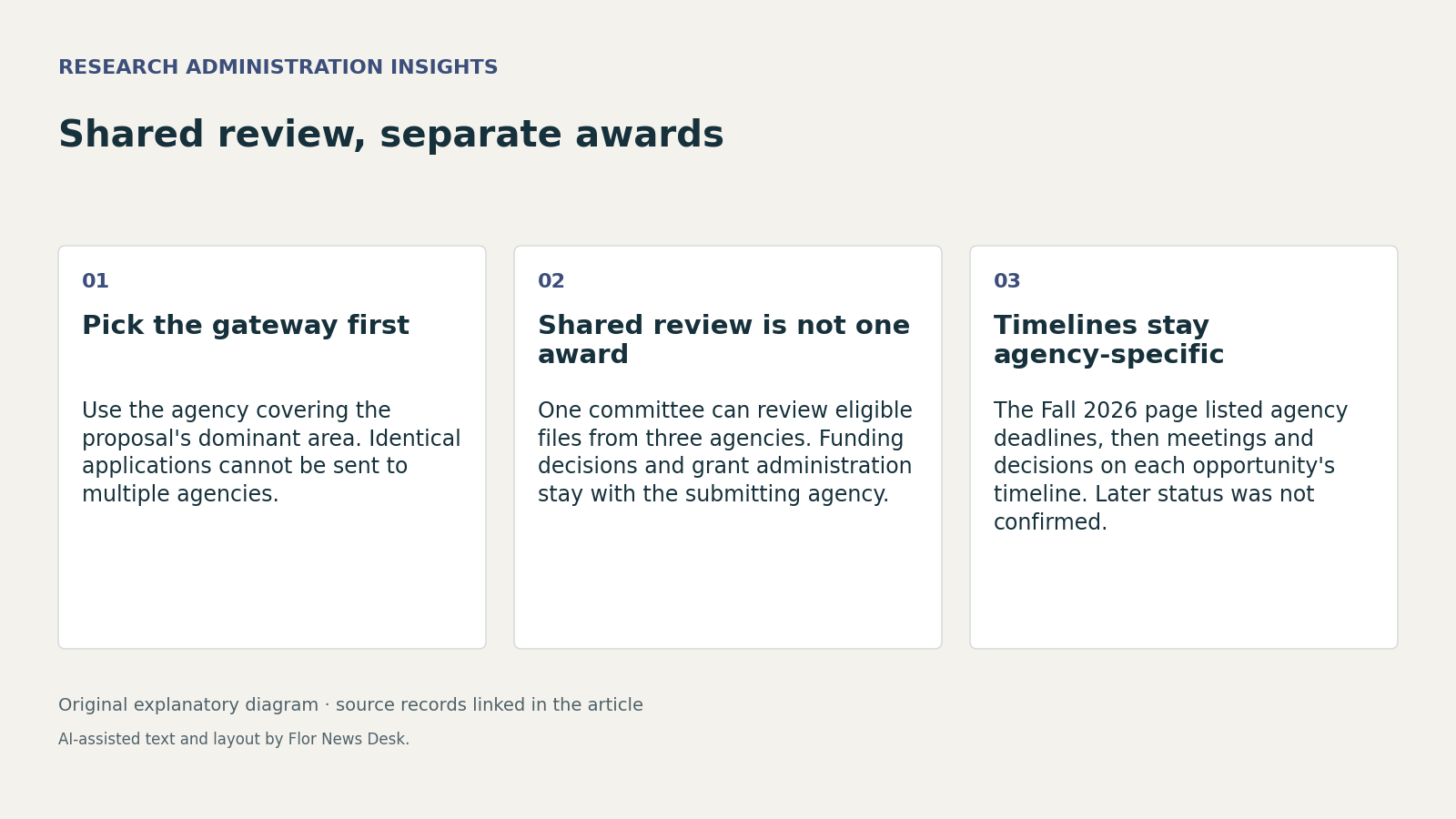
The immediate administrative change is not a new funding pool but a new review path. CIHR’s materials show that the Tri-Agency Interdisciplinary Peer Review Committee was being used for Fall 2026 competitions after exiting its pilot phase, across participating opportunities at SSHRC, CIHR and NSERC, while funding decisions and grant administration remained with the agency that received the application CIHR TIR FAQ CIHR TIR Peer Review Guide. For research offices, that makes intake, eligibility screening and post-award handoff separate operational questions.
The first question is gateway choice. The current FAQ says eligible applications can come from SSHRC Insight Grants, SSHRC Insight Development Grants, CIHR Project Grant and NSERC Discovery Horizons, provided the project spans at least two of three broad areas and that interdisciplinarity is essential to achieving the project goals CIHR TIR FAQ. The same page directs applicants to submit through the funding opportunity that matches the proposal’s dominant discipline or area, and it says an identical project cannot be submitted to more than one agency CIHR TIR FAQ. A practical institutional response is to require applicants to record both the selected gateway agency and the rationale before final routing. That is an evidence-based compliance step, not a prediction about funding advantage.
The second question is what shared review changes inside peer review. According to the guide, once full applications are in, committee members first complete an ability-to-review and conflict-of-interest exercise using project summaries and their self-assessed expertise. Each application is then assigned to five committee members, three Reviewers and two Readers, and the agencies say they will seek, but cannot guarantee, at least two External Assessment Reports for each application CIHR TIR Peer Review Guide. The guide also says reviewer workloads are balanced across applications from the three agencies CIHR TIR Peer Review Guide. The administrative implication is that institutions should not assume a familiar single-agency reviewer pattern, or guaranteed external assessments, when preparing interdisciplinary files and internal conflict tracking.
The third question is what the committee does not change. The current FAQ and the guide both state that funding decisions, funding and grant administration remain the responsibility of the agency to which the application was submitted; the guide adds that applicant feedback formats also stay agency-specific CIHR TIR FAQ CIHR TIR Peer Review Guide. A still-online older FAQ, modified on 2021-07-19, likewise says applications are reviewed by the same interdisciplinary committee but compete within the funding opportunity where they were submitted, and that successful applications are funded and administered by the submitting agency, although that page should be treated cautiously because it still describes the arrangement as a pilot older CIHR TIR FAQ. Taken together, the records support a narrow but important conclusion: review may be shared, but award ownership is not.
The timing record needs equal care. The FAQ page updated on 2026-07-09 lists Fall 2026 and Spring 2027 milestones, including a 2026-09-09 full-application date for SSHRC Insight Grants and a 2026-10-19 full-application date for the CIHR Fall 2026 Project Grant competition, and says committee meetings and notices of decision follow each funding opportunity’s own timeline CIHR TIR FAQ. As of 2026-11-02, those submission dates are already past, but the retrieved records do not establish whether later committee meetings or notices of decision occurred as scheduled. The safe reading for research administrators is therefore limited and useful: treat the Tri-Agency Interdisciplinary Peer Review Committee as an established routing and review mechanism, but keep schedule monitoring, award terms and post-award administration attached to the specific agency competition.