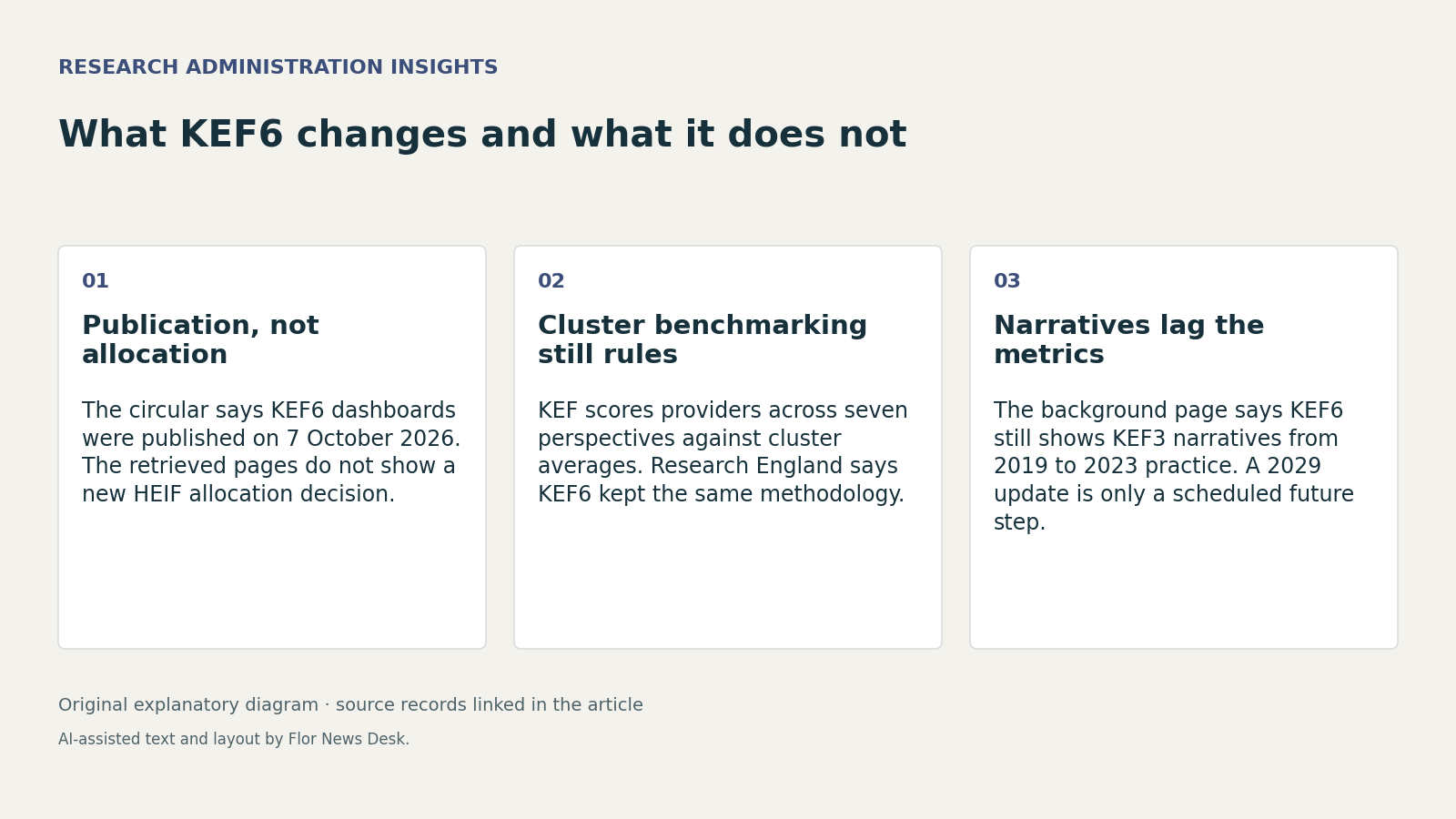
Research England’s 7 October 2026 KEF6 circular matters first as a publication and records event, not as a new money event. The letter says KEF6 was published that day and that the dashboards could be accessed from midday on 7 October 2026, covering English higher education providers that received a Higher Education Innovation Funding allocation in 2025 to 2026 and providers that submitted narrative statements for KEF3 (KEF6 circular letter). On the retrieved record, that supports immediate checks on inclusion, published results and internal briefing, but it does not by itself evidence a fresh funding decision.
Research England also frames KEF6 as a continuity exercise rather than a redesign. The circular says there were no substantive changes to the underlying methodology and that KEF6 can be compared with KEF2 onward, while the background KEF page says the methodology, metrics and perspectives used for KEF2 continued through KEF6 and that results are published annually as interactive dashboards (KEF6 circular letter; Knowledge exchange framework). For research offices, the practical implication is analytical rather than procedural: before assuming a new collection regime, confirm that existing evidence chains still support the recurring KEF views now being republished.
The cohort description is worth checking carefully. The circular ties KEF6 results to providers with a 2025 to 2026 HEIF allocation and to those that submitted KEF3 narrative statements, while the UKRI news item says all institutions receiving a Research England HEIF allocation in 2025 to 2026 were included and that some HEIF-eligible institutions without an allocation chose to participate (KEF6 circular letter; KEF6 results show growth in university knowledge exchange outcomes). That means an institution should verify which inclusion route applies to it before describing its KEF6 position internally or externally.
The news coverage gives useful context, but not a complete institutional evidence base. UKRI says cluster averages across all knowledge exchange perspectives either improved or were maintained from the previous year in almost all cases, and it highlights movement in Working with business and Research partnerships for selected clusters. The same page explains that KEF covers seven perspectives and assigns quintile scores relative to each institution’s knowledge exchange cluster average (KEF6 results show growth in university knowledge exchange outcomes). For administrators, that means a KEF6 score is best read as cluster-relative benchmarking, not as a standalone indicator of funding gain, compliance standing or institutional quality.
The source record also contains a date conflict that institutions should not ignore. The background KEF page says KEF6 was published in September 2026, but both the circular and the news item are dated 7 October 2026 (Knowledge exchange framework; KEF6 circular letter; KEF6 results show growth in university knowledge exchange outcomes). The background page also says KEF6 still displays KEF3 narrative statements published in November 2022, covering 2019 to 2023 practice, and that the next narrative update is scheduled for 2029 after the REF2029 submission deadline (Knowledge exchange framework). So even where current dashboards are live, some narrative context is explicitly older material.
As of 31 October 2026, the safest KEF6 checklist supported by these pages is narrow but useful: confirm that the institution appears for the expected reason, log the documented publication date, brief leadership on the seven-perspective and cluster-relative structure, and keep KEF6 publication separate from any claim about HEIF redistribution or new compliance duties that these records do not establish (KEF6 circular letter; KEF6 results show growth in university knowledge exchange outcomes; Knowledge exchange framework).