ORCID’s September 10 account of its arts, humanities and social-science work highlights a familiar mismatch: scholarly contributions can extend beyond journal articles, while institutional records may be built around article-shaped fields. The published account discusses linking broader outputs and institutional assertions. It also distinguishes an indication of provenance from a certificate that the underlying claim is true.
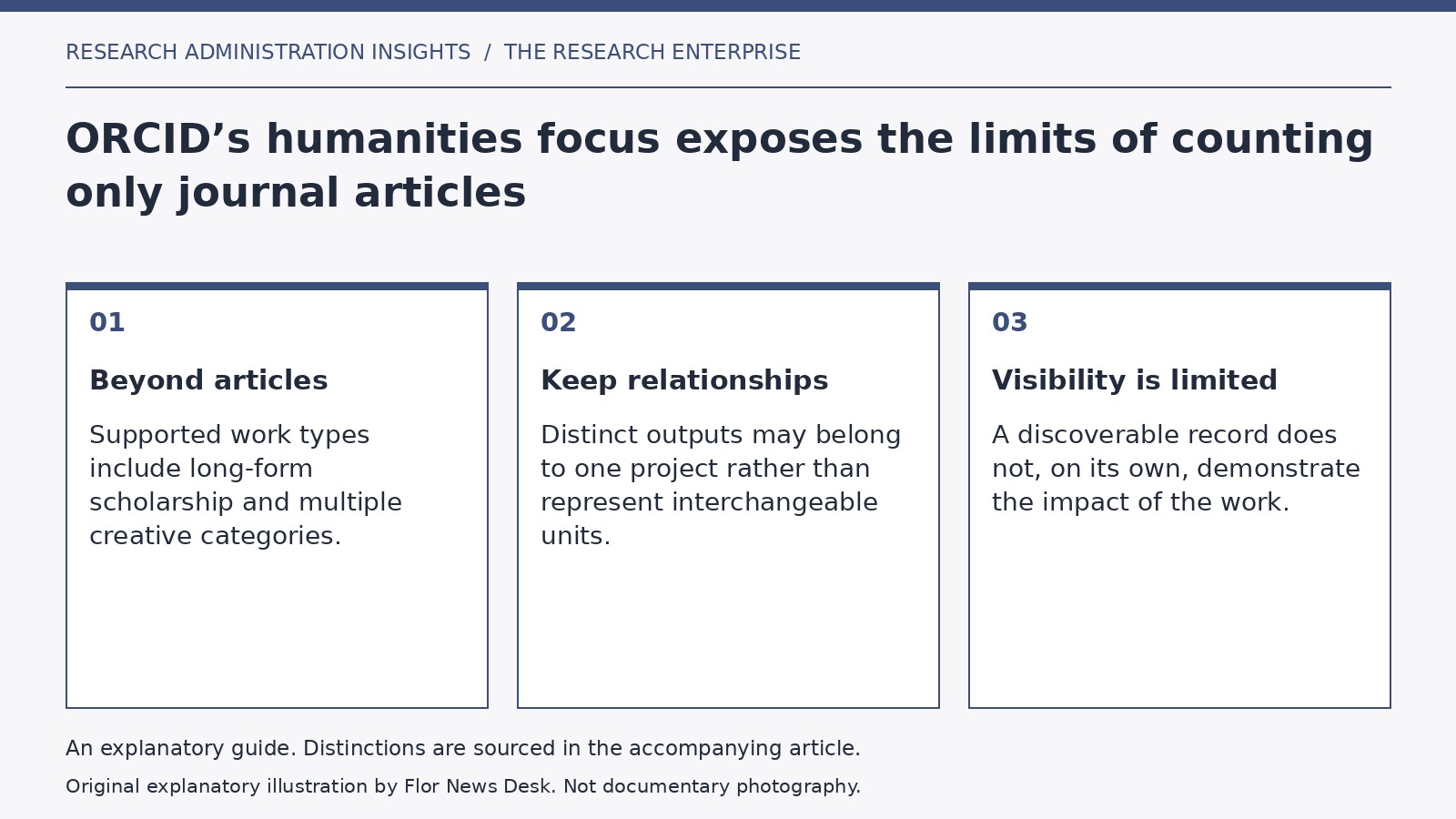
ORCID’s supported work types include books, chapters and creative categories such as designs, images and musical compositions. Its documentation notes that some types require newer API support. An institution cannot infer from the presence of a category in the public interface that every local integration preserves that category correctly. The data model and the actual import route both matter.
A richer record can still be a poor count
Consider a hypothetical project producing an exhibition, a catalogue and a recorded discussion. Recording only the catalogue would omit part of the contribution. Counting all three as equivalent units would create a different distortion. The appropriate interpretation depends on what the assessment is trying to understand and how the outputs relate to one another.
A sensible record design could preserve the distinct output types while also explaining their relationship. That would allow an evaluator to see a portfolio rather than an unexplained total. It would not settle the artistic or scholarly merit of the project. This is a proposed use of structured records, not evidence that any named institution has adopted this exact approach.
Test what survives the journey
For administrators, a practical test is to follow a small, consented sample from its source record through the local reporting system. Does a creative output retain its type, title and attribution? Does a contribution disappear because the destination accepts only familiar publication categories? Is an absent field being interpreted as no activity?
Those questions turn a broad commitment to recognizing diverse scholarship into a checkable workflow. They also keep visibility separate from impact. A well-linked record can help someone find and understand a contribution; it cannot alone establish who used the work, what changed as a result or how much weight it deserves in an assessment. Those conclusions need evidence suited to the claim.