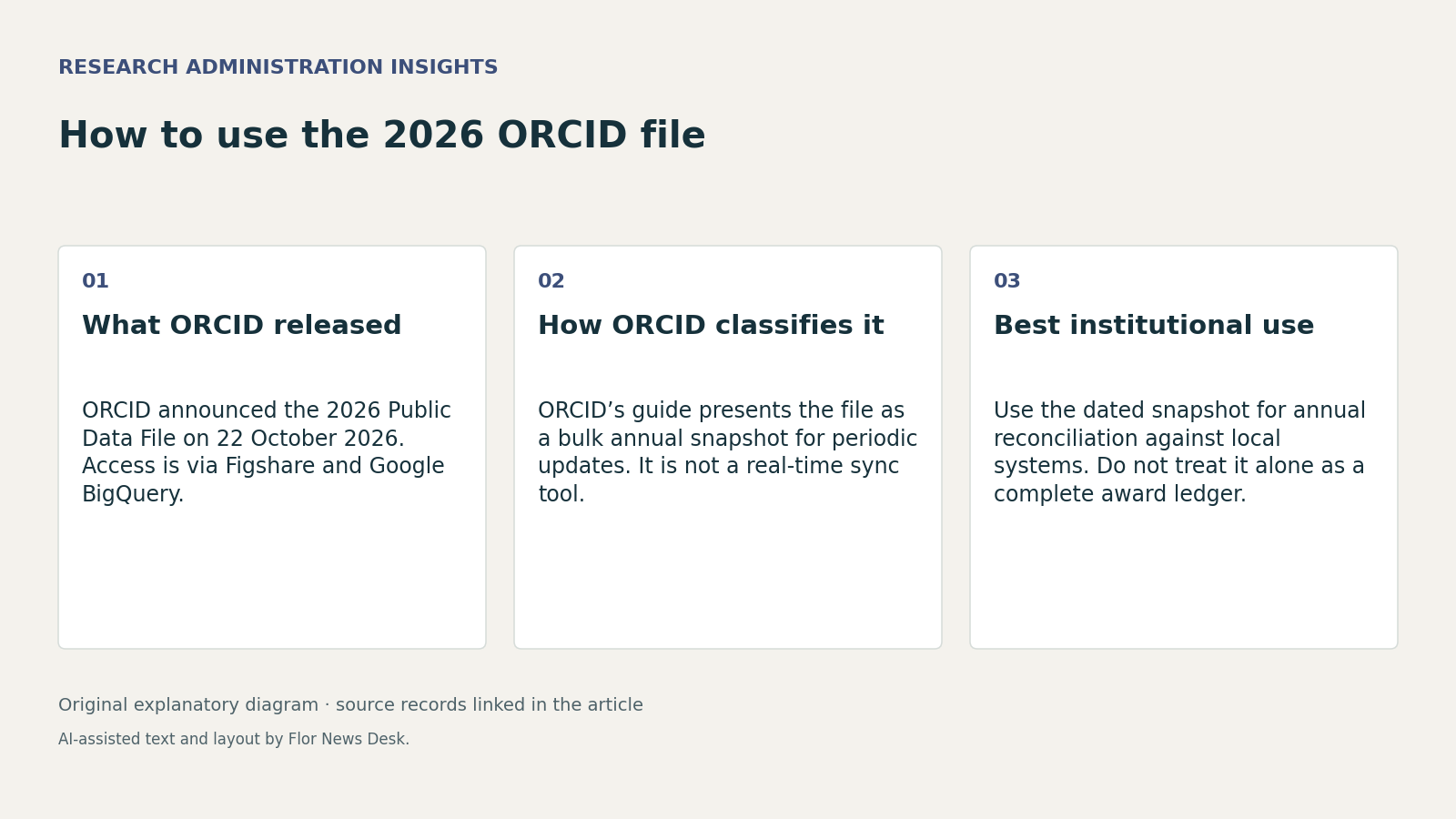
ORCID’s release of its 2026 Public Data File on 22 October 2026 creates a new annual checkpoint for research offices that want to test their ORCID-linked records in bulk. The immediate institutional value is not that ORCID has become a live grants-monitoring system. It is that ORCID now offers a dated public snapshot through Figshare and Google BigQuery, and ORCID ties that release to a principle of free download in standard formats under CC0, subject to researchers’ privacy settings. ORCID Public Data File announcement
That distinction matters because ORCID’s own synchronization guide separates the public data file from other access routes. ORCID says webhooks, the Lambda file, and Public Data Sync are premium services, while the search API is freely available for finding records modified since a chosen date. By contrast, the public data file is described as a bulk annual snapshot for periodic updates. Research offices should therefore read the 2026 release as a tool for scheduled reconciliation or quality assurance, not for day-to-day monitoring of record changes. Synchronizing with ORCID
A practical first use is institutional rather than researcher-facing: preserve the 22 October 2026 snapshot date in local ingest notes, map only the fields your systems can actually compare, and check how many locally held ORCID iDs resolve to public records in the file. That follows directly from the source record’s two strongest facts: the file is bulk-accessible, and its scope is limited by public visibility. Analysis: a dated snapshot is most useful when an institution can later explain which version it tested and why an apparent gap might reflect privacy settings rather than a failed identity match. ORCID Public Data File announcement Synchronizing with ORCID
The funding implication is narrower than the bulk-access headline may suggest. The ORCID announcement does not provide a schema, field list, completeness measure, or any evidence that a university could treat the file alone as a full award register. ORCID’s announcement frames the release around public data availability, and the synchronization guide frames it around periodic bulk processing. That makes the 2026 file well suited to gap-finding, but not sufficient as standalone compliance evidence for award attribution or grant reporting. ORCID Public Data File announcement Synchronizing with ORCID
Cross-platform checks are still worth doing, but the dates in the source record limit what can be claimed. On 27 April 2026, Crossref said its funder-name matching project had reached a first production deployment and reported 0.9897 precision and 0.8094 recall from a manually labeled set of 3,505 funder names. The same post says that evaluation used a July 2025 snapshot containing 25.7 million funder entries across 12.4 million works, and that applying the approach across current and future funder data was the next milestone. Those are promising results, but they do not establish complete 2026-wide reconciliation of funder metadata. Crossref funder-matching post
For research offices, the operational conclusion is straightforward: use the ORCID file as a fixed annual comparison point against internal CRIS, repository, or grants systems, then document every mismatch before any reporting rule depends on it. If ORCID-linked records and separate funder metadata align, that strengthens confidence in local identifiers. If they diverge, the source record here cannot show whether the cause is privacy, timing, incomplete public data, or a metadata-matching miss. The first ingest should be run as an audit exercise, not as proof. ORCID Public Data File announcement Synchronizing with ORCID Crossref funder-matching post