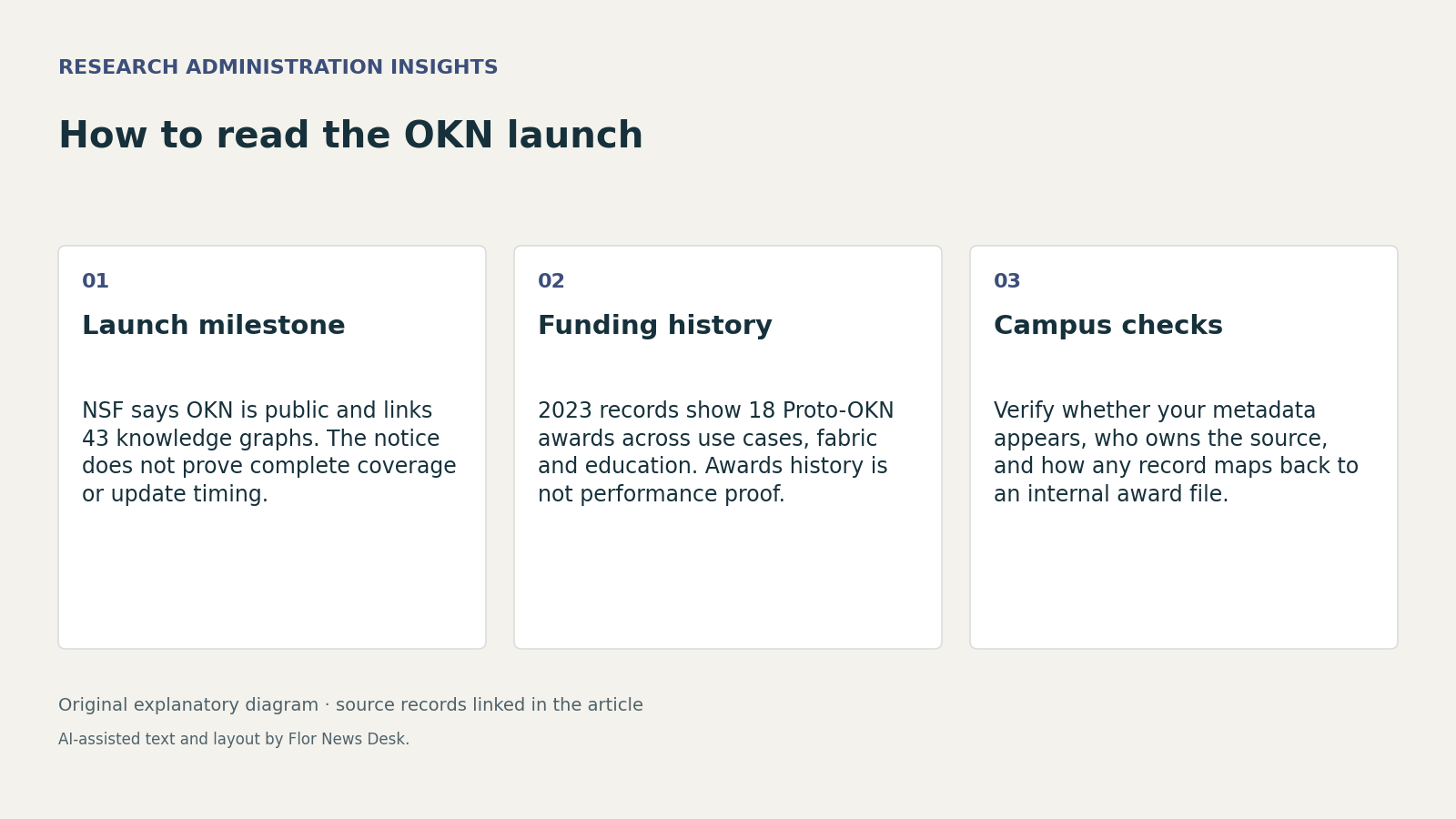
NSF’s September 25, 2026 launch of the Open Knowledge Network changes one immediate fact for research offices: a federally backed knowledge-graph platform is now publicly available, but the public record still does not show what any single campus is in it, how complete it is, or whether it can stand in for award reporting. NSF said the Open Knowledge Network was available for public use at okn.us and linked 43 knowledge graphs with tens of billions of connected facts; the NSF Directorate for Technology, Innovation and Partnerships timeline separately records September 25, 2026 as the launch milestone. NSF launch notice NSF TIP timeline
What that announcement proves is narrower than the scale claims around it. NSF attributes the platform to its Prototype Open Knowledge Network effort and says federal partners and cross-sector collaborations helped build it. But the same launch page does not document coverage completeness, update frequency, service terms, access controls, campus reporting obligations, or whether any particular institution’s datasets are included. The timeline page adds chronology, not operating detail. For administrators, that makes OKN a new discovery layer first, not an authoritative compliance system. NSF launch notice NSF TIP timeline
The programme history helps explain why caution is sensible. NSF’s archived Proto-OKN solicitation in 2023 divided work across three tracks: use cases, shared technical fabric, and education/public engagement, with estimated award numbers and funding ceilings rather than delivered outputs. NSF then announced 18 awards totaling $26.7 million on September 26, 2023 across those tracks. That is evidence of funded development and a clear lineage to the 2026 launch, but not evidence that every proposed capability, collaboration or data flow became a stable production feature. Proto-OKN solicitation 2023 NSF awards announcement
The first practical check, then, is simple: verify discoverability before anyone treats OKN presence as institutional visibility. Because NSF describes the network as a federation built from publicly available data, campuses should confirm whether their datasets or metadata actually appear and how they are represented. If a record is missing, duplicated or context-poor, the launch materials do not say how corrections are handled or how quickly updates appear. NSF launch notice Proto-OKN solicitation
Second, separate discoverability from permission. The solicitation says the prototype used publicly available data, but neither the archived funding page nor the 2026 launch notice sets out reuse terms or provenance rules for any specific institutional content. That gap matters if staff are asked whether material surfaced through OKN can be re-used, harvested or linked onward without checking the underlying source conditions. The public record supports asking those questions; it does not answer them. Proto-OKN solicitation NSF launch notice
Third, keep award administration distinct from graph visibility. NSF’s public pages do not say that an OKN record maps cleanly to an institutional award file, satisfies sponsor reporting, or carries all metadata needed for compliance. Research offices that choose to engage should therefore test whether any OKN-facing record can be matched back to an internal award number, source dataset and responsible steward before using it in reporting workflows. NSF launch notice NSF TIP timeline
Finally, review sensitive-domain assumptions before promising open access. NSF says the network spans areas including health, justice and national security, yet the public pages do not specify access controls. That does not prove controlled institutional data are exposed. It does mean offices should know who will answer OKN questions and who will review provenance or correction concerns. As of November 10, 2026, the public record supports a launch milestone and a funding lineage. It does not yet support broad claims about complete campus coverage, reporting substitution or settled governance. NSF launch notice 2023 NSF awards announcement