India’s possible association to Horizon Europe has moved far enough in the public EU record to matter for consortium planning, but not far enough to treat Indian organisations as already eligible beneficiaries.
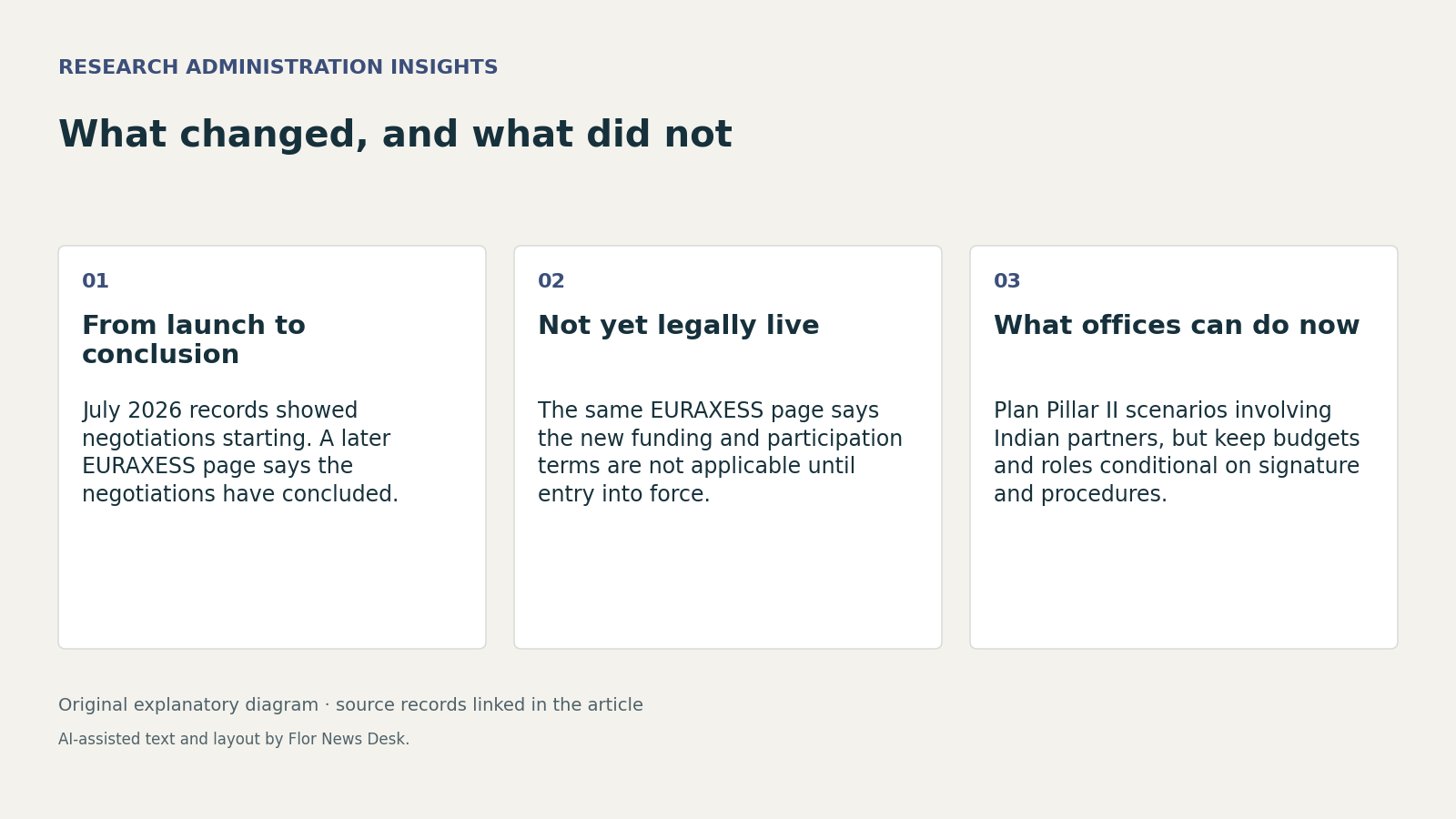
The clearest operational point comes from a EURAXESS India page stating that the European Commission and India have concluded negotiations on India’s association to Horizon Europe and that, after signature of the agreement and completion of procedures on both sides, eligible participants in India would be able to access Horizon Europe funding directly for eligible research and innovation activities. The same page says eligible Indian participants would be able to lead collaborative projects under Pillar II, “Global Challenges and European Industrial Competitiveness,” but also says those new arrangements are not yet applicable until the agreement enters into force. It further says association is envisaged for January 2027. EURAXESS India summary
That is a meaningful shift from the earlier July 2026 position. A European Commission digital policy page on the third EU-India Trade and Technology Council said the parties had agreed to start formal negotiations on India’s association to Horizon Europe, with the aim of concluding them before the end of 2026. In other words, the July record established only the launch and intended timetable for talks; it did not establish signature, entry into force, or funding eligibility. European Commission digital policy page
For research offices, the practical distinction is between a negotiated outcome and a live programme status. The EURAXESS page supports internal scenario planning because it signals the direction of travel: direct Horizon Europe funding for eligible Indian participants and potential coordinator status in Pillar II. It does not, on this record, establish that proposal systems, call texts or Participant Portal eligibility settings have already changed. It also does not provide the signed legal text, a call-by-call scope list, or confirmed retroactive application. Those are not minor paperwork details; they determine whether a planned Indian partner should be budgeted as an expected beneficiary or handled under the pre-association position.
A sensible immediate check is therefore limited and conditional. Teams building 2027 collaborations can identify any Pillar II bids where an Indian organisation’s role would change materially if direct funding and coordinator eligibility take effect. They can also flag proposals whose workshare, budget structure or consortium leadership assumptions depend on that change. But the same teams should keep a second version of those plans until the signature and procedural steps mentioned by EURAXESS are complete. That is analysis, not a claim about current legal status.
The timeline in the available record supports that cautious approach. EURAXESS says exploratory discussions began on 6 February 2026 and formal negotiations began on 17 July 2026, while the July Commission page described conclusion before the end of 2026 as an objective rather than an accomplished fact. As of 13 November 2026, the available sources therefore show progress toward association, not final implementation. EURAXESS India summary European Commission digital policy page
The immediate administrative lesson is narrow but useful: prepare for a possible January 2027 eligibility change, especially in Pillar II, while treating signature, completion of procedures and entry into force as separate gates. Until a signed agreement or updated programme records are available, institutions have evidence of intended access and leadership rights for eligible Indian participants, but not evidence that those rights are already operational. That distinction should shape proposal advice over the next several weeks.