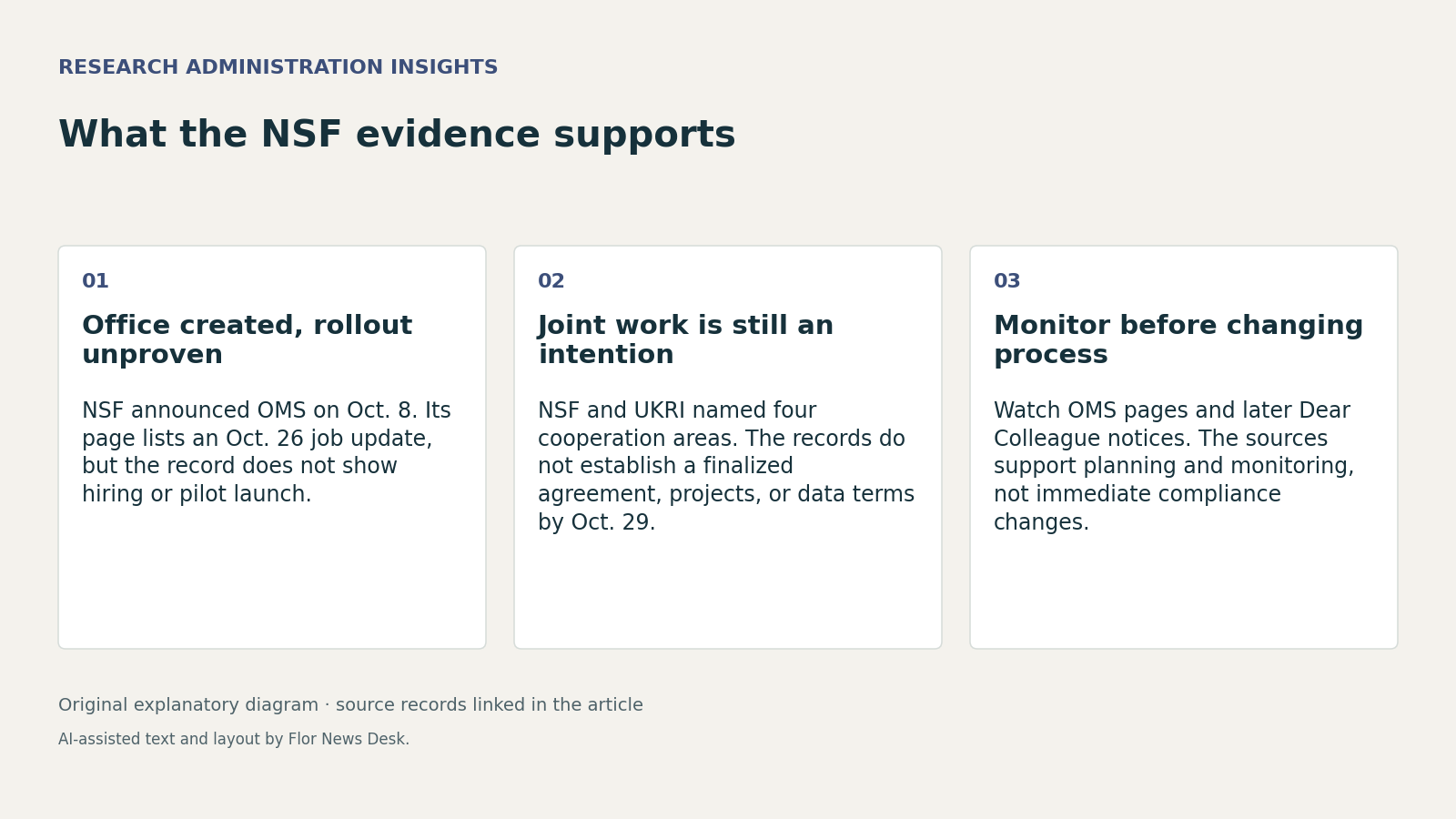
NSF moved its metascience effort from a leadership idea to a named internal unit on October 8, 2026, when it said it was establishing an Office of Metascience. By the records available as of October 29, 2026, NSF’s Office of Metascience page presented OMS as part of the Office of the Director and carried an updates item dated October 26, 2026 for an office-head job opportunity. That is a concrete institutional change, even if the reviewed records do not show a completed hire, a budget line, or a live pilot yet. (October 8 NSF announcement; OMS page)
The policy area itself is broader than one programme. In the NSF–UKRI metascience statement, the agencies described metascience as using scientific and analytical methods to study how science and technology systems are funded, practiced, and organized. They said they intended to explore cooperation on research productivity and impact, review and funding, use of new methods and tools, and responsible analysis of relevant data. Read alongside the OMS page, that places the new office in the machinery of research administration rather than in a single disciplinary portfolio.
For research offices, the practical distinction is between establishment and implementation. The sources support three implemented facts: NSF announced OMS on October 8, 2026; NSF now presents it as an Office of the Director component; and NSF says the office will share experiments and findings publicly. The same sources do not establish application deadlines for the office-head role, staffing levels, pilot procedures, changes to merit review, or any measured effect on proposal handling. Administrators should treat those gaps as real, not as details that can be inferred away. (October 8 NSF announcement; OMS page)
The office also appears tied to a wider NSF management shift announced before October 8. In a September 10 Dear Colleagues message, NSF leadership said the agency was adopting a portfolio approach, broadening who carries out NSF-supported work, and using a new Office of Metascience to assess which initiatives should expand and which should end. Analysis: that makes OMS look less like a symbolic label and more like an internal testbed for agency-wide changes. But the same September record only promised later Dear Colleague Letters, announcements, and funding opportunities in the following weeks and months. As of October 29, the reviewed documents do not establish which of those later steps, if any, have happened. (September 10 Dear Colleagues message; October 8 NSF announcement)
The NSF–UKRI statement strengthens that interpretation, but only as a statement of intent. It refers to a partnership between the NSF Office of Metascience and the UK Metascience Unit and says the agencies intended to formalize collaboration in coming months. That language matters because it suggests OMS is meant to operate beyond one domestic workflow question. It does not prove that a formal agreement, joint project, or data-sharing arrangement existed by October 29. (NSF–UKRI metascience statement)
For administrators, the immediate takeaway is to monitor OMS as an operational node, not to rewrite compliance processes in advance. The sourced record supports watching the OMS page and later NSF notices for any actual experiments in review, funding, or portfolio evaluation. It also supports basic internal readiness work around governance for any future participation in metascience analysis, because responsible use of relevant data is explicitly named in the NSF–UKRI agenda. What the record does not yet support is any claim that NSF has already changed core proposal rules. (OMS page; NSF–UKRI metascience statement)