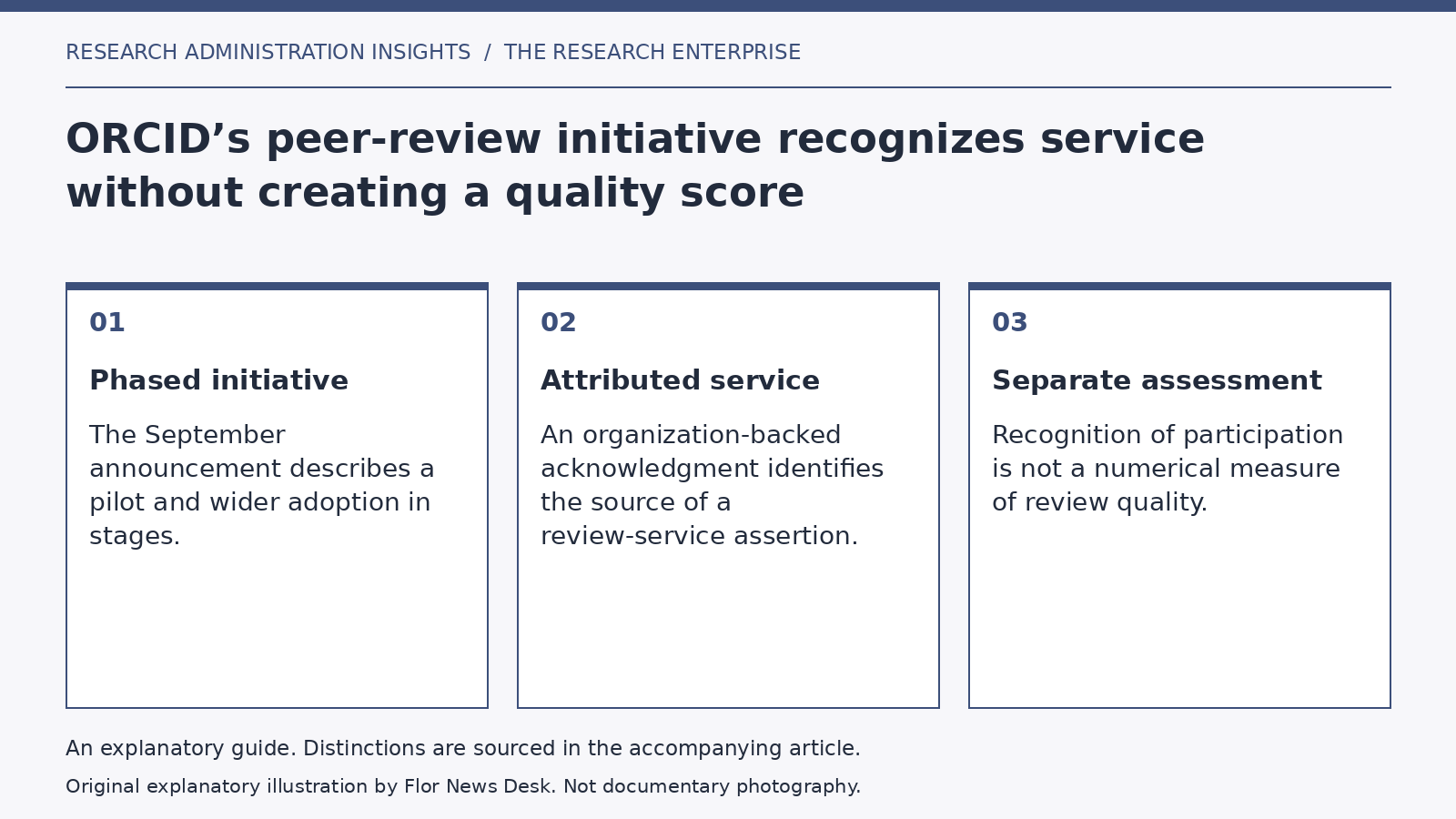
ORCID announced a Peer Review Recognition initiative on September 15 with several large publishers, describing a phased effort to expand publisher-backed acknowledgments of reviewing. The announcement is about making an existing contribution more visible and portable. It is not a published ranking of reviewers or proof that every publisher has already adopted the proposed workflow. ORCID’s initiative outline distinguishes the pilot from wider future adoption.
The existing peer-review workflow guidance describes authenticated researcher identifiers, permission to update a record and acknowledgments added by member organizations. The peer-review section is not populated by individuals simply typing in their own review claims. That gives a reader information about the source of an assertion. It does not, by itself, reveal how demanding the review was or how much its recommendations improved a manuscript.
Service records and evaluation records
A research office could use a portable acknowledgment to reduce repeated requests for proof that someone contributed reviewing service. It would still need a separate approach to evaluating that contribution. Counting acknowledgments alone cannot explain differences in assignment scope, disciplinary practice or the complexity of a particular report. These are limits of the count as an inference, not accusations about the participating publishers.
A useful institutional display would therefore retain the asserting organization and the type of activity rather than collapse everything into a single unexplained score. Where confidentiality applies, recognition should not be treated as permission to disclose a manuscript or identify an otherwise anonymous review. The intended use of the record matters as much as its availability.
Do not turn the rollout into a completed event
The announcement discusses implementation in stages. Administrators assessing an integration should ask what actually operates in their system, which permissions a researcher has granted and what fields are returned. They should not assume that a planned broader model has replaced every existing permission flow.
The initiative offers a practical opportunity to recognize work beyond authorship. Its value is clearer when a service acknowledgment remains precisely that: an attributed record of participation. Decisions about promotion, grants or research quality require their own criteria, rather than an unsupported leap from a visible marker to a judgment of excellence.