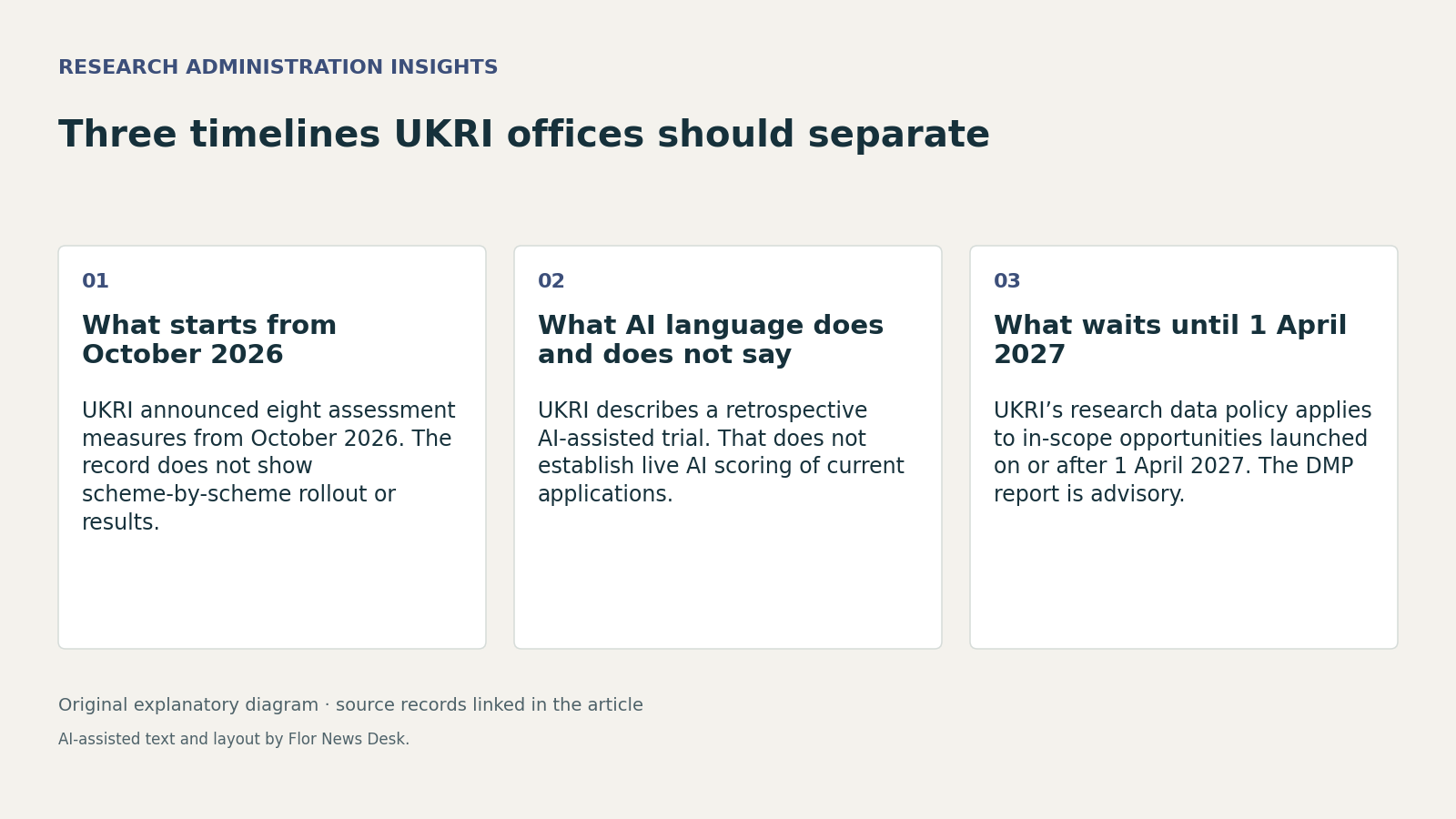
UK Research and Innovation’s 10 September 2026 grant-assessment package creates an immediate administration problem: institutions now know the reform menu, but not yet the call-by-call map. UKRI said it would bring together eight measures from October 2026 and cut grant processing times by at least 50% by 2031, yet the announcement page available on 24 October 2026 does not identify which opportunities were already using which measures or with what results (UKRI news, 10 September 2026). For research offices, that means local guidance should start with verification, not assumption.
The operational significance is that UKRI has moved beyond general discussion into specific levers that can alter submission and assessment workflows. According to UKRI, those levers include more demand management for selected high-volume opportunities, staff triage including desk rejection, wider use of Distributed Peer Review for suitable high-volume opportunities, weighted multi-criteria assessment trials, more flexibility for Programme Directors and Opportunity Leads, and in-person verification for higher-risk awards (UKRI news, 10 September 2026). The practical reading is not that every applicant faces every rule, but that pre-award teams may need different intake checks depending on the scheme.
That distinction matters because the source record does not establish implementation status at scheme level. A central research office can therefore justify three immediate actions from the evidence alone: track whether a call is named for demand management or Distributed Peer Review; update applicant communications so staff triage and verification are possible outcomes where UKRI specifies them; and keep records of which advice was based on a published call document rather than the September umbrella announcement. Those are procedural safeguards against overgeneralising from a strategic statement.
The AI point also needs careful handling. UKRI said it would begin with a retrospective AI-assisted assessment trial with the UK Metascience Unit and would keep expert human judgement central (UKRI news, 10 September 2026). That is materially different from saying live applications are being machine-scored or that assessors may rely on generative AI without further rules. As analysis, the safest institutional response is to prepare governance questions now, such as recordkeeping and communications, while avoiding any statement that AI is already part of live decision-making unless a specific funding opportunity says so.
UKRI’s own framing also argues for equality monitoring before local processes harden. The announcement says UKRI will watch equality, diversity and inclusion effects while expanding tools such as triage and Distributed Peer Review (UKRI news, 10 September 2026). Because those tools can change who gets filtered out early and who is asked to review, institutions have a sourced reason to log participation and outcomes for any call that adopts them, even though the announcement provides no results data yet.
Research offices should also resist folding separate October publications into the same compliance deadline. UKRI’s research data policy was published on 14 October 2026, but its summary page says it applies to in-scope opportunities launched on or after 1 April 2027, while earlier opportunities remain under existing guidance and council policies (research data policy). On the same date, UKRI published an independent report on a pan-UKRI approach to data management plans, but that page presents findings and recommendations, not an adopted mandate or timetable (data management plans report page).
The useful administrative conclusion is narrow but important. October 2026 brings a confirmed assessment-reform package with unresolved call-level details; 1 April 2027 is the stated start point for a separate data-policy regime on in-scope opportunities; and the data-management-plan work remains advisory on the record currently available. Treating those as one blended reform would make local guidance faster to write, but less accurate.