The U.S. National Science Foundation’s full-proposal deadline for NSF 26-513: U.S. National Science Foundation State and Regional Artificial Intelligence Infrastructure Hubs: Expanding Access to Compute for Scientific Discovery (AI Infrastructure Hubs) falls at 5 p.m. local time on November 4, 2026, and the administrative burden is more specific than a standard narrative submission. NSF identifies the anticipated award instrument as a cooperative agreement, but the solicitation also says consortia, not NSF, must fund the computing, data and related AI resources the hubs will rely on. That combination turns the final pre-deadline task into documentation of commitments and control, not only scientific vision. NSF solicitation
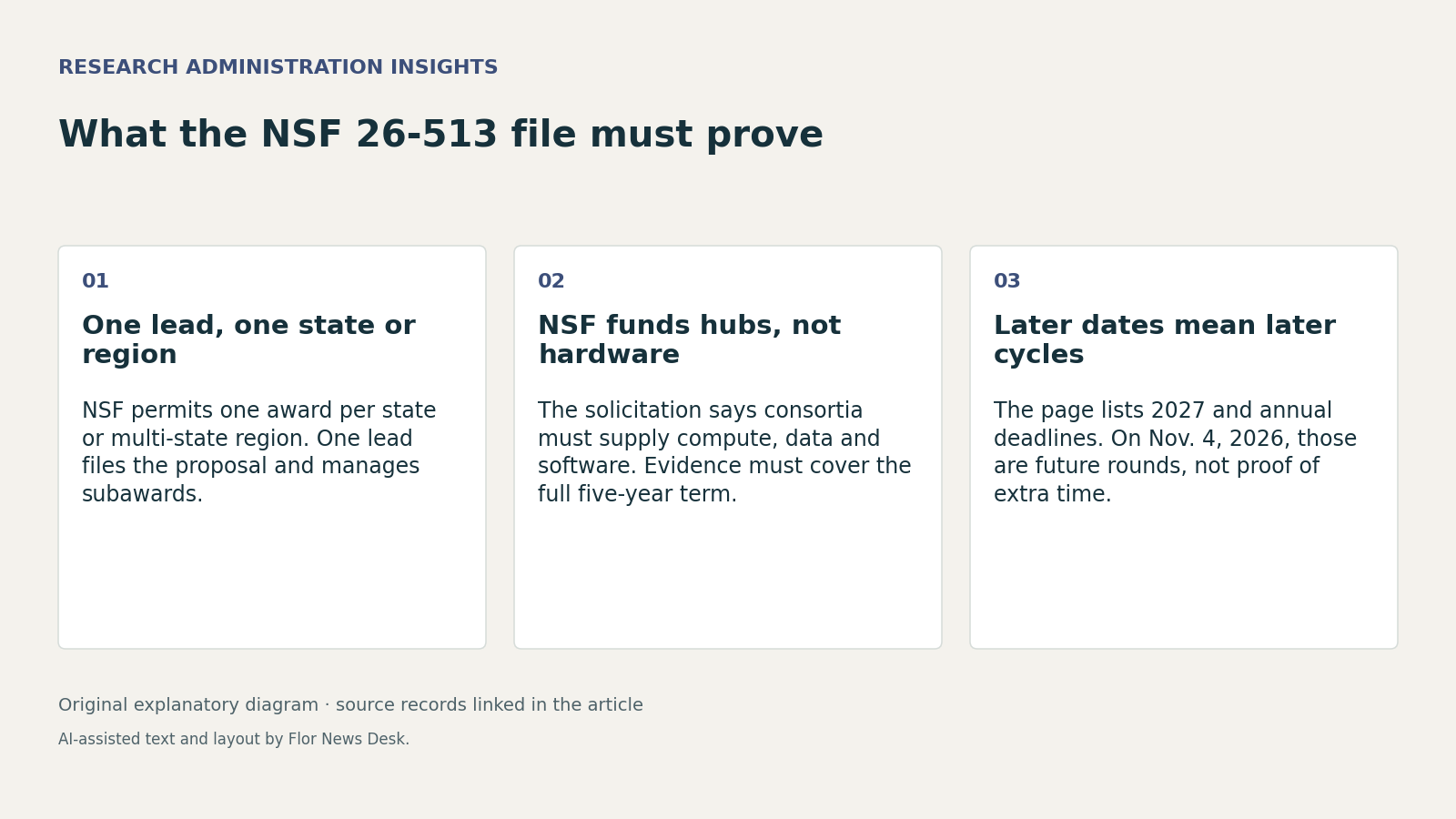
The first pressure point is consortium structure. NSF says only one award will be made per state or multi-state region, and collaborative proposals cannot be filed as separate simultaneous submissions seeking separate awards; they must come in as one proposal, with subawards administered by the lead organization. NSF solicitation For research offices, that means the immediate risk is not only review failure. It is also a fragmented state or regional effort that cannot fit the submission mechanics NSF has chosen. Lead institutions therefore need clear authority from partners before filing, because the proposal package itself must reflect a settled lead-and-subaward model.
The money language matters too, but only within the limits of the source record. The solicitation estimates 10 awards in an award cycle, gives an anticipated funding range of $40 million to $100 million, says approximately $100 million is available for the program, and states that typical hub proposals should request $4 million to $12 million over five years. NSF solicitation NSF’s August 4, 2026 announcement separately described the program as a $100 million initiative that would initially support up to 10 hubs. NSF announcement Those statements support planning ranges, not proof that any consortium will receive a particular amount or that the full top-line has already been obligated.
The most consequential requirement for administrators is that NSF says it does not fund acquisition of AI infrastructure, including computing, data, software, networking, storage, cloud services or other AI systems or services. The solicitation says proposers should provide evidence such as letters of commitment or vendor quotes showing support for compute resources for the full five-year award period. NSF solicitation In practice, that makes external resource evidence part of proposal compliance. A polished project description will not substitute for documentation showing where capacity comes from and how long it will remain available.
The August 4 announcement adds useful context, but not a shortcut. NSF said it intends the program to expand access to compute, data and other AI resources through state and regional partnerships, and said several private-sector and philanthropic organizations intend to support participants. NSF announcement The same announcement says NSF’s role is to fund coordination, workforce development and faculty training, while consortia leverage outside contributions. NSF announcement That supports a practical reading of the solicitation: named supporters in a news release are not the same as executed commitments in a proposal file.
Governance is the other document set that research offices cannot treat as decorative. NSF calls for documentation of consortium governance and participating institutions, and encourages a one-page support letter from a senior administrator or state leadership. NSF solicitation Because NSF says the hubs are meant to organize state or regional access to AI resources rather than purchase those resources directly, governance records do real evidentiary work: they show who can make operating decisions, who controls subawards and who stands behind the non-NSF contributions.
One timing caution remains. The solicitation page lists November 3, 2027 and the first Wednesday in November annually thereafter as later deadlines. NSF solicitation As of November 4, 2026, those are future program cycles, not evidence that the 2026 deadline is flexible or that an incomplete consortium can roll forward unchanged. The source record here establishes a live same-day deadline and the documents needed to meet it, but not any rescue path for proposals that are still missing partners, subaward terms or five-year compute commitments.