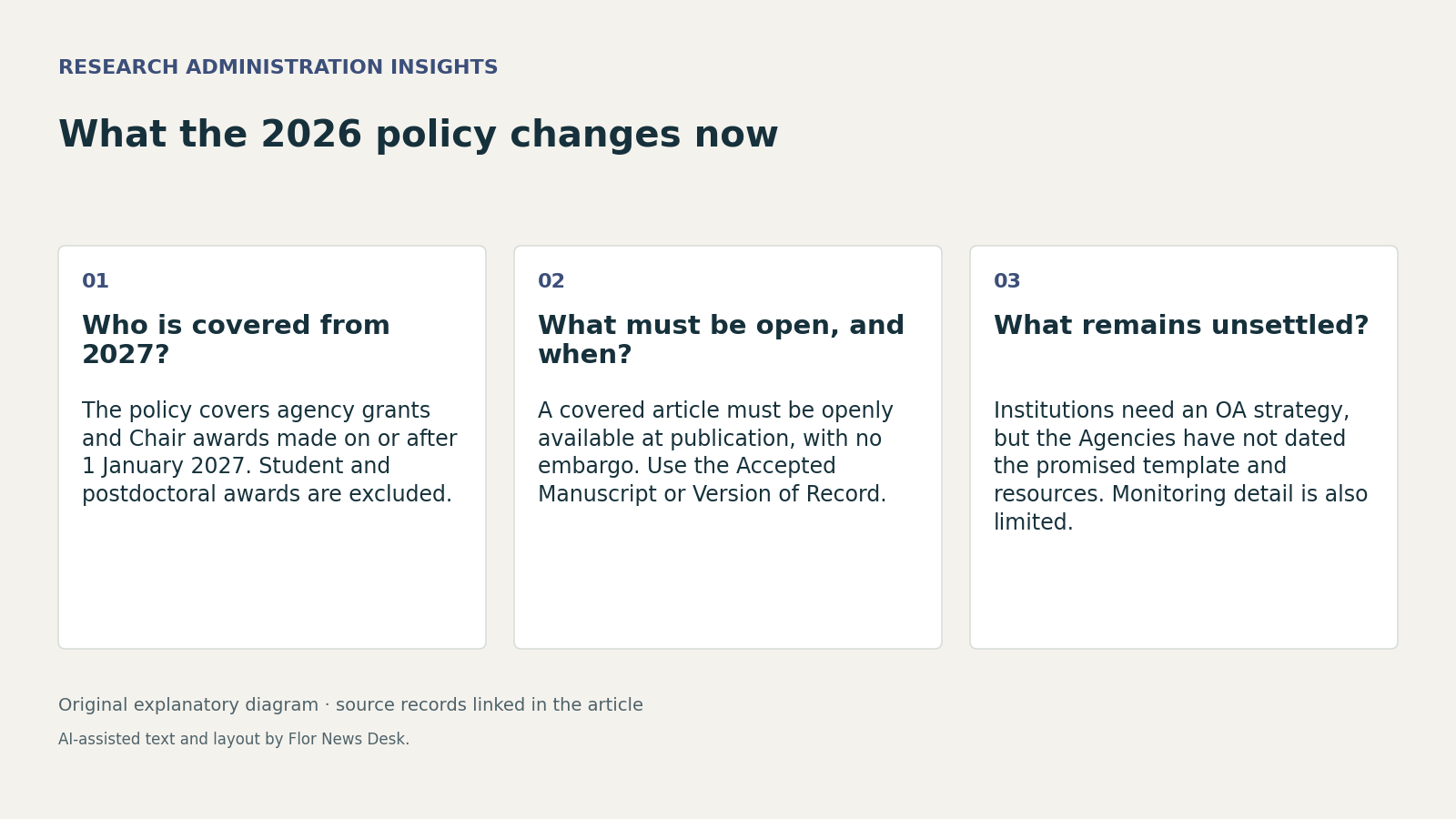
Canada’s revised Tri-Agency open-access policy creates a hard compliance point at publication, not a later repository clean-up step. The policy page, which shows a modification date of 5 October 2026, says it applies to CIHR, NSERC and SSHRC grants and Chair awards made on or after 1 January 2027. It covers peer-reviewed research articles arising in whole or in part from those awards, including awards administered by the Tri-agency Institutional Programs Secretariat, and it excludes student and postdoctoral awards and fellowships. Policy text
The immediate operational consequence is straightforward: institutions cannot treat compliance as something authors can fix after a publisher embargo ends. The policy requires each covered article to be openly available with no embargo at the time of publication, either in a Canadian institutional repository or through a trusted Canadian platform, and it permits either the Accepted Manuscript or the Version of Record. It also requires acknowledgment of the funder, including the agency name and a funding reference number such as an FRN or Application Number; the guidance adds any applicable persistent identifiers. Policy text Guidance and FAQ
That makes rights retention the pressure point before submission, not after acceptance. The guidance says authors must retain rights over covered articles and apply an open licence to the Version of Record where publisher agreements allow, or otherwise to the Accepted Manuscript; it also provides sample language for notifying journals of the author’s obligations. The Agencies’ public letter to publishers asks for contracts that let authors share accepted manuscripts openly and without embargo, and asks publishers to disclose the licence on the Version of Record and any publication fees at submission. But that letter is a request, not evidence that publishers have already changed agreements or submission systems. Research offices therefore need standard author instructions and an escalation path for disputed terms before 1 January 2027. Guidance and FAQ Letter to publishers
The “trusted Canadian platform” route also needs testing, not assumption. The guidance says repository deposit is unnecessary when an article is openly available at publication through such a platform, and it gives examples including Érudit, Scholars Portal Journals, Canadian academic library journal hosting platforms and the Public Knowledge Project’s Publishing Services. The FAQ adds an important limit: only journals hosted on PKP servers in Canada qualify on that point; using Open Journal Systems software by itself does not. The same guidance notes that its examples are not a complete authoritative list. For administrators, the practical issue is classification: a locally hosted journal may use familiar software but still need repository deposit if it does not meet the Canadian-hosting condition. Guidance and FAQ
Institutions also have a second track to plan: policy governance. The policy requires each eligible postsecondary institution and research hospital to develop and publicly post an institutional open-access strategy within two years after agency guidance and supporting resources are made available. However, the public record does not give a release date for the promised template or other implementation resources. That means institutions can start drafting now, but they should not present 5 October 2026 as a confirmed start date for the two-year clock unless the Agencies later say so. Policy text Guidance and FAQ
As of 19 October 2026, the remaining uncertainty is mostly about administration, not the core rule. The policy says the Agencies will monitor compliance and may act under the Tri-Agency Framework: Responsible Conduct of Research, while the FAQ says they plan to report aggregate open-access performance data rather than article-level results on that page. Separately, the CIHR Project Grant Program page lists January 2027 decision milestones for the Fall 2026 competition, but it does not define what counts as the award date for this policy. Research offices should therefore avoid inferring coverage from competition calendars alone and focus first on rights-retention language, repository ingest checks and award-identifier capture. Policy text Guidance and FAQ CIHR schedule page