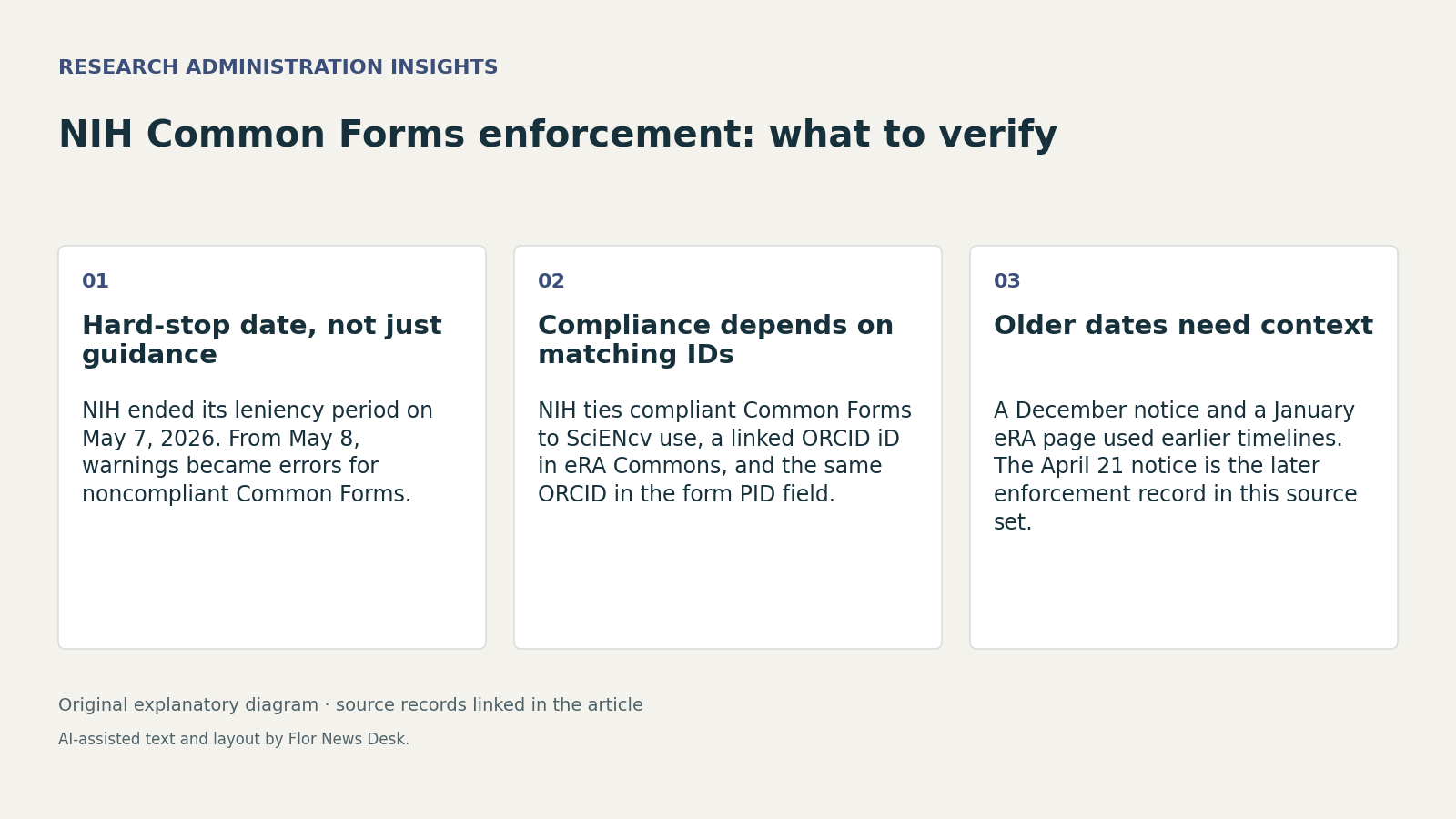
NIH’s April 21, 2026 enforcement notice changed Common Forms from a guidance issue into a submission-control issue. NIH said its leniency period would end on May 7, 2026, and that, from May 8, 2026, system warnings would become errors for applications, Just-in-Time materials, Research Performance Progress Reports, and Prior Approval submissions that did not use compliant Common Forms.NIH enforcement notice That matters more than the older December 2, 2025 rollout notice, which had set earlier January and February milestones that NIH later adjusted.Initial implementation notice As of 2026-10-20, this source set supports the announced enforcement date, not a measured count of blocked submissions.NIH enforcement notice
The practical issue for research offices is that NIH defines compliant submission around a chain of matched records, not a single form upload. NIH said individuals submitting Common Forms must use SciENcv, obtain an ORCID iD, link that ORCID iD to eRA Commons, and make sure the same ORCID appears both in the form’s Persistent Identifier field and in the eRA Commons profile associated with the username entered in the application Credential field.NIH enforcement notice NIH’s investigator accounts guidance repeats that all individuals who must complete the Common Forms, including all senior/key personnel listed on an application, must have an ORCID iD linked to their eRA Commons Personal Profile.NIH accounts guidance The administrative implication is that an ORCID iD by itself is not the control point; identity consistency across SciENcv, the form, and Commons is.
The affected population is broader than principal investigators. NIH’s accounts page says all PD/PIs, senior/key personnel, other significant contributors, and other individuals named on the R&R Senior/Key Personnel form require Commons IDs, and that trainees, scholars, and participants appointed to institutional training and research education awards must have ORCID iDs linked to eRA Commons at the time of appointment.NIH accounts guidance That means an institution that limits outreach to proposal teams could miss a second compliance front in appointment and training workflows.
Research administrators should also read the January timeline carefully. NIH’s December 2 notice said the Common Forms and NIH Biographical Sketch Supplement would be required for due dates and post-submission workflows on or after January 25, 2026, and it described a warning-to-error conversion by February 6, 2026.Initial implementation notice A separate eRA page described a release scheduled for January 26, 2026 that would update JIT, RPPR, and a Prior Approval request to use person-level attachments, and it warned that some initiated but unsubmitted records would need to be redone.eRA changes page Because that page uses scheduled-future wording and the later April 21 notice reset the NIH-wide enforcement date to May 8, those January statements are best treated as historical expectations, not proof of final implementation status.NIH enforcement notice
From those records, a sensible local control plan follows. First, identify every upcoming application, RPPR, JIT, Prior Approval action, and training appointment that requires a Common Form or related identity setup.NIH enforcement notice NIH accounts guidance Second, verify that each required person has a Commons ID and a linked ORCID iD. Third, compare the ORCID shown in SciENcv-generated materials with the Commons profile. Fourth, test the person-level upload path in the relevant module, because NIH said RPPR, JIT, and Prior Approval now accept attachments by individual rather than as one flattened file.NIH enforcement notice eRA changes page Fifth, adjust onboarding and appointment checklists, since NIH ties ORCID linkage to the appointment point for certain trainees.NIH accounts guidance
The March 25, 2026 revised NIH Grants Policy Statement notice is useful background, but not the operational source to run this control from. NIH said that version incorporated policies in effect as of March 17, 2026 and that NIH would continue issuing interim changes through Guide notices and Federal Register notices.NIHGPS publication notice For administrators, the lesson is straightforward: keep policy manuals for baseline rules, but anchor Common Forms enforcement calendars and ORCID setup checks to the later April 21 notice and the relevant system guidance. The public record here does not establish post-May failure volumes or how any related error surfaced in Grants.gov, so those are points institutions still need to verify locally.NIH enforcement notice