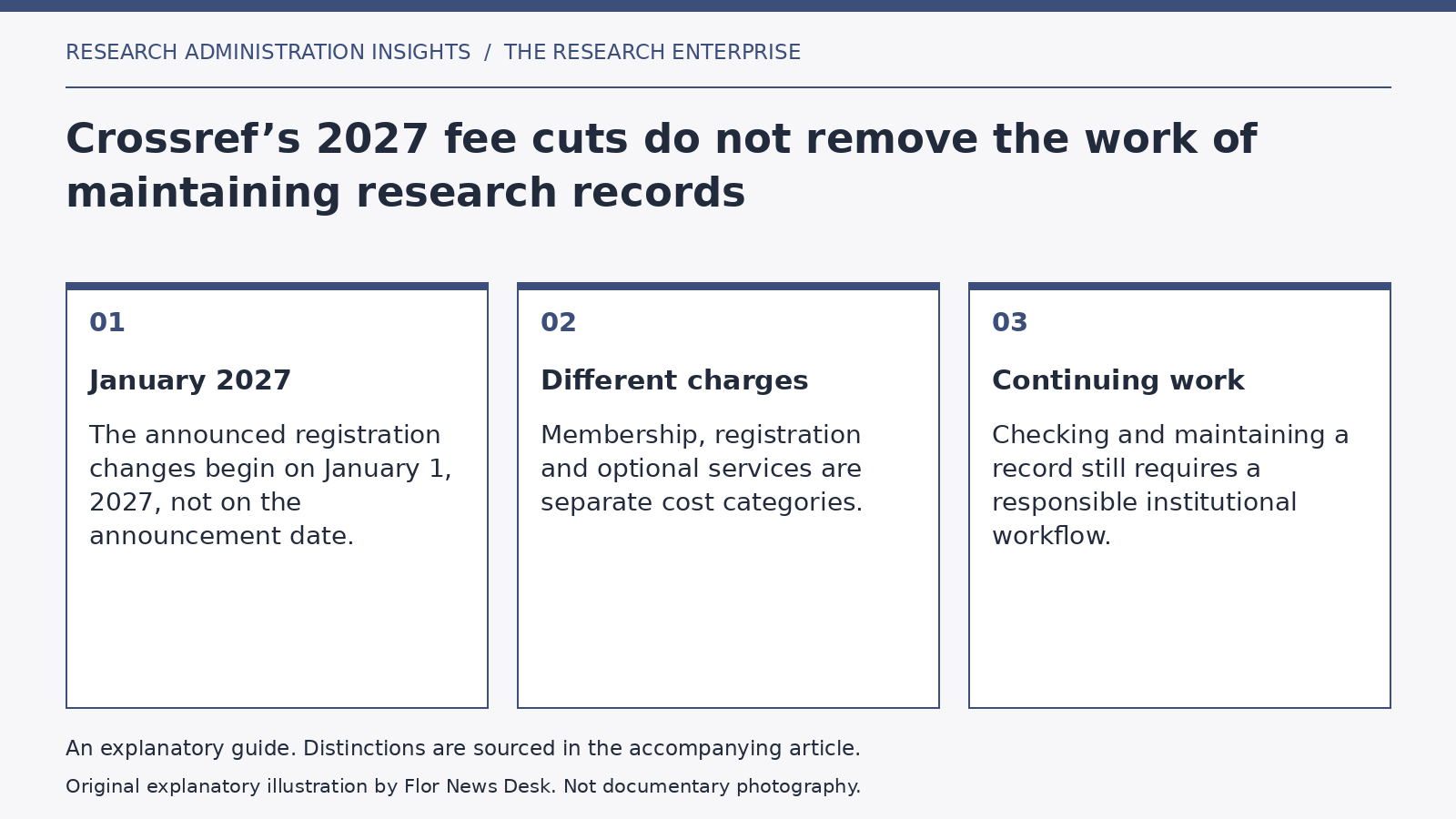
Crossref has announced lower charges for many new content registrations and the removal of back-year registration fees from January 1, 2027. Its August announcement is a future pricing change, not evidence that September invoices already use the new schedule. For research offices considering an older publications backlog, the distinction is between a cheaper registration transaction and the work needed to create a reliable record. Crossref’s dated announcement sets out the effective date and exceptions.
Crossref’s fee guidance separates annual membership from one-time content-registration charges and optional services. It also says that updating a record after its initial registration is free. A budget that treats every correction as another paid registration would therefore mix different activities. Equally, a reduction in registration charges should not be presented as the elimination of every institutional publishing expense.
A backlog needs two estimates
Consider a hypothetical repository preparing to register an older collection. One estimate would classify the intended records under the applicable pricing schedule. A separate estimate would cover checking titles, contributor names, publication dates, landing pages and relationships between records. Removing the first charge does not determine how long the second task will take. Neither announcement nor fee table measures that local workload.
The useful planning unit is consequently a record that can be maintained, not simply an identifier bought at the lowest price. An institution could ask which records already have stable landing pages, which require source checks, and who will correct mistakes after registration. This is an operational proposal, not a Crossref requirement or a measured finding about any particular university.
Avoid counting the same saving twice
A comparison of two budgets should hold the collection and service scope constant. Otherwise, a larger backfile project can increase total spending while its registration component becomes cheaper. The two statements are compatible. Before committing a backlog, the responsible team can document the schedule it used, the intended registration date and the work excluded from the estimate. That makes any later claim about savings traceable to an actual cost category rather than to an attractive headline.