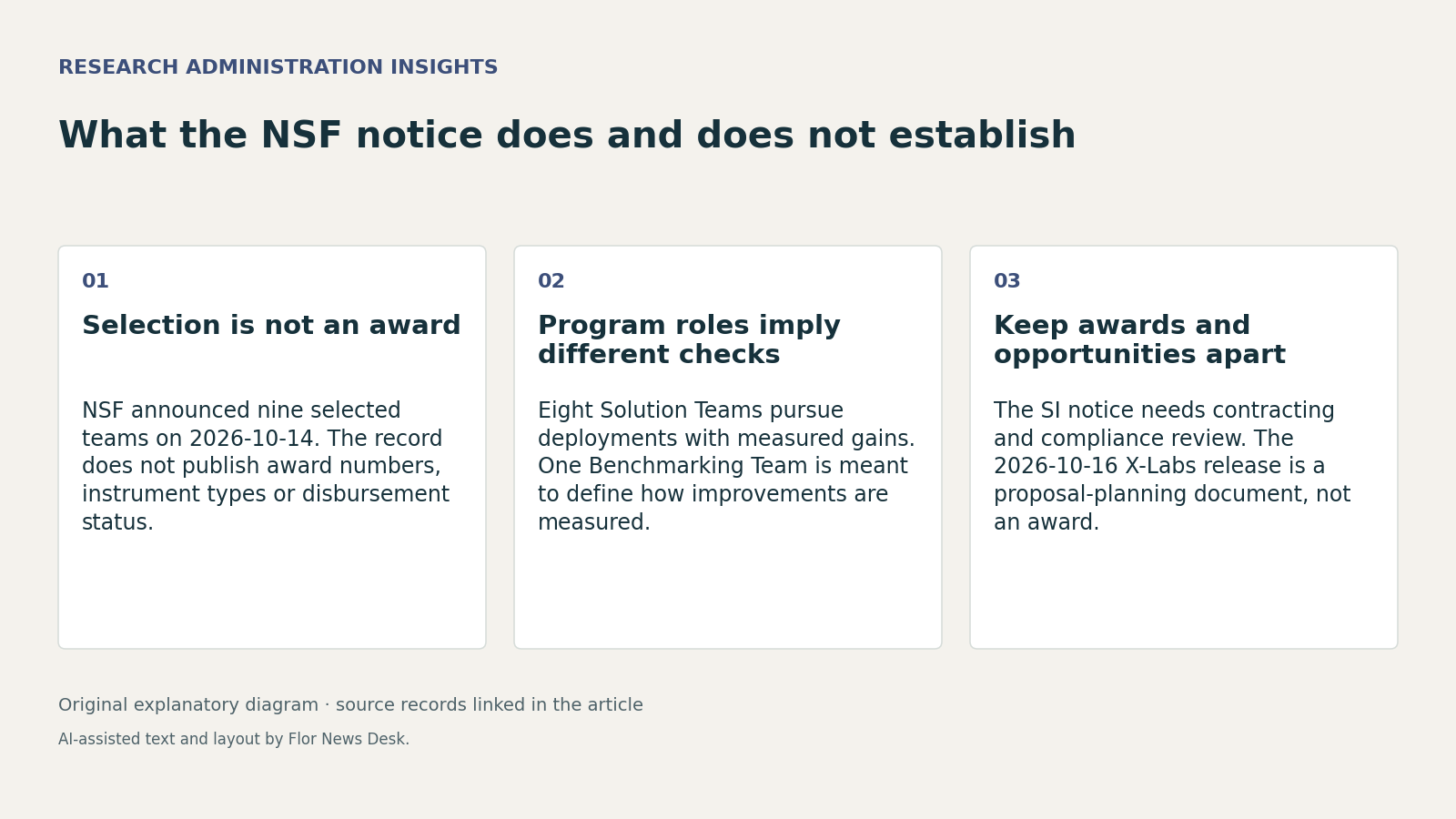
NSF’s 2026-10-14 notice on super intelligence infrastructure efficiency is specific enough to trigger campus action, but not specific enough to close an institutional file. The U.S. National Science Foundation Directorate for Technology, Innovation and Partnerships said it selected nine teams in a competition that began in May 2026, and said the selected teams will receive up to $3.5 million over two years. Yet the same record is a selection announcement, not evidence that grant or contract instruments were executed, funds were disbursed or work started. That distinction is the first administrative fact to preserve in any internal briefing or public-facing institutional update. NSF selection notice
The program design also tells research offices where to look for risk. NSF separates eight Solution Teams from one Benchmarking Team. According to the agency, Solution Teams pair “Pitchers” with “Catchers” to deploy software-based efficiency technologies in large-scale operational settings and report measured efficiency gains, while the Benchmarking Team is meant to develop and distill industry standards for measuring improvements. In practice, those roles imply different administrative questions: deployment work can raise procurement, data-access and computing-environment issues, while benchmarking work can raise standard-setting, measurement and deliverable-definition issues. That is analysis, not a claim that any named campus faces those issues now; the fetched NSF record does not publish team rosters, subaward structures, benchmark specifications or payment schedules. NSF selection notice
The timeline language matters too. NSF said teams are expected to produce at-scale deployments or benchmarking standards within two years, and that teams reaching at-scale deployments within one year will enter a fast-track component. As of the current date, 2026-10-21, those are still expectations stated on 2026-10-14, not implementation results. Research offices should therefore distinguish three statuses in their records: selected, formally awarded and demonstrably operating. A campus that compresses those stages into a single “won funding” label risks overstating both revenue timing and operational readiness. NSF selection notice
NSF’s broader TIP index reinforces why verification should come before celebration. The TIP latest page lists the 2026-10-14 selection item among recent updates and points readers to a TIP Investment Explorer with award data, but it is not itself an award record for this competition. That means an institution looking for booking, indirect cost planning or sponsor-reporting certainty still needs the actual award number, instrument type and written allocation of responsibilities. The index shows portfolio activity; it does not settle who has a signed prime award, who is only an anticipated subrecipient or contractor, or when money can be recognized. TIP latest page
A second TIP update, published on 2026-10-16, shows why campuses should keep this selection workflow separate from proposal-development workflows. NSF announced an X-Labs bioengineering funding opportunity titled “From Sequence to Function,” said the release brings the X-Labs portfolio to four topics, and noted an RFI on possible future topics with responses due by 2026-10-30, plus a webinar on 2026-11-18. That is a live opportunity pipeline, not an award pipeline. Administratively, the super intelligence notice calls for contract and compliance checking around selected teams, while X-Labs calls for intake, eligibility review and proposal planning. Mixing those two stages would blur very different obligations. X-Labs bioengineering update
The most useful near-term response, then, is targeted evidence gathering. If a principal investigator or external partner says your institution is involved, ask for the written award or draft agreement, the budget path, the invoicing structure and the technical environment the work will require. The public NSF record supports urgency, because selections have been announced. It does not yet support assumptions about who has executable authority, which standards govern benchmarking or when any selected effort becomes an operating project. NSF selection notice