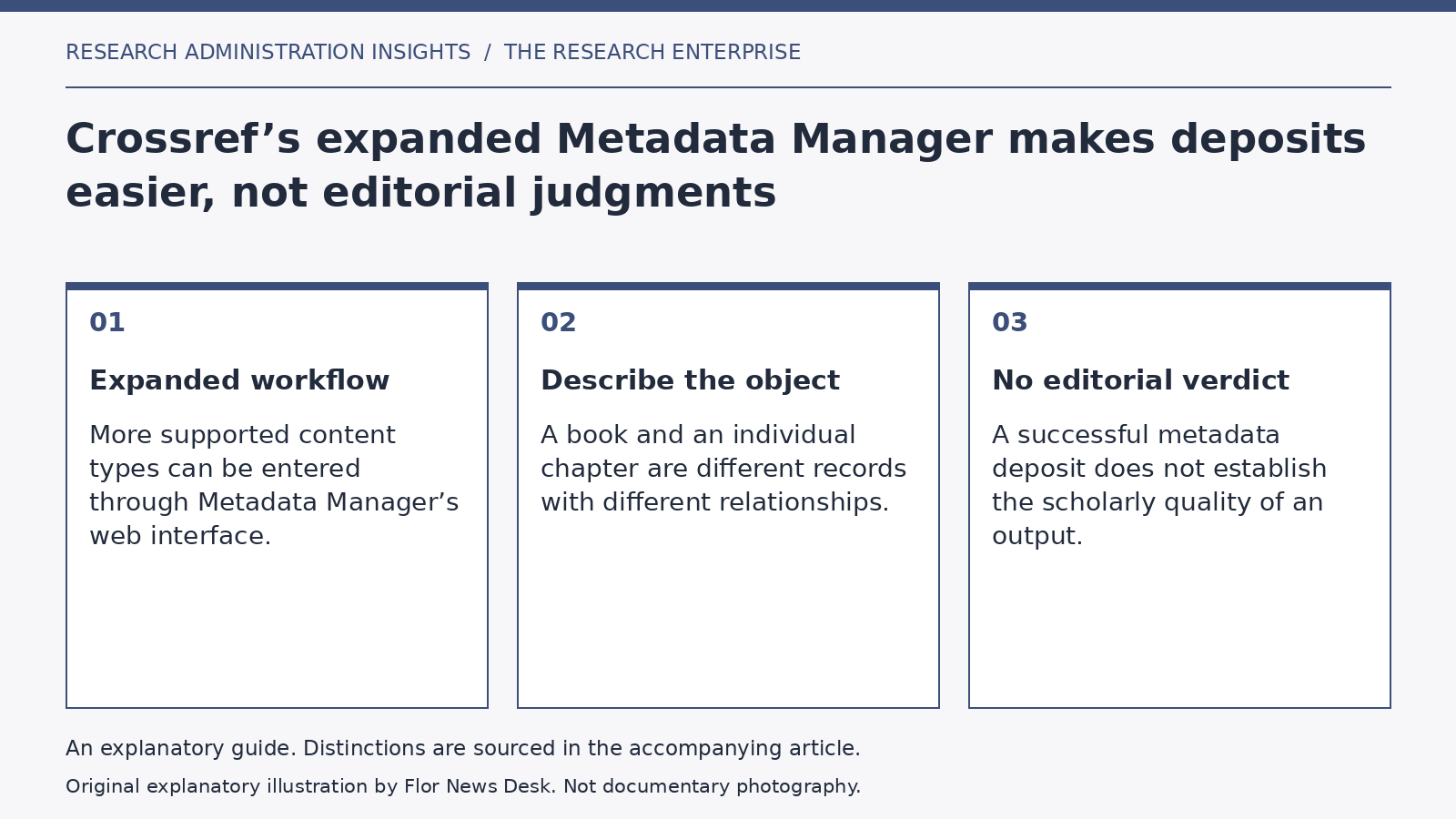
Crossref’s August 20 expansion of Metadata Manager brought books, chapters, reports, dissertations and post-publication updates into its newer web-based deposit workflow. The change concerns how members submit metadata, not a finding that these materials have passed a new scholarly assessment. Crossref’s announcement describes an easier alternative to the older web deposit form for supported content types.
The distinction matters when a research office translates a successful deposit into an internal status. A record can be technically accepted while a title, contributor relationship or publication description still needs correction. Metadata Manager’s documentation describes supported formats and workflow conditions, including limitations on editing post-publication update metadata through the tool. It should not be read as a promise that every kind of record has identical editing capabilities.
Choose the object before completing the form
Imagine an edited volume with several separately titled chapters. An institutional import needs to distinguish the book from its components before it counts outputs. Copying the volume title into every chapter record would make the form look complete without resolving what each record represents. This hypothetical problem is about interpretation, not evidence of a defect in Crossref’s software.
A useful local check would compare the intended object, its landing page and its relationship to other records. The person completing a form could then send an ambiguous case back to the publishing team rather than guessing. A faster interface is most useful when responsibility for the underlying description is clear. Otherwise, convenience can accelerate the movement of an unresolved ambiguity into downstream systems.
Separate three kinds of acceptance
Technical submission, editorial acceptance and an institution’s reporting classification answer different questions. The first concerns a deposit transaction. The second concerns a publication’s own editorial process. The third concerns the purpose for which an organization is recording the output. None can safely be inferred solely from another.
For administrators adopting the expanded tool, a small sample review before a larger import offers a practical test of that separation. It could check whether book and chapter identities remain distinct and whether correction requests reach the right person. These are proposed quality controls, not a certification that any particular collection is accurate or peer reviewed.