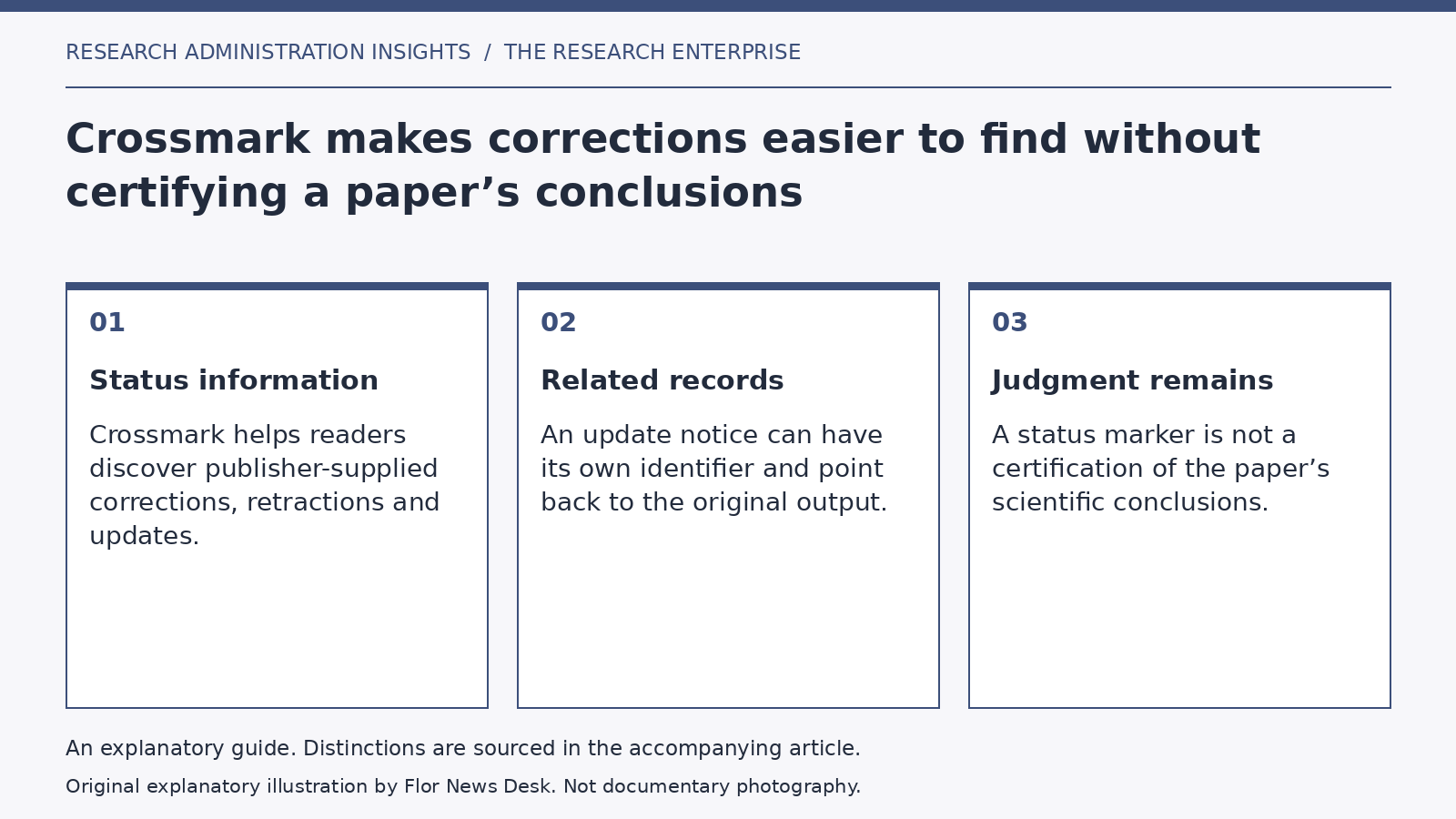
Crossmark is designed to help readers discover whether a research output has been corrected, retracted or otherwise updated. Crossref’s service description explains that members supply update information and can expose additional editorial metadata. It also cautions that the presence of the marker is not itself a guarantee. A visible status mechanism should therefore not be recast as certification of a paper’s findings.
Crossref’s update-registration guidance explains how a separate correction or retraction notice can have its own identifier and a relationship to the original document. It also discusses less desirable in-place changes that can obscure the record. The administrative issue is not simply whether a page remains available, but whether a reader can understand what changed and which document records that change.
The notice and the original answer different questions
Imagine a hypothetical institutional bibliography that stores only the original title and identifier. Adding a correction relationship would not necessarily mean removing the original item. It would mean making its status interpretable. Whether a particular correction changes an assessment depends on the correction’s content, not on the presence of an update flag alone.
That distinction cuts both ways. A correction is not automatically proof of misconduct, and the absence of a recorded update is not proof that every conclusion remains sound. A status field supplies one kind of evidence about a publication’s history. It cannot replace reading the relevant notice or evaluating the research on its merits.
Preserve the route back to the explanation
A useful local reporting design would keep the original identifier, the update relationship and a link to the explanatory record rather than flattening them into an unexplained warning. Staff could then tell whether a report reflects the status observed at a particular time or a subsequent change. This is an implementation proposal, not evidence that a specific reporting system has this capability.
For administrators maintaining research-output records, the aim is neither to hide corrections nor to turn every correction into a verdict. It is to preserve a clear path from the summarized status to the publisher’s explanation. That supports more careful decisions while recognizing the limits of metadata: it can make a change discoverable, but it does not decide the scientific significance of the change for the reader.