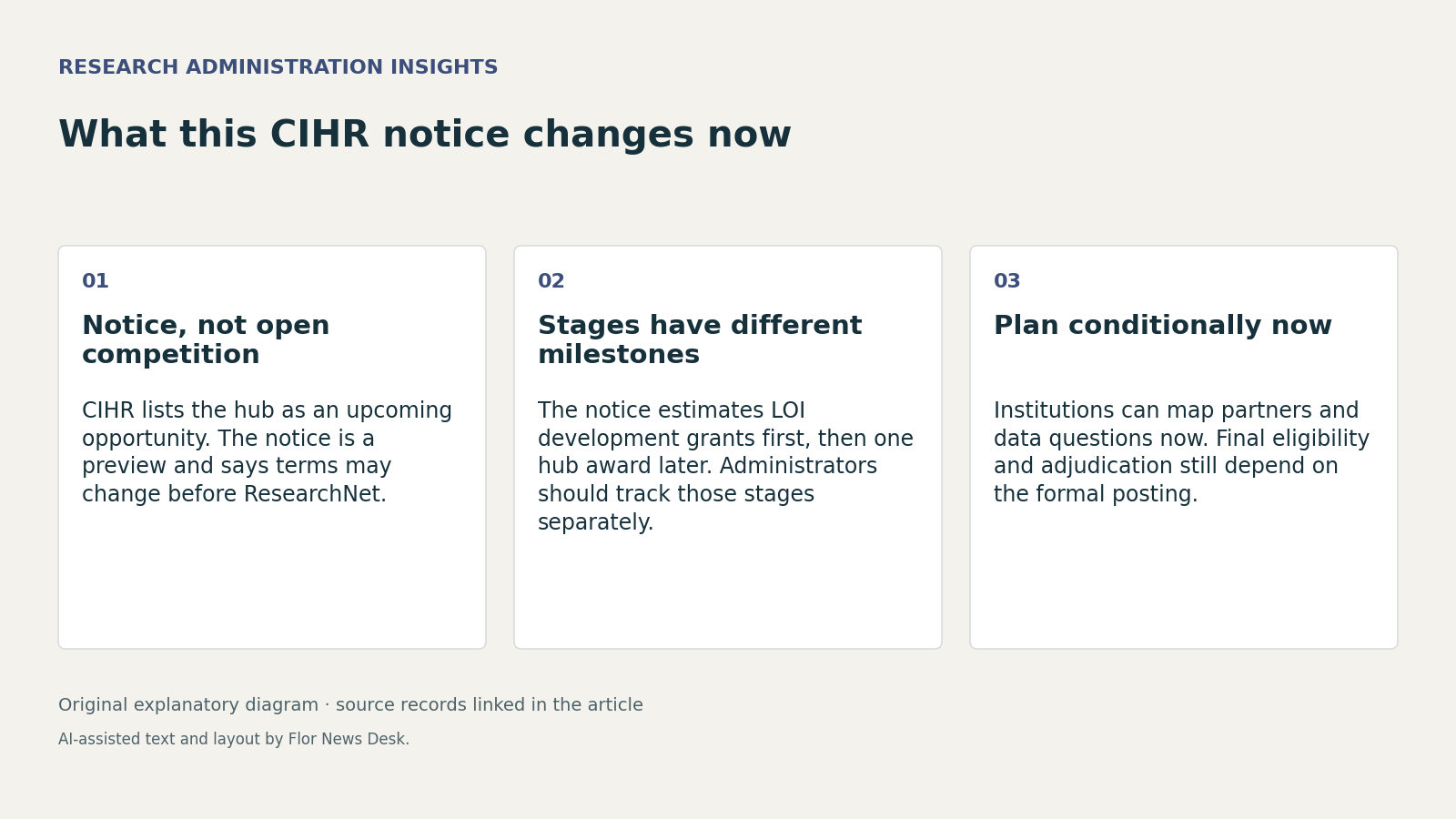
The actionable development is a notice, not a grant. CIHR’s Institute of Gender and Health has posted a Notice of Upcoming Funding Opportunity: Pan-Canadian 2S/LGBTQI+ Knowledge-to-Action Hub that sets out an anticipated $1,690,000 envelope and estimated milestones beginning with a January 2027 launch. The same record says the information is anticipatory only and not an official funding commitment. Its page shows a modified date of 2026-10-21, not a publication date, so the source does not establish when CIHR first began circulating the plan.
For administrators, the most useful detail is the staged funding logic. CIHR says the total would support about three Letter of Intent stage development grants, with up to $30,000 each and $90,000 total at that stage, plus one hub grant later in the process (NOFO). That matters because it frames the early round as funded proposal development rather than only an unfunded expression of interest. It does not, however, prove that the same structure, amounts or number of awards will appear unchanged in the final competition text.
The timeline also needs careful handling. CIHR lists estimated dates for a January 2027 launch, an April 2027 Letter of Intent deadline, a September 1, 2027 start for Letter of Intent stage funding, an April 2028 application deadline and an October 1, 2028 funding start (NOFO). Those are different milestones for different stages. Research offices should not compress them into a single start date or imply that hub funding itself begins in 2027.
CIHR’s Upcoming funding opportunities page explains why this distinction is more than semantics. The index says it provides previews before a full opportunity is posted on ResearchNet and separates those previews from “Published funding opportunities.” In practical terms, that supports opening internal planning conversations now while withholding final institutional approvals that depend on confirmed eligibility, application instructions and adjudication rules. The index page’s modified date of 2026-11-02 shows recent maintenance, not proof that the hub call has formally opened.
The notice does offer one immediate tool for consortium-building, but with limits. CIHR says a voluntary Partner Linkage Tool will post submitted information on its website and that participation does not affect evaluation or funding (NOFO). Administratively, that makes the tool useful for finding collaborators, not for validating applicant status or signalling institutional endorsement. Institutions may want a separate internal step before any prospective lead uses the tool in a way that could be read as representing the university.
A second planning issue is data stewardship. The hub notice says the planned activity would include evidence synthesis, knowledge mobilization and data stewardship (NOFO). CIHR’s archived Webinars page shows that, on 2026-01-14 and 2026-01-28, CIHR and Statistics Canada were already foregrounding 2SLGBTQI+ data variables, terminology, gaps and access pathways. That webinar record does not set hub requirements. It does support a narrower inference: any institution considering a bid should identify early who would handle data-access and stewardship questions if those become central in the eventual ResearchNet posting.
The final caution comes from CIHR’s own awards record. The Funding Decisions Notifications page lists multiple September 2026 decisions under “Operating Grant: Advancing 2S/LGBTQI+ Health Through Research,” including streams on older persons, cancer, gender affirming care and Indigenous communities. It does not provide a decision record for the Pan-Canadian 2S/LGBTQI+ Knowledge-to-Action Hub. That separation is important: CIHR is already funding related work, but this hub remains a proposed future opportunity rather than an awarded program.
So the administrative takeaway is specific. Research offices have enough evidence to map potential partners, think through what a small development grant could support, and monitor ResearchNet for the authoritative call text (NOFO; Upcoming opportunities). They do not yet have evidence of final eligibility, review criteria or committed funding. Acting now means building conditional plans, not treating the notice as a posted competition.