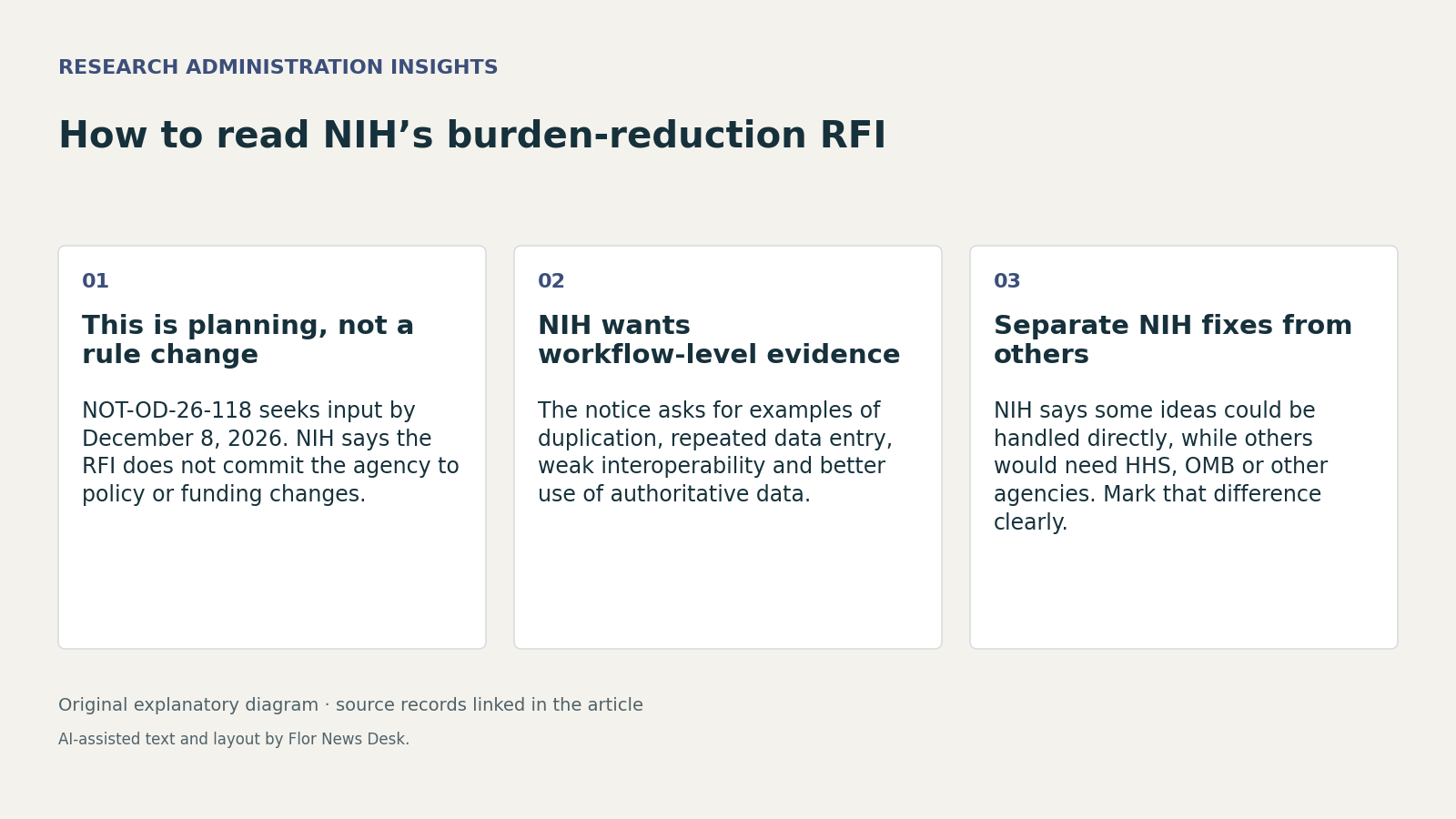
NIH has opened a defined comment window on administrative burden in extramural research, and the most important fact for research offices is the deadline, not any implied reform. Notice NOT-OD-26-118, released on October 8, 2026, asks for recommendations on requirements, policies, processes, forms and systems across the extramural award lifecycle, with responses due December 8, 2026. NIH’s Extramural Nexus post, published on October 20, 2026, directs commenters to submit electronically by that date.
What this does not do is just as important. NIH says in the notice that the RFI is for planning only, not a solicitation, and does not commit the agency to funding, policy adoption or any particular timetable. The notice also says responses are voluntary, may be submitted without organizational attribution and may be shared publicly without redaction. NIH further notes that some ideas could require coordination with HHS, OMB, other agencies, regulation or statute. The Nexus post adds that NIH may be able to act directly on some recommendations, while others would need wider federal coordination. That makes this less a lobbying exercise than a sorting exercise: which burdens are genuinely NIH-controlled, and which are not? NOT-OD-26-118 Extramural Nexus post
The topics NIH names also narrow what a useful submission should look like. The notice asks about duplication reduction, collecting information later or only once, use of authoritative data sources, system interoperability, and appropriate use of AI, generative AI or large language models. The Nexus post adds burdens created by complex guidance or systems, overcompliance, harmonization with other federal agencies or funders, and time-and-effort estimates when available. On those premises, a strong institutional response is likely to be built around a single workflow, not a general complaint: name the step, identify the duplicate data request, note who re-enters or rechecks it, estimate the effort if you can, and propose the narrowest workable fix. NOT-OD-26-118 Extramural Nexus post
The source record does not establish which campus systems or NIH forms are producing the greatest burden now, so institutions should resist turning assumptions into evidence. A safer approach is to test real handoffs where the same NIH-related information is entered, checked or reformatted more than once. Hypothetically, if a personnel or organization record already exists in an authoritative institutional source and is then manually retyped for sponsor-facing use, that is the kind of chain NIH is explicitly asking commenters to describe. The operational value is in documenting the duplicate step and the alternative data source, not in asserting that all local burden comes from NIH. NOT-OD-26-118
There is also a small but practical deadline trap in NIH’s own web ecosystem. A retrieved NIH notices listing page includes NOT-OD-26-118 in its notices table with a release date of 2026-10-08 and an expiration date of 2029-01-01. But that listing is index metadata, not the operative response window. The full notice text gives December 8, 2026 as the response date. For administrators managing calendars, the distinction matters: a listing-page expiration field does not extend an RFI’s comment period.
The RFI also arrives in a year when NIH is already framing administrative burden as part of broader grants-management change. The Nexus post points to earlier work on funding-opportunity consolidation, forms alignment, receipt dates and web resources. Separately, NIH’s selected policy-changes page lists 2026 notices on letters of collaboration, Common Forms enforcement, conference grant permissions and Data Management and Sharing Plan requirements. Those pages do not establish whether those earlier steps reduced burden in practice, but they do show NIH placing this RFI alongside active policy and process changes rather than treating it as a stand-alone consultation.
For research offices, the near-term opportunity is therefore narrow and concrete. Submit by December 8, 2026; avoid confidential detail because NIH says responses may be made public; separate NIH-only fixes from changes that would need broader federal action; and attach effort estimates where they exist. If proposing AI or large language model use, describe the task to be reduced and the existing duplicate step, because NIH’s notice asks for appropriate use tied to burden reduction, not technology for its own sake. The record supports one clear conclusion: this is a real input window with a firm date, but not yet a promised rule change. NOT-OD-26-118 Extramural Nexus post