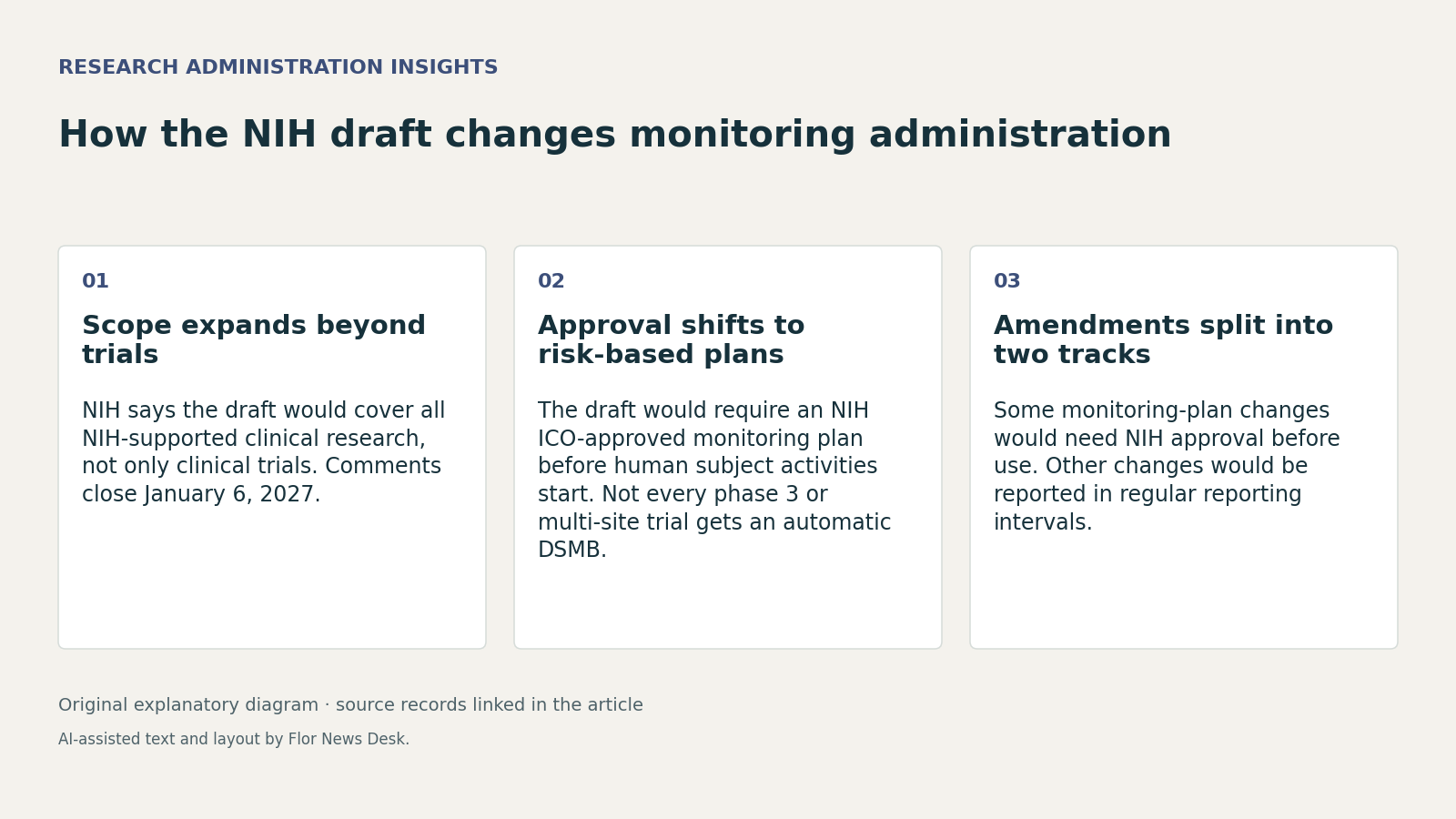
NIH’s November 2, 2026 draft update to its Data and Safety Monitoring policy would do more than revise clinical-trial terminology: it would expand the policy from clinical trials to all NIH-supported clinical research, and NIH is taking comments through January 6, 2027 (draft notice; OSP announcement). For research administration offices, the practical issue during that comment window is not whether the policy is already in force. It is whether current intake, sponsor-routing and compliance systems are even structured for the model NIH is proposing.
The biggest operational change in the retrieved notice is scope. NIH says the draft would move beyond the 1998 policy’s focus on clinical trials and would require a risk-based Data and Safety Monitoring Plan for all NIH-supported clinical research, with approval by the awarding NIH Institutes, Centers, and Offices before human subject activities begin (draft notice). That shifts monitoring from a narrower trial-management question into a broader award-readiness question. Analysis: if institutions currently collect monitoring materials only in clinical-trial channels, they may need to identify where broader clinical-research proposals would be screened, how NIH ICO approval would be recorded, and who is responsible for proving that approval was in place before activities start.
The draft also changes a familiar trigger. NIH says it would no longer require a Data and Safety Monitoring Board for every phase 3 or multi-site clinical trial, instead tying monitoring needs to study-specific risk (draft notice). That does not automatically reduce local work. It may replace a bright-line rule with a judgment-and-documentation problem. Institutions that have built templates or internal expectations around automatic board review for certain trial categories would need to decide whether to keep stricter local practice, align with NIH’s proposed minimum, or separate the two in guidance so investigators do not confuse institutional preference with NIH requirement.
Amendments may be the most immediate workflow challenge. The notice says monitoring-plan changes connected to matters requiring NIH prior approval would need NIH ICO review and approval before implementation, while other amendments would be reported during regular reporting intervals (draft notice). That creates two administrative tracks. Research offices would need a reliable way to distinguish changes that must wait for NIH action from changes that can be logged for later reporting. The notice establishes the distinction, but the retrieved records do not supply a model decision tree or examples of borderline cases.
The compliance language raises the stakes further. NIH says compliance would be enforced through award or agreement terms, with possible remedies including specific award conditions, suspension, withholding, termination and potential effects on future funding decisions (draft notice). In practical terms, that makes monitoring-plan administration more than a scientific oversight issue. It becomes an award-management control issue. Analysis: offices that split proposal review, award setup and post-award reporting across different teams should test whether responsibility for monitoring documentation is explicit enough to survive an NIH inquiry.
NIH’s Office of Science Policy says the proposal is intended to harmonize requirements, make burden more proportionate to risk and clarify expectations for reliable data and scientific conclusions, and it points institutions to the comment process ending January 6, 2027 (OSP announcement). What the retrieved records do not establish is whether NIH will finalize the policy in this form, when any final version would take effect, or whether the proposal would actually reduce burden or improve safety outcomes. That limitation matters. The sound administrative response before January 6 is not to claim a new rule exists, but to identify where existing processes would need evidence standards, routing rules and amendment logic if NIH converts this draft into award terms.