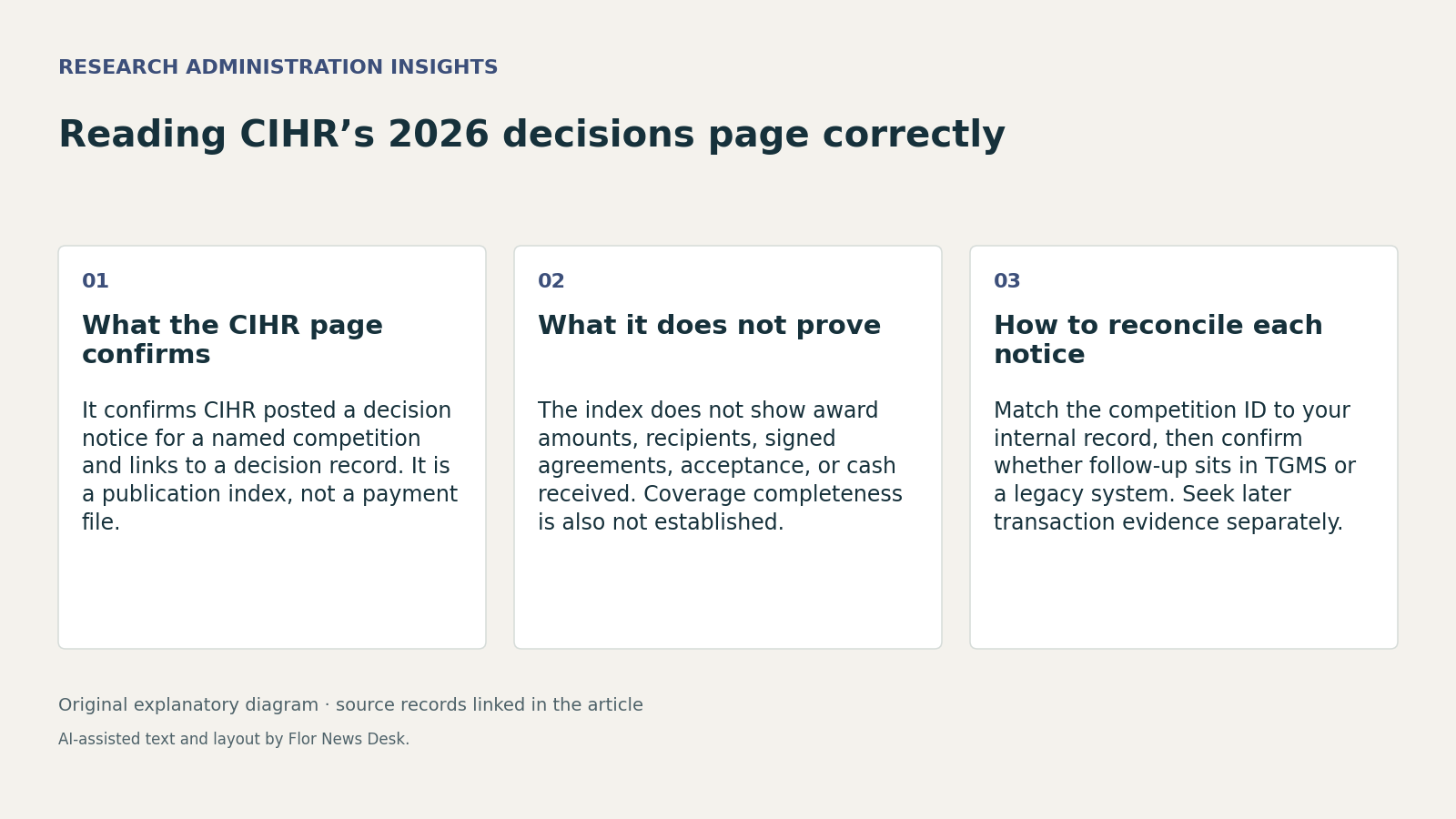
A CIHR-maintained 2026 funding-decisions index has become a practical starting point for post-award checking, but research offices should treat it as a notice index, not as proof that an award is fully in force. On a page retrieved on 30 October 2026 and marked modified on 29 October 2026, the Canadian Institutes of Health Research lists funding decision notifications by month from January through October 2026. Each line pairs a funding opportunity name with a competition identifier and a “View” link to a decision record, and the October section includes three entries: Planning and Dissemination Grants – ICS, Future Leaders in Canadian Brain Research Program, and College and Community Innovation Social Innovation Fund (CCSIF) (CIHR 2026 index).
What that page settles is narrower than it may first appear. The record shows that CIHR has published decision notices in a centralized annual index, and it links outward to underlying decision records. The same page also links to annual decision-notification pages for 2025, 2024, 2023 and 2022 (CIHR 2026 index). But the briefed record does not establish award amounts, recipient names, institutional acceptance, signed agreements, disbursement status, or even whether the 2026 page is complete for every CIHR decision. It also gives no publication date for the index itself. For administrators, that means the page is best used as a trigger for reconciliation, not as the final evidentiary record.
The first practical step is to anchor each local file to the CIHR competition identifier and the linked decision record. That sounds basic, but a centralized month-by-month page changes the order of operations: instead of starting from email traffic or internal spreadsheets, an office can begin with the CIHR index, capture the competition code, open the linked record, and check whether the institution’s own file points to the same opportunity and decision notice (CIHR 2026 index). If an internal ledger cannot be matched to the posted competition identifier, that is a record-quality problem even before any payment question arises.
The second step is to separate decision status from platform status. The federal tri-agency grants management solution, or TGMS, is intended to bring the three granting councils onto one platform covering functions that include searching opportunities, applying, viewing status, accessing notice of decision and terms and conditions, receiving funds, and submitting reports or amendment requests (TGMS overview). But that page describes an implementation-phase vision, not a complete current-state map. It does not identify which of the CIHR competitions listed on the 2026 decisions page are already operating in TGMS.
That uncertainty matters operationally because the TGMS implementation record says rollout will happen in phases, beginning with a small subset of simpler opportunities, with more functions added over time. During the transition, each funding opportunity is supposed to be clearly identified as hosted either in TGMS or in legacy systems, and the agencies say training and technical support will accompany the change (TGMS implementation). The analytical implication is straightforward: a posted CIHR decision should not be read as evidence that the next action for the principal investigator or institution sits in TGMS unless the opportunity is explicitly identified that way.
A sensible reconciliation sequence, then, is: confirm the CIHR monthly index entry; verify the underlying decision record and competition identifier; determine whether the opportunity is being handled in TGMS or a legacy system; and only then look for later evidence of terms acceptance, agreement execution, or cash movement in the institution’s own financial records. The source record supports that sequence because it distinguishes an announced decision from the later functions TGMS is meant to consolidate, while leaving key outcome questions unresolved (CIHR 2026 index; TGMS overview; TGMS implementation).