NSF’s Directorate for Geosciences moved core research submissions into solicitation NSF 26-516 effective on Aug. 17, 2026, and its Aug. 24 transition notice said investigators could use active legacy opportunities only through Sept. 25, 2026; from Sept. 26 onward, NSF said only GEO Core would accept proposals. For research offices checking workflows on Sept. 27, 2026, that makes NSF 26-516 the operative routing document, although the retrieved records do not independently confirm whether every legacy page had in fact been archived by then. NSF GEO update NSF 26-516 solicitation
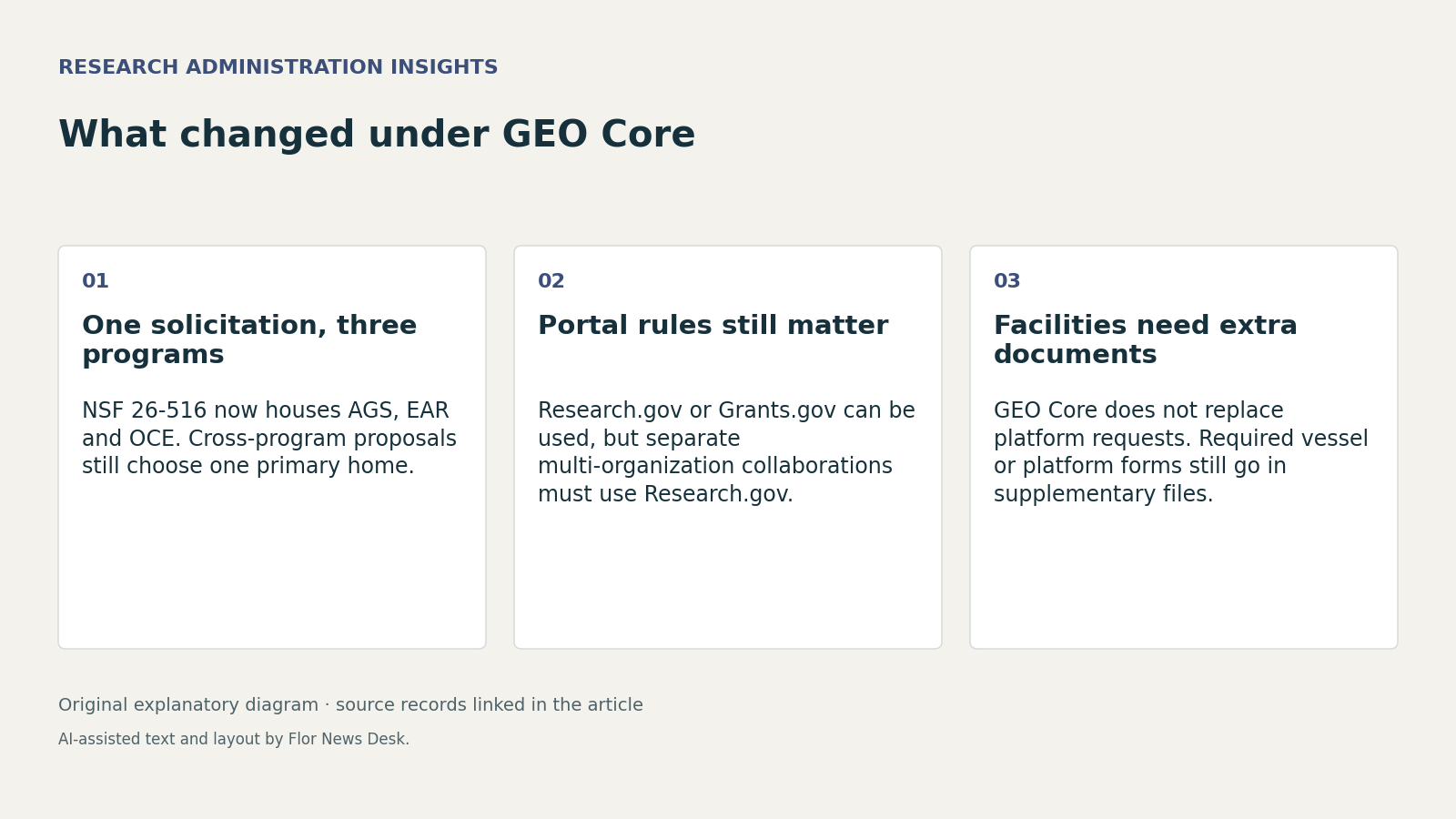
The main administrative change is consolidation. One solicitation now covers Atmospheric and Geospace Sciences, Earth Sciences, and Ocean Sciences under a single GEO Core structure. Full proposals are accepted anytime and are due by 5 p.m. the submitting organization’s local time, but investigators still have to place a cross-program project in the program that best matches its primary focus. The practical implication is that an institutional checklist can be simplified at the solicitation level without erasing program-selection judgments at the scientific level. GEO Core program page NSF 26-516 solicitation
Submission mechanics also changed in ways grants offices should test rather than assume. NSF 26-516 permits Research.gov or Grants.gov for proposal submission, but separately submitted collaborative proposals from multiple organizations must use Research.gov. The solicitation also ties compliance to the Proposal & Award Policies & Procedures Guide version in effect on the proposal’s due date, so offices that copied PAPPG references from older geoscience templates should update them instead of treating the consolidation as a page move only. NSF 26-516 solicitation
The consolidation does not remove special handling for shared facilities or instrumentation. NSF’s Aug. 24 update says the Facility and Instrumentation Request Process sits within the Atmospheric and Geospace Sciences program and that the Ocean Sciences program includes the NSF U.S. Subseafloor Sampling Program. The solicitation adds that any proposal needing community research platforms must file the relevant request with platform managers and upload a copy as a supplementary document; proposals using Academic Research Fleet vessels must include a University National Oceanographic Laboratory System Science & Marine Equipment request form. For administrators, the practical point is that GEO Core centralizes the competition, not the platform-request paperwork. NSF GEO update NSF 26-516 solicitation
What the retrieved records do not settle is a one-for-one map from each of the 15 legacy opportunities into new internal review lanes. The program page supplies research-area contact emails across atmospheric, geospace, earth, and ocean topics, and that is the clearest current route in the record for institutions that are unsure where a legacy concept now belongs. The same page advertises virtual office hours on Oct. 5, 2026 for Ocean Sciences, Oct. 6, 2026 for Earth Sciences, and Oct. 27, 2026 for Atmospheric and Geospace Sciences. By contrast, the Aug. 24 update’s Sept. 15, 2026 office-hours notice is already historical and should not be treated as an upcoming milestone. GEO Core program page NSF GEO update
One more distinction matters for planning. NSF lists an anticipated $110,000,000, about 200 to 350 awards, and says estimated budgets, award counts, average award sizes, and durations remain subject to the availability of funds. That is an announcement of a funding opportunity, not evidence that institutions will see a fixed award volume because of the consolidation. A sensible late-September compliance check is therefore narrow: point bookmarks and internal forms to NSF 26-516, verify whether any routed proposal still names a legacy solicitation, confirm the correct submission portal, and escalate ambiguous program fit to the contacts on the GEO Core page. GEO Core program page NSF 26-516 solicitation