NSF proposal offices should now treat the Data Management and Sharing Plan as a Research.gov workflow, not a stand-alone PDF, for current submissions. The rule entered NSF policy on January 22, 2026, when the agency’s PAPPG notice revised Chapter II.D.2 to require a DMSP created using a tool implemented on Research.gov, and later NSF records describe that web-based tool as released on April 27, 2026. An August 17, 2026 solicitation for NSF 26-521 repeats that instruction in active proposal-preparation text. PAPPG 24-1 Supplement 2 policy notice Engineering DMSP guidance NSF 26-521 solicitation
The dating matters because not every NSF page has caught up cleanly. The January 22 policy notice and the Social, Behavioral and Economic Sciences data-management page still preserve future-tense wording that the Research.gov tool would be released on April 27, 2026, and that proposals submitted before that date should keep using a PDF upload. As of October 8, 2026, that language is best read as a historical transition marker, not as proof of current system behavior. The stronger evidence of implementation comes from later or updated records, especially the July 2026 Engineering page and the August 17 solicitation. PAPPG 24-1 Supplement 2 policy notice SBE data management page Engineering DMSP guidance
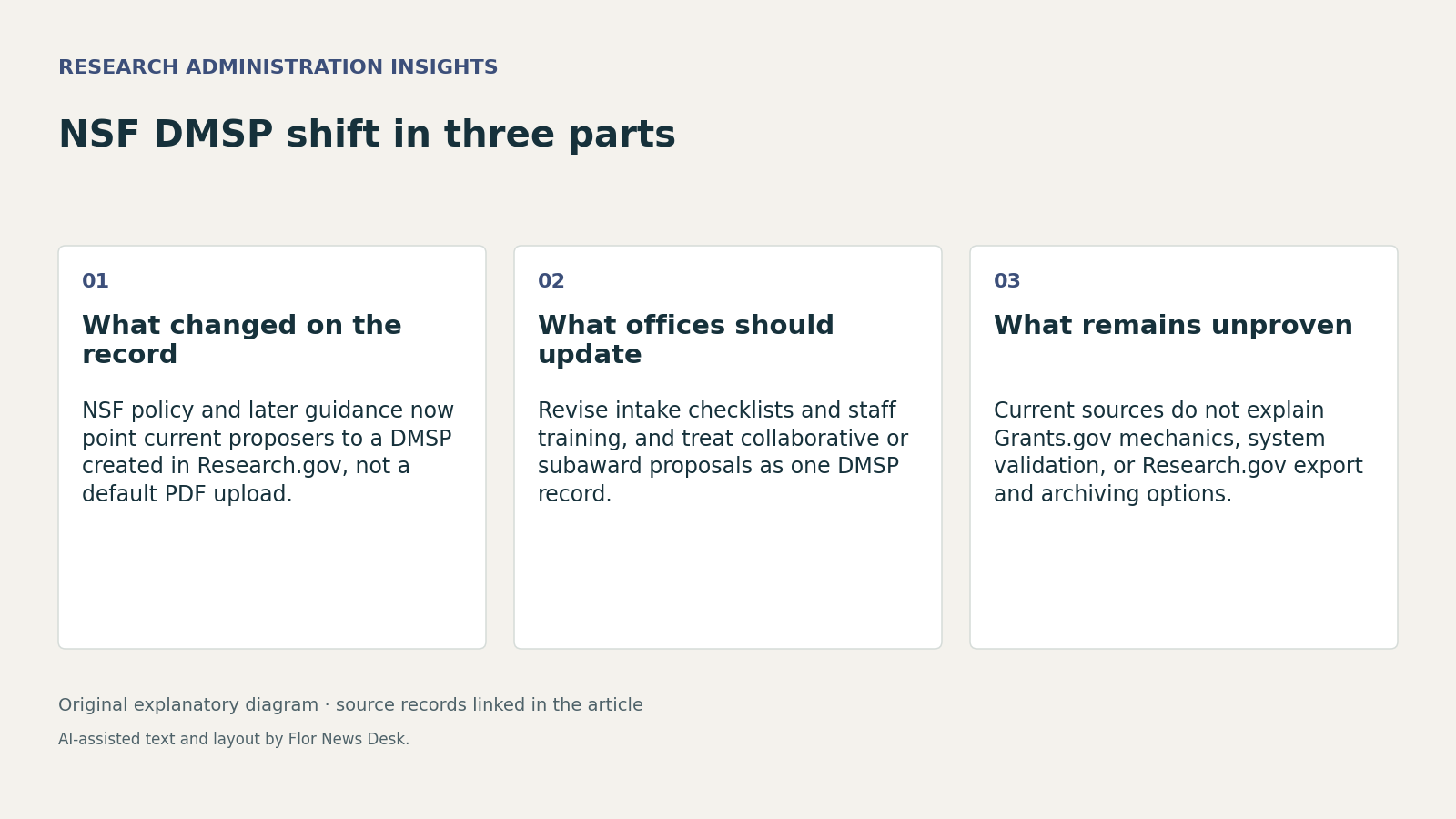
For research administrators, the operational consequence is immediate: intake checklists that still default to collecting a two-page DMSP attachment are now misaligned with NSF’s current instructions. The January 22 notice also says collaborative proposals and proposals with subawards are treated as one unified project for DMSP purposes, so campuses should not assume separate subrecipient plans satisfy the rule by themselves. The same policy text allows a DMSP to be only a justified statement that no detailed plan is needed, which means offices still need a review path for low-data or no-data projects rather than forcing every proposal into the same template. PAPPG 24-1 Supplement 2 policy notice
The Research.gov form also changes what information must be gathered before routing closes. NSF Engineering lists fields covering data category, access policies and limitations, standards and metadata, provenance, public archiving, timing for public accessibility, data availability, and accountability. That is more than a formatting tweak: it is a practical field map for revising internal questionnaires and repository planning. At the same time, both the SBE and Mathematical and Physical Sciences pages say solicitations or program guidance can add requirements beyond general NSF instructions, so a campus-wide NSF template should branch by program when necessary. Engineering DMSP guidance SBE data management page MPS data management and sharing plan page
What the public record does not settle is just as important. NSF 26-521 says proposals may still be submitted through Research.gov or Grants.gov, but it does not explain the technical steps for using a Research.gov-created DMSP when the rest of the proposal goes through Grants.gov. The Engineering page says proposals without a DMSP will be returned without review, yet that same page says it is still being provided for informational use until a fuller update is available. That supports a real compliance risk, but not a complete picture of validation logic, export options, or institutional archiving behavior. NSF 26-521 solicitation Engineering DMSP guidance
The near-term fix is narrower than a policy overhaul. Research offices can update NSF routing forms to ask where the DMSP was created, train department staff on the Research.gov fields, and flag solicitations with added directorate instructions. That last point is not theoretical: the MPS page says annual and final project reports for MPS Materials Research must discuss how the DMSP was carried out and any changes made during the project. The analytical takeaway is that NSF has moved DMSPs into a more structured proposal record, and institutions now need continuity between proposal entry and later award reporting even though some submission mechanics remain undocumented in the sources reviewed here. MPS data management and sharing plan page Engineering DMSP guidance