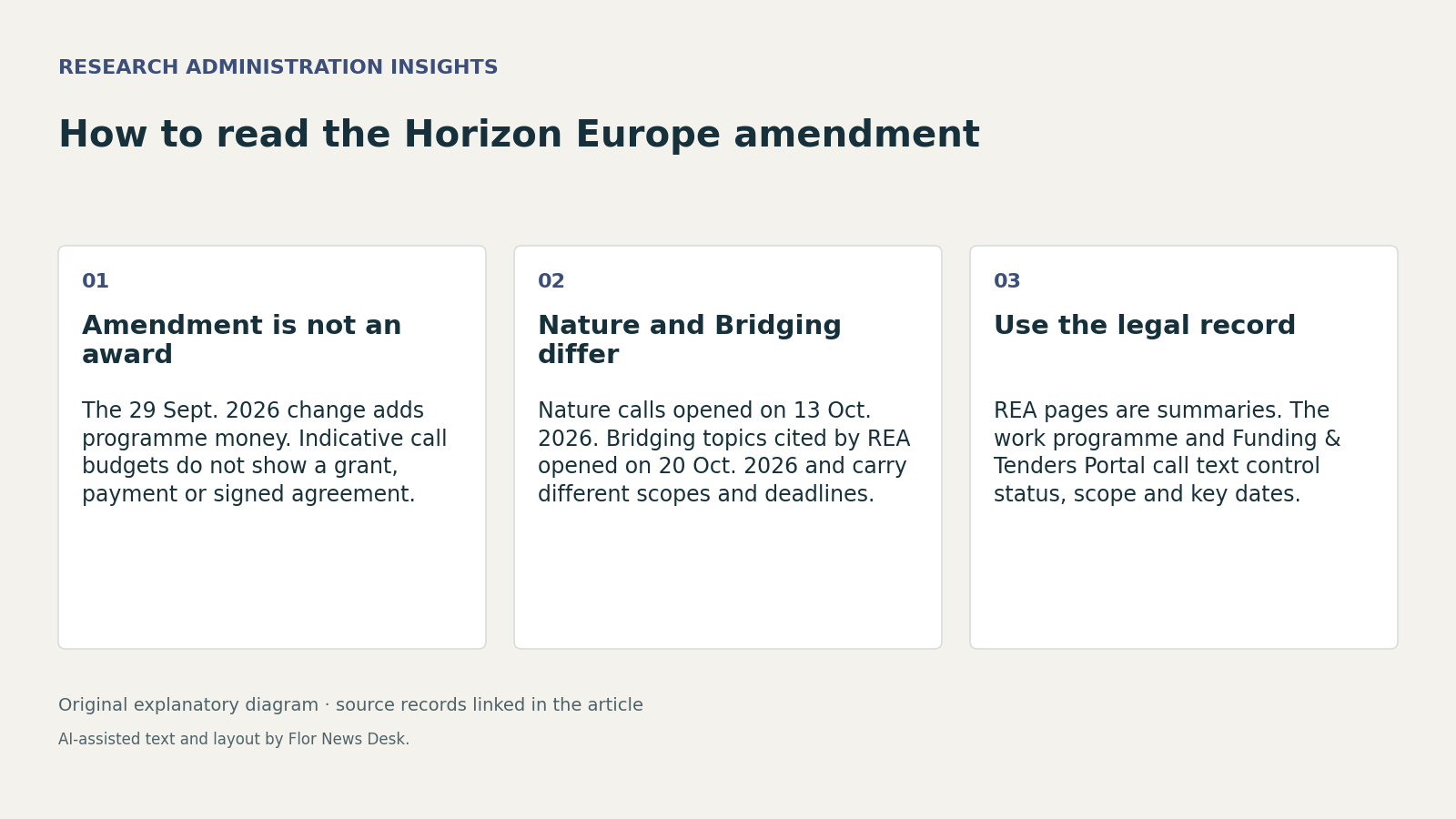
The European Commission’s 29 September 2026 amendment to the Horizon Europe 2026-2027 work programme matters because it changed what can be competed for now, not because it proves any institution has new money in hand. REA says the amendment added €500 million through the end of 2027 and created two new cross-cutting calls, Nature actions and Bridging actions, with REA managing around half of that extra budget through those packages REA news. A EURAXESS programme page says the same amendment added two horizontal calls worth €237 million for “Transformative change towards a nature-positive economy and society” and €260 million for “Bridging actions 2027,” bringing the two-year total to about €14.8 billion EURAXESS overview.
For institutions preparing proposals, the Nature side is already in its active window. The REA Nature page says HORIZON-NATURE-2027-01 opened on 13 October 2026 with three topics and an overall indicative budget of €41.45 million, while HORIZON-NATURE-2027-02 opened the same day with five topics and €108 million Nature actions page. The same page lists 14 January 2027 as the proposal deadline for HORIZON-NATURE-2027-01 and later planned milestones in June, September and October 2027 Nature actions page. Administratively, that creates a real filing timetable, but not a complete compliance record: the page also says the legal instruments and call text take precedence Nature actions page.
The Bridging actions require a different routing decision. The REA Bridging page says this 2027 package is aimed at research and innovation challenges linked to Horizon Europe 2028-2034 and the future European Competitiveness Fund Bridging actions page. It lists HORIZON-BRIDGING-2027-02-05 opening on 20 October 2026 with €32.5 million and a 28 January 2027 deadline, and HORIZON-BRIDGING-2027-06-02 opening the same day with €20 million and a 16 February 2027 deadline Bridging actions page. One is framed around advancing promising results from Horizon Europe Pillar II Clusters 1 to 6; the other is framed around valorising project results through innovation ecosystems Bridging actions page. That is a scope distinction, not just a deadline difference.
What the current source record does not establish is just as important. The pages in hand describe indicative budgets, call openings and planned later steps such as applicant information, expected grant-signature months and projected start months in 2027 Nature actions page Bridging actions page. None of that evidences selections, signed grant agreements or disbursements to beneficiaries, and neither the REA nor EURAXESS summaries changes that REA news EURAXESS overview. The practical inference is straightforward: treat this as proposal pipeline information, not recognised income.
The second operational distinction is between a useful summary and a controlling record. Both REA call pages state that the full funding information sits on the Funding & Tenders Portal and that the legal call text prevails Nature actions page Bridging actions page. REA’s 9 October news item is valuable for spotting the package, but it is not enough on its own to confirm live status or all conditions, especially because the same summary mentions three research-infrastructure Bridging topics with a combined €30.5 million opening on “9 March” without stating a year REA news.
As of 20 October 2026, the immediate priority is calendar discipline. Nature openings dated 13 October 2026 are already past events in the record; the Bridging openings dated 20 October 2026 are current to the day; and the 16 October 2026 horizontal activities info day listed by EURAXESS has already passed EURAXESS overview. Research offices therefore need to map teams to exact call identifiers, verify status in the legal call record, and keep the amendment’s headline €500 million separate from any later award evidence. The amendment created actionable opportunities. It did not, by itself, close the administrative gap between a published call and money received.