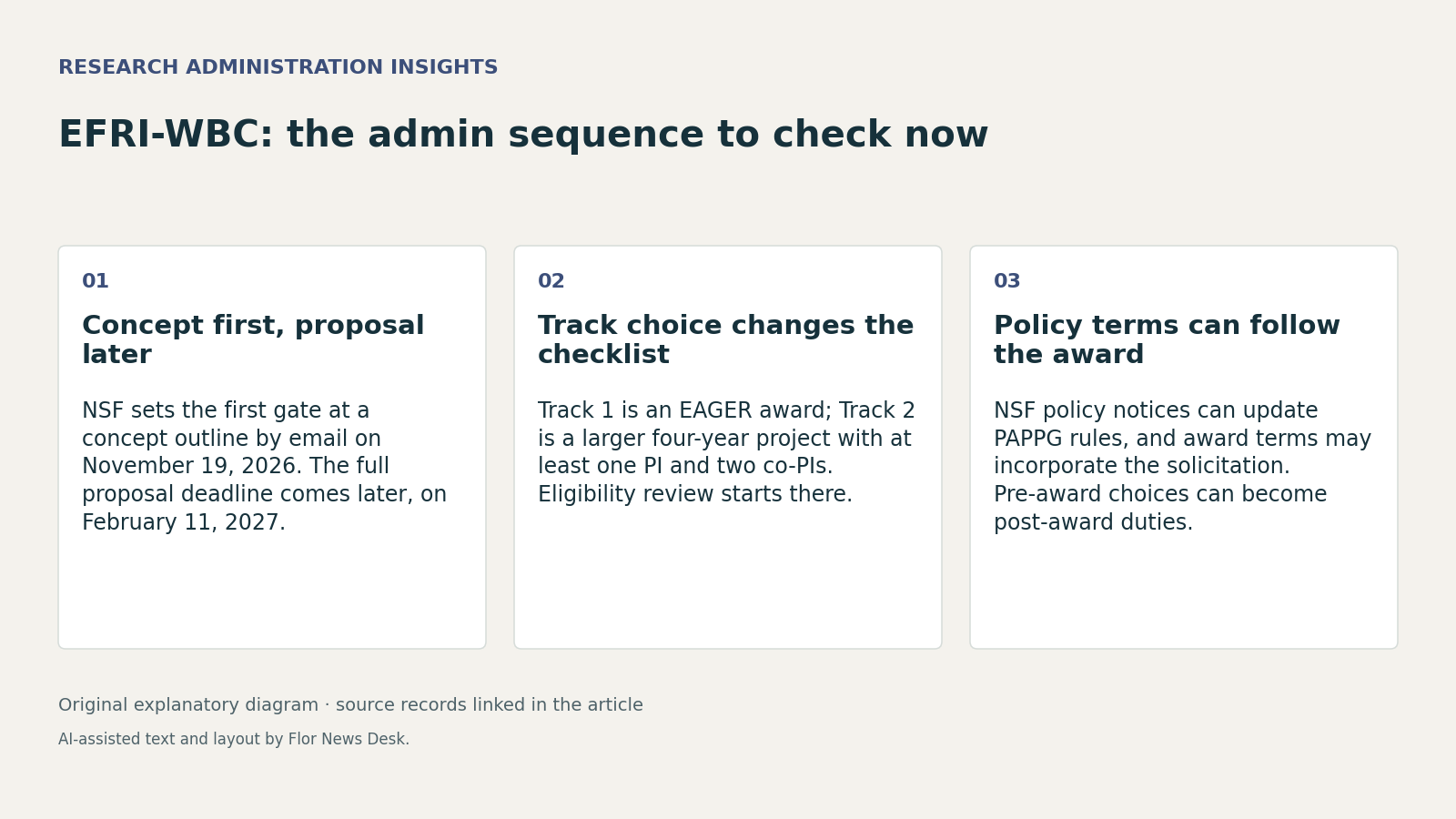
NSF’s new EFRI Wave-Based Computing solicitation creates an earlier administrative gate than the February 2027 proposal deadline suggests. For the FY 2027 cycle, each prospective principal investigator must email a concept outline to the EFRI inbox by November 19, 2026, while full proposals are due February 11, 2027. That timing matters because the concept stage is not just an expression of interest. It is the point at which institutions need to know who the lead PI is, which track the team is pursuing, and whether the proposed team can satisfy the solicitation’s eligibility rules.
Those track rules are materially different. NSF says Track 1 uses EArly-concept Grants for Exploratory Research awards of $100,000 to $400,000 for up to two years, while Track 2 supports four-year projects up to $2,000,000 and requires at least one PI and two co-PIs solicitation. The same record also narrows who can lead. For submissions from institutions of higher education, the lead PI must be full-time tenured or tenure-track faculty; for all proposals, either the PI or a co-PI must hold a full-time tenured or tenure-track appointment in a College or Department of Engineering solicitation. Administratively, that means a team can be scientifically attractive yet still fail on structure.
Budget review also starts earlier than the full proposal deadline. NSF prohibits voluntary committed cost sharing in this competition and requires both tracks to budget travel for the PI and one graduate student or researcher to the annual EFRI grantees’ meeting solicitation. Because the concept outline is submitted by email rather than through the usual proposal workflow, research offices cannot assume that system checks will catch missing organizational details. The practical implication is simple: if an institution wants the November outline to reflect a viable project, pre-submission review has to cover team composition and required budget assumptions before the email is sent.
The policy layer is easy to overlook because the solicitation itself points users to the Proposal and Award Policies and Procedures Guide version in effect on the proposal due date. NSF’s January 22, 2026 policy notice says interim notices can supersede parts of PAPPG 24-1 and that Data Management and Sharing Plans must use the Research.gov tool after its April 27, 2026 release. The same notice says recipients must share data supporting NSF-funded publications at the time of publication, with any exceptions justified in the DMSP, and deposit Author Accepted Manuscripts in NSF’s repository at or before publication policy notice. The analysis point is not that those items belong in the concept outline; it is that offices should not treat compliance planning as a post-selection problem.
Two more PAPPG chapters sharpen the risk. NSF’s non-award decisions chapter says proposals may be returned without review if they miss preparation requirements, miss deadlines or are not responsive, and it says the reconsideration process does not apply to EArly-concept Grants for Exploratory Research proposals. Separately, NSF’s awards chapter says award notices can incorporate the proposal, solicitation and referenced PAPPG sections by reference. Taken together, those records argue for careful front-end review: submission errors can block review, while accepted commitments can later become award obligations.
What the record does not establish is equally important. The solicitation is not an award notice, so it does not show that any institution has received money, how many awards will be made, or whether October 2026’s promised informational webinar has already occurred as of the 2026-10-24 retrieval solicitation. Research offices should read NSF 26-524 as a live solicitation with a near-term concept-outline task, not as evidence of funded projects or settled implementation details beyond what the current records state.