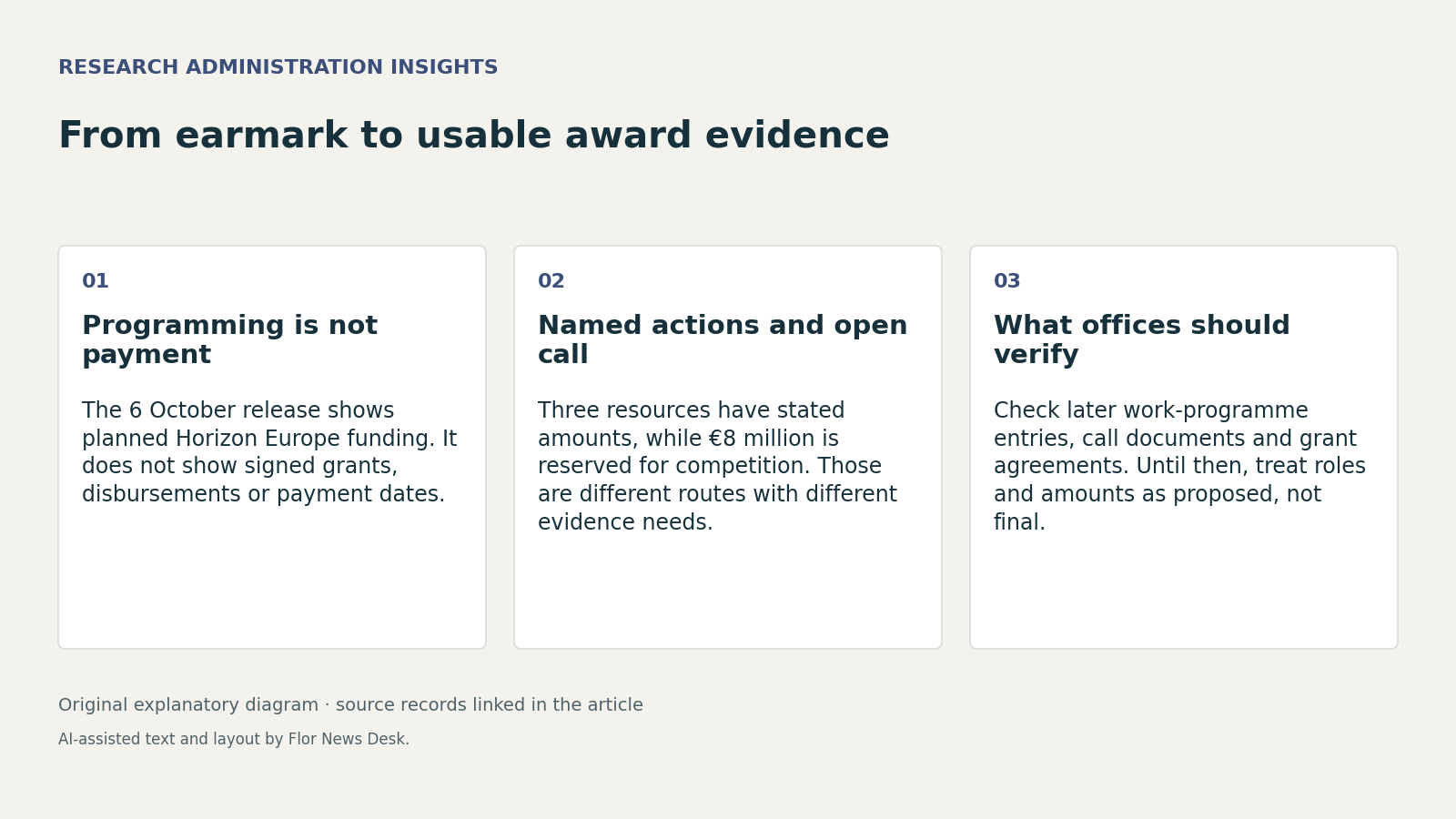
The European Commission’s 6 October 2026 announcement matters because it puts a concrete figure into Horizon Europe planning: €65 million for core life-sciences data and knowledge resources. But for research offices, the first rule is the limit of that announcement. As of 9 October 2026, the public record shows an earmark in an amended work programme and states that funding remains subject to evaluation under normal Horizon Europe procedures. That is not the same thing as a signed grant agreement, a payment date or cash received (Commission news release, Horizon Europe work programmes index).
What the Commission says is now programmed is specific. The 6 October release lists planned grants of €19 million for GENCODE, €30 million for UniProt and €8 million for Europe PMC, plus another €8 million through an open competitive call for other life-sciences data and knowledge repositories and scientific services. The same release says the planned actions would involve EMBL-EBI and the Centre for Genomic Regulation for GENCODE, EMBL-EBI and the SIB Swiss Institute of Bioinformatics for UniProt, and EMBL-EBI for Europe PMC. Those named roles are still prospective in this record; the release does not publish grant agreements or final contractual terms (Commission news release).
The work-programme record supports the distinction. The Horizon Europe work-programmes page says work programmes set out funding opportunities, and the listed 2026-27 programme documents are dated 29 September 2026. But that index page does not itself identify the €65 million measure, show a call identifier, or set out eligibility, deliverables, evaluation results or payment mechanics. In administrative terms, that means the Commission has signalled budgeted intent inside programme planning, while the operational evidence needed for award management is still absent from the source set (Horizon Europe work programmes index).
A second source places the earmark in policy context without curing those gaps. The Commission’s Strategy for European Life Sciences page says the 2 July 2025 strategy is backed by broader funding lines and adds that another €65 million under Horizon Europe is programmed for critical data and knowledge repositories, naming GENCODE, UniProt and Europe PMC. That helps explain why the measure appeared now: it fits a wider life-sciences competitiveness agenda. But it remains a strategy summary, not a grant record. The same page also contains at least one other stale future-tense timeline unrelated to this funding item, underscoring a practical lesson: administrators should separate policy narrative from dated evidence of implementation (Strategy for European Life Sciences).
For institutions, the immediate checks differ by role. If your organisation is one of the named participants, the task is to verify whether and how that role appears in later grant documentation before treating the amount as secured funding. If your organisation is not named but runs a relevant repository or service, the actionable point is the existence of an €8 million competitive opportunity, while recognising that the present record does not yet establish the eventual call text or award conditions (Commission news release).
The practical conclusion is narrow but important. On 6 October 2026, the Commission moved support for several high-profile life-sciences resources from general policy concern into explicit Horizon Europe programming. What research offices still need, and what the current sources do not provide, are the documents that convert that programming into executable awards: the specific work-programme entry, any open-call documentation, and signed grant agreements. Until those appear, this is a funding direction with named intended uses, not a completed funding outcome.