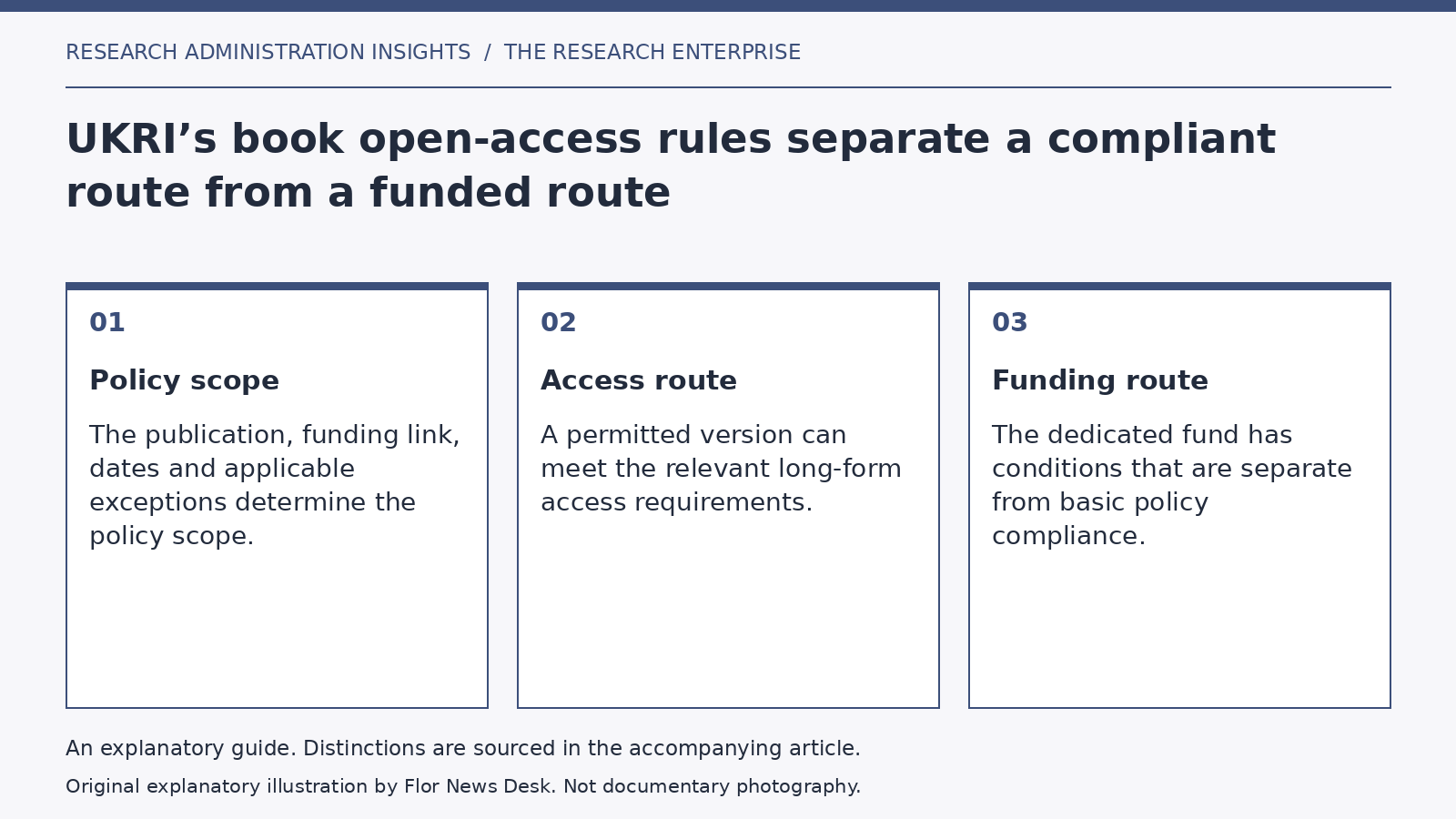
UKRI’s guidance for in-scope monographs, chapters and edited collections separates access to a publication from funding for its publication costs. The long-form guidance covers relevant outputs published from January 1, 2024, explains the maximum twelve-month access period and describes permitted versions and licensing. Scope and exemptions still matter; the date alone does not make every book subject to the same requirement.
The funding guidance draws a narrower boundary for the dedicated long-form fund. It supports making the Version of Record immediately open under an appropriate licence, while delayed access or self-archiving can be compliant without being funded through that mechanism. An institution should therefore not promise payment merely because an author has identified a compliant access route.
Ask two questions before approving a cost
A hypothetical book project illustrates the difference. Its proposed repository deposit might satisfy the applicable access route, yet an invoice for a different publishing service would still need to meet the funding rules. Conversely, an attractive funding opportunity does not settle whether the manuscript, author or timing meets the relevant conditions. These are separate checks, not competing definitions of openness.
An internal decision record could distinguish the output’s policy scope, the chosen access route and the requested funding mechanism. It could also identify the version to be made available and the evidence needed to show publication. This is a suggested administrative structure, not a claim that UKRI mandates this particular form or that a real application has been approved.
Keep the author’s promise aligned with the institution’s
Before a publishing commitment is made, the author and the responsible institutional team need the same understanding of what is being paid for. Otherwise, an access commitment can be mistaken for a financial authorization, leaving the eventual invoice disconnected from the earlier decision.
The practical value of UKRI’s distinction is that it permits a more precise conversation. A route can be suitable for compliance without drawing on the dedicated fund. A funding request can require further checks even when the academic output is clearly relevant. Keeping those outcomes separate avoids inventing eligibility and helps the institution give an answer supported by the current guidance and the project’s actual circumstances.