Budget integrity
The approved budget, sponsor restrictions, rebudgeting authority, cost sharing, and indirect-cost treatment shape financial decisions.

Research administration topic
Research finance administration applies award terms, accounting standards, institutional policy, and informed judgment to the financial life of sponsored work. It connects budgets, payroll, purchasing, cost allocation, billing, reporting, and closeout with the approved project.
 research finance administration
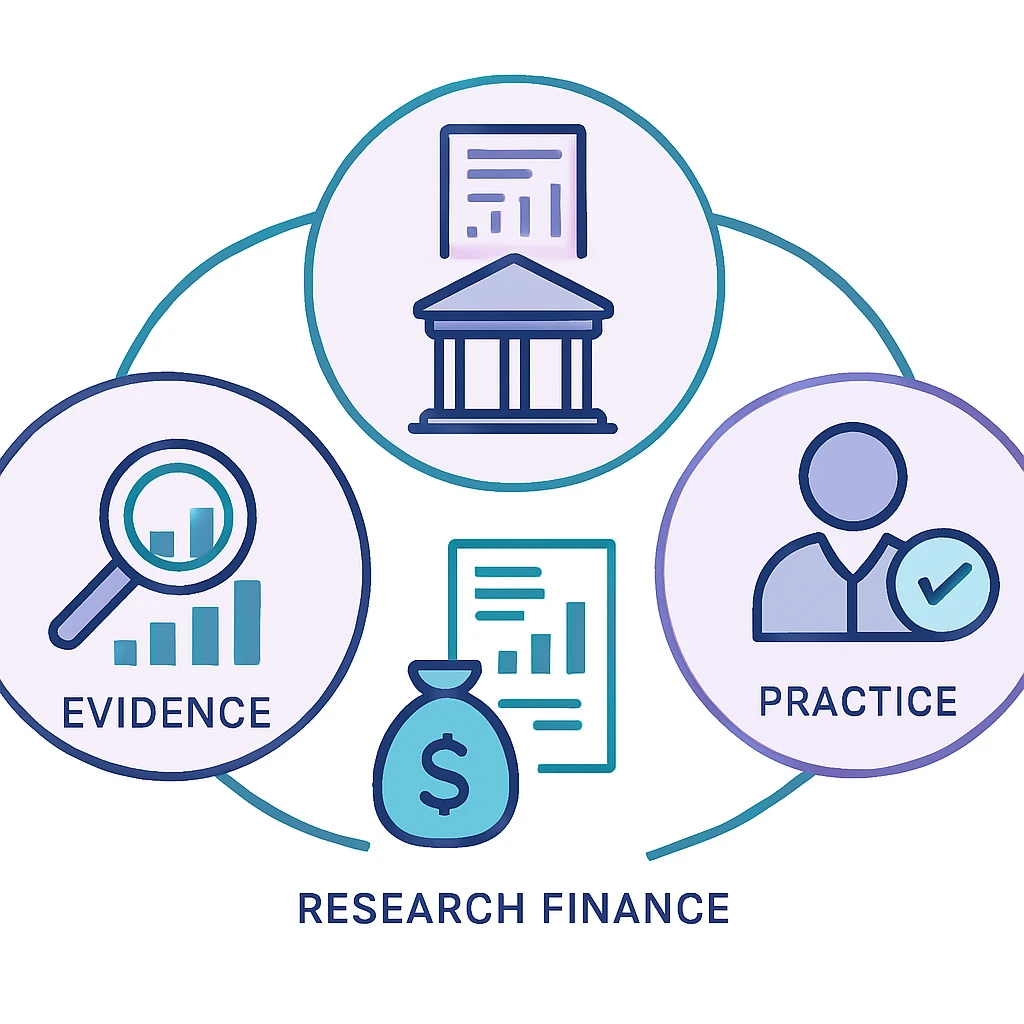
Defined term: Research finance administration applies award terms, accounting standards, institutional policy, and informed judgment to the financial life of sponsored work. It connects budgets, payroll, purchasing, cost allocation, billing, reporting, and closeout with the approved project.
Scope becomes clearer when responsibilities, authority, records, and decision points are visible. The dimensions below show how the topic operates across the research enterprise.
Core dimensions
Each area requires policy knowledge, usable processes, clear ownership, and professional judgment.
The approved budget, sponsor restrictions, rebudgeting authority, cost sharing, and indirect-cost treatment shape financial decisions.
Allowability, allocability, reasonableness, consistency, documentation, and timing must be considered for costs charged to an award.
Regular review connects ledger activity, payroll, commitments, invoices, sponsor reports, and project progress.

Local structures vary, but the work generally moves through a sequence of definition, review, authorization, performance, monitoring, and learning.

Financial dashboards are most useful when they combine actuals, commitments, payroll projections, remaining time, deliverables, and known changes. A favorable balance is not automatically good performance, and a high spend rate is not automatically a problem.
Measures should be defined carefully and interpreted with context. A faster process is not necessarily better when it creates rework, weakens oversight, or shifts hidden effort to another team.
Related resources
Use these routes to move from the broad topic into a focused workflow or decision.
Read the connected resource for deeper context, practical steps, and related questions.
Read the connected resource for deeper context, practical steps, and related questions.
Read the connected resource for deeper context, practical steps, and related questions.
Common questions
The answer depends on the award, applicable rules, institutional policy, the project purpose, consistency, documentation, timing, and any required approval.
Late or repeated transfers can indicate weak initial allocation, delayed review, inadequate documentation, or an attempt to move costs based on available balance.
A projection estimates future payroll, commitments, and planned activity so the team can act before a deficit, underspend, or missed deliverable occurs.
Sources
These external resources provide additional policy or practice context. The journal’s own published policies govern its workflow.
Move into a related guide, compare connected topic hubs, or search the journal archive for relevant records.