Pathways and context
Impact often develops through engagement, uptake, standards, tools, training, partnerships, policy, products, and cumulative bodies of work.

Research administration topic
Research impact assessment examines how research contributes to knowledge, policy, practice, health, economy, environment, culture, capacity, and communities. Responsible assessment uses evidence suited to the pathway and avoids reducing diverse contributions to a single metric.
 research impact assessment
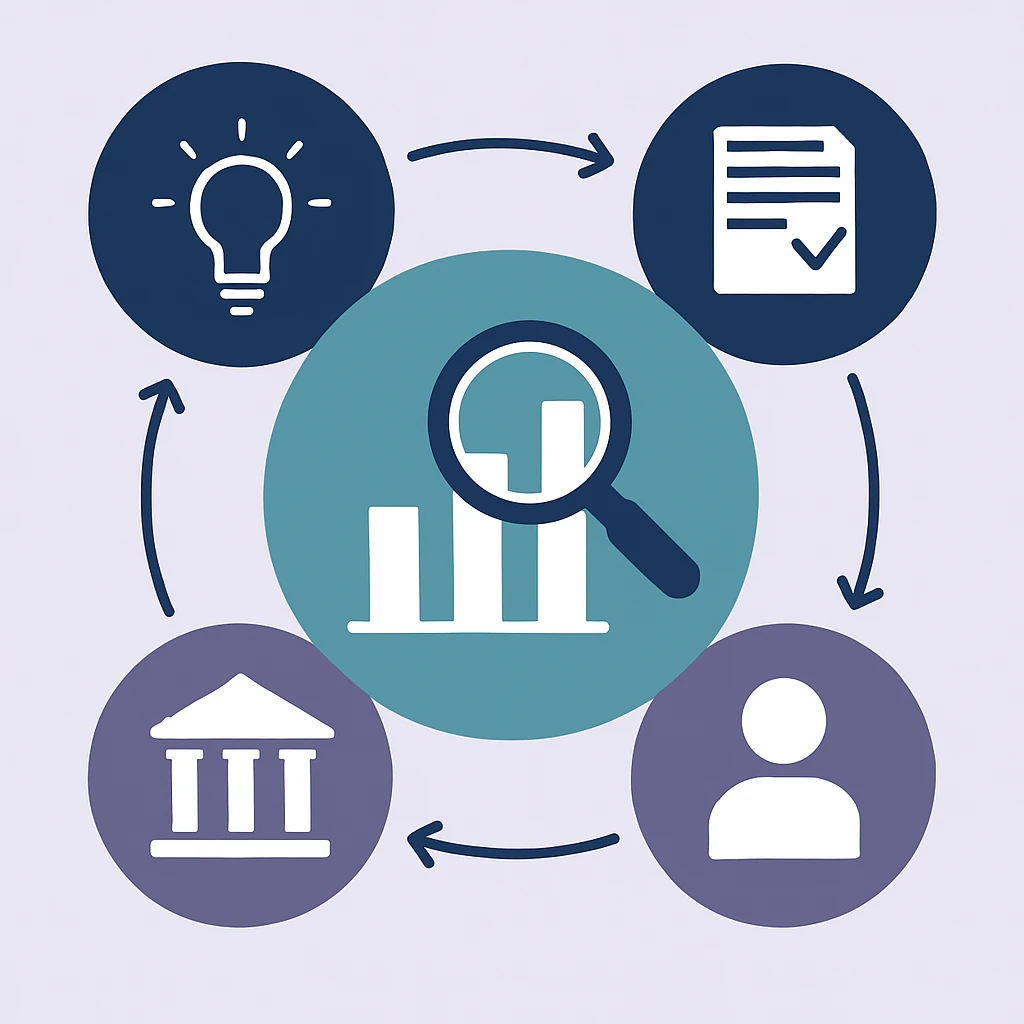
Defined term: Research impact assessment examines how research contributes to knowledge, policy, practice, health, economy, environment, culture, capacity, and communities. Responsible assessment uses evidence suited to the pathway and avoids reducing diverse contributions to a single metric.
Scope becomes clearer when responsibilities, authority, records, and decision points are visible. The dimensions below show how the topic operates across the research enterprise.
Core dimensions
Each area requires policy knowledge, usable processes, clear ownership, and professional judgment.
Impact often develops through engagement, uptake, standards, tools, training, partnerships, policy, products, and cumulative bodies of work.
Assessment should distinguish outputs, outcomes, reach, significance, attribution, and plausible contribution using multiple sources.
Indicators should fit the purpose, discipline, career stage, timeframe, and unit of analysis, with qualitative evidence where needed.

Local structures vary, but the work generally moves through a sequence of definition, review, authorization, performance, monitoring, and learning.

Citation counts can illuminate scholarly attention but do not directly measure every form of quality or societal impact. Case studies, policy documents, practice changes, standards, adoption, partnerships, capacity building, and stakeholder testimony may provide complementary evidence.
Measures should be defined carefully and interpreted with context. A faster process is not necessarily better when it creates rework, weakens oversight, or shifts hidden effort to another team.
Related resources
Use these routes to move from the broad topic into a focused workflow or decision.
Read the connected resource for deeper context, practical steps, and related questions.
Open How Institutions Can Approach Research Impact Assessment
Read the connected resource for deeper context, practical steps, and related questions.
Read the connected resource for deeper context, practical steps, and related questions.
Common questions
No. Quality, outputs, reach, outcomes, and impact are related but distinct concepts and may require different evidence.
Sometimes, but often research contributes alongside other evidence, actors, policy conditions, and implementation efforts. Contribution claims should match the evidence.
Early planning can clarify stakeholders, pathways, engagement, data collection, responsibilities, and realistic time horizons without predetermining the results.
Sources
These external resources provide additional policy or practice context. The journal’s own published policies govern its workflow.
Move into a related guide, compare connected topic hubs, or search the journal archive for relevant records.